

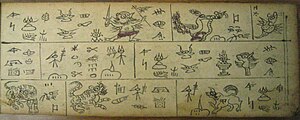
Dunba or tomba is a system of pictographic symbols used by priests of the Dunba caste ( ²dto¹mba , Bon religion) of the Nashi people living in the south of China. In the Nashi language, for the recording of which it is used along with other writing systems, this letter is called ²ss ³dgyu ("notes on a tree") or ²lv ³dgyu ("notes on a stone"). [one]
The emergence of writing dates back to about the VII century BC. e. Probably, the signs were used to pause recording abstract terms for which there were no proper notation. Dunba is a mnemonic system, that is, the reader must be familiar with the context of the recording, otherwise he will not be able to read it even if he knows the written language. In addition, different authors may use the same characters to convey different meanings. In some cases, Dunba is used interspersed with the syllabic Hebe .
Content
- 1 Origin and development
- 2 Scope of use
- 3 Structure and form
- 4 Materials and means of writing
- 5 See also
- 6 notes
- 7 Literature
- 8 References
Origin and Development
It is believed that the Dunba script arose independently, although under the influence of other scripts. The founder of the Bon tradition in Tibet, Tonpa Shenrab ( ston pa gshen rab) , also known as Shenrab Miwo ( gshen rab mi bo ), is considered its creator. [2] According to Chinese historical tradition, Dunba has been used since the 7th century. - The early era of the Tang Dynasty. By the time of the Song Dynasty in the 10th century Dunba has already become widespread among the Nashi people. [2]
After the Chinese Revolution of 1949, communist authorities began to restrict the use of Dunba.
In 1957, the Chinese government introduced a phonographic script based on the Latin alphabet for the Nashi people. [3]
During the Cultural Revolution , hundreds of Dunba manuscripts on paper and fabric were destroyed - of which they made building paste for houses. About half of the Dunba manuscripts preserved to our time were exported from the PRC to the United States, Germany, and Spain.
Currently, the dongba is almost out of use, and the Chinese government is trying to revive its use to preserve the indigenous Nashi culture.
Scope of Use
Initially, writing was used as a mnemonic system for reading aloud ritual texts. [4] For the purposes of inventory, drafting contracts and letters, the syllabic letter of the geb was used . Milnor concludes that the Dunba letter “was unlikely to make a breakthrough to become a full-fledged writing system. It originated many centuries ago to serve a specific ritual purpose. Since this goal was not related to the need to expand the scope of distribution among non-religious specialists - in the end, literate Nasi write now, as before, in Chinese - the maximum that this letter was capable of was to continue to serve the goals of exorcism (exile of demons ), entertain tourists, etc. ". [5]
Structure and Form
Dunba has a mixed character - partially pictography , partially ideography . It consists of approximately 1000 characters, but this number is conditional, as new characters are constantly being invented. Priests draw detailed drawings to record information, and the illustrations were simplified and conditional, to represent not only material objects, but also abstract concepts. Often, several characters are combined to convey the meaning of a particular word. In general, since this is a mnemonic letter, only key concepts are written; a single icon can be used to convey various phrases or even a whole sentence.
Examples of puzzles in a letter:
- the image of two eyes conveys the concept of “fate” (both words are pronounced myə 3 ),
- a rice bowl can convey the concepts of “food” and “sleep” (both pronounced ( xa 2 )
- the image of the throat ( se 3 ) conveys the grammatical particle of the verb form.
Materials and means of writing
The name of the Nashi script , ²ss ³dgyu (“wood writing”) or ²lv ³dgyu (“wood writing”), indicates materials that were originally used for writing. Currently, recordings are made on home-made paper, usually from daphne fibers. [6] Sheets usually have a size of 28 by 14 cm and are stapled along the left edge to form a book. Pages are arranged in 4 horizontal lines. [7] Lines go from left to right, from top to bottom. [1] Vertical lines are used to separate text elements (see photos above), similar to sentences or paragraphs. Writing instruments - wrote from bamboo and ink from ash.
See also
- Nashi (language)
Notes
- ↑ 1 2 He, 292
- ↑ 1 2 He, 144
- ↑ He, 313
- ↑ Yang, 118; Ethnologue : "[Dongba is] not practical for everyday use, but is a system of prompt-illustrations for reciting classic texts." Naxi at the Ethnologue
- ↑ Seaver Johnson Milnor, A Comparison Between the Development of the Chinese Writing System and Dongba Pictographs
- ↑ Yang, p.138
- ↑ Yang, p. 140
Literature
- Yang, Zhengwen. Zhengwen Naxi Study Collection. - Beijing: Culture Publisher, 2008.
- Fang, Guoyu. Guoyu Naxi Study Collection. - Beijing: Culture Publisher, 2008.
- He, Zhiwu. Zhiwu Naxi Study Collection. - Beijing: Culture Publisher, 2008.
- Crampton, Thomas . Hieroglyphic Script Fights for Life (February 12, 2001). Archived on April 11, 2009.
Links
- Edongba Input Dongba hieroglyphs and Geba symbols.
- Dr. Richard S. Cook, Naxi Pictographic and Syllabographic Scripts: Research notes toward a Unicode encoding of Naxi
- Lawrence Lo, Ancient Scripts: Naxi
- "Translation of the full text of the" Chronicle of the Universe of Yao "" [from Dongba to Chinese ; handwritten bilingua : Dunba text - color, Chinese - black ink ; X century ] / National Library of China // World Digital Library