The Order of the Württemberg Crown ( German: Orden der Württembergischen Krone ) is a dynastic order of the Dukes, and then of the Kings of Württemberg .
| Order of the Wurttemberg Crown | |||
|---|---|---|---|
| Orden der Württembergischen Krone | |||
| |||
| Motto | Furchtlos und trew (Fearless and Faithful) | ||
| A country |  Kingdom of Wurttemberg Kingdom of Wurttemberg | ||
| Type of | Knight's Order | ||
| Statistics | |||
| Established | 1702 (September 23, 1818) | ||

Content
Background
In 1702, the Duke of Württemberg, Eberhard Ludwig , founded the “Hunting Order of St. Hubert . " After the significant expansion of the territory of Württemberg and the adoption of the royal title by Frederick I, the order received a new statute and on March 6, 1807 was renamed the “Knightly Order of the Golden Eagle” ( Ritterorden des Goldenen Adlers ). For admission to the order was necessary noble origin, or the rank is not lower than Field Marshal Lieutenant . In addition to this order, in November 1806, King Frederick I created the “Order of Civil Merit” , which was awarded to particularly distinguished officials.
Duke Eberhard Ludwig with the sign of the Order of the Holy Hunt Hubert (on a red ribbon over his left shoulder).
Frederick I , Duke (in the future - the king) of Württemberg with the sign of the Order of the Hunter of St. Hubert.
King Frederick I with royal regalia and signs of the Order of the Golden Eagle - a sign on a chain and an embroidered star.
Coat of arms of the Kingdom of Württemberg until 1817 with the sign of the Order of the Golden Eagle on a chain (the sign of the Order of Civil Merit is visible above).
Badge of the Order of the Golden Eagle.
Badge of the Order of Civil Merit
History and Degrees
On September 23, 1818, both orders - the Golden Eagle and the Civil Merit, were united by the Württemberg King William I. The order originally contained 3 degrees:
- Big cross
- Commander
- Knight
The number of people awarded was not limited. Until 1913, the awarded Württemberg citizens simultaneously received personal nobility and received the prefix “knight von ...” to their surname.
In September 1870, the degree of “knight” was divided into 2 classes. Later, those who deserved the award for military deeds received an order badge adorned with two crossed golden swords. In 1892, the statute was again amended. The order was divided into the following degrees:
- Big cross for monarchs
- Big cross
- Commander (Komtur) with a star
- Commander (Komtur)
- Honorary Cross
- Knight's cross
- Gold Medal of Merit
- Silver medal of merit (until 1892).
The sons of King Württemberg were awarded the Order of the Württemberg Crown when they reached 7 years old, the other princes of the Württemberg House - at 14 years old.
The Order of the Württemberg Crown was awarded to all Russian monarchs , beginning with Alexander I. Emperor Nicholas I was awarded the Highest Order of the Württemberg House in 1826 [1] .
In 1871, in the form of special honor, the Reich Chancellor Otto von Bismarck was awarded the Grand Cross of the Order in diamonds.
Signs of the Order
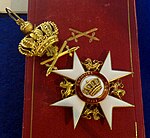
The badge of the Order of the Württemberg Crown is a golden Maltese cross of white enamel. On the signs of the Grand Cross and commanders in the corners of the cross are golden Württemberg lions. On the Knight's Cross, lions could be added as an indication of the special merits of the awarded. In the center of the cross is a round medallion of white enamel with a wide rim of red enamel. In the center of the medallion is a golden royal crown. Wurttemberg's motto “Furchtlos und trew” is engraved in gold on the rim of the medallion. On the back of the cross in the center is the same medallion, in the center of which is the monogram of King Frederick I. The cross is suspended from the golden royal crown, which is attached to the order ribbon through the ring.
Since 1866, crossed gold swords were added to the signs of the Order of Military Merit. Since 1890, when receiving a higher degree without swords, swords from the younger degree were transferred to the older one.
The sign of the Big Cross was worn on a ribbon over the right shoulder, on the left side of the chest - an eight-pointed star. Commander signs were worn on a neckband, a commander with a star wore a cruciform star. Signs of other classes and medals of the order were worn on the left side of the chest.
The star of the Big Cross is an eight-pointed silver (for monarchs - gold), on the center of which is a round gold medallion with a wide rim of red enamel, on which the motto is inscribed. The center of the medallion is black enamel for monarchs and silver for the rest of the gentlemen. An order cross without a motto is superimposed on the center of the medallion.
Commander star with a star - the sign of the order, increased to the size of a star, with rays in the corners of the cross.
Sash carmine red, with black stripes at the edges. For members of the ruling dynasty and monarchs, the ribbon of the Big Cross is blood red with black stripes around the edges.
Notes
- ↑ Sovereign gentlemen. Foreign orders of Russian emperors. Catalog of the exhibition in the Moscow Kremlin. M., 2010.S. 105
Literature
- Friedrich Gottschalck: Almanach der Ritterorden , Goeschen, Leipzig 1819, S. 251–275,
- Maximilian Gritzner: Handbuch der Ritter- und Verdienstorden aller Kulturstaaten der Welt . Weber, Leipzig 1893 (Reprint der Originalausgabe: Reprint-Verlag Leipzig, Holzminden 2000, ISBN 3-8262-0705-X ).
- Jörg Nimmergut: Handbuch Deutsche Orden. Nickel ua, Zweibrücken 1989, S. 315-320 ( Antiquitäten ).
- Jörg Nimmergut: Deutsche Orden und Ehrenzeichen 1800–1945. Band 3: Sachsen - Württemberg I. Zentralstelle für Wissenschaftliche Ordenskunde, München 1999, ISBN 3-0000-1396-2 , S. 1677-1704.
Links
- Wikimedia Commons has media related to the Order of the Württemberg Crown
- Winkler P.P. Crowns of the Order // Brockhaus and Efron Encyclopedic Dictionary : in 86 volumes (82 volumes and 4 additional). - SPb. , 1890-1907.