
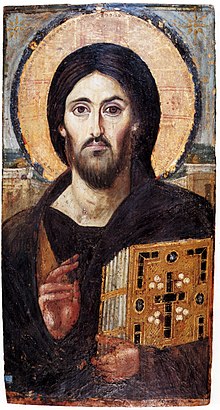
Bifacialism , or Bifacialism - accepted in medieval Orthodoxy (the Church in the east) and until now among the Old Believers the addition of the fingers (fingers) of the right hand to perform the sign of the Cross . Biloba has become common in the Greek East in the VIII century (instead of the most common form of fingerprinting, known as patristic evidence, is monosperm [1] [2] ). It was supplanted by triplet — in the 13th century among the Greeks [3] [4] and in the 1650s in the Moscow Patriarchate in the Russian state (see. Schism of the Russian Church ). The Old Believers continued to insist on bifurcation on the grounds that Jesus Christ , and not the whole Trinity , underwent the crucifixion through crucifixion [5] . In addition, the Old Believers pointed to existing images - icons, miniatures, where there were saints baptized in two faces.
Content
Form and Symbols
With duosomal addition, the thumb, little finger and ring finger are folded together; each finger symbolizes one of the three hypostases of God: the Father, the Son, and the Holy Spirit; and their union is one Deity - the Holy Trinity.
In double-edged two fingers are a symbolic expression of the dogma of the Council of Chalcedon depict the two natures of Jesus Christ. The middle and index fingers remain straightened and connected to each other, while the index finger is completely straight, and the middle one is slightly bent relative to the index one, which symbolizes the two natures in Jesus Christ - divine and human [6] , and the bent middle finger indicates a derogation ( kenosis ) of divine nature in Christ.
Maxim Grek wrote in “The Word of the Sign of the Cross, we are also marked”: “By stretching out long and medium, the two natures converging in Christ, that is, Christ's Savior Himself, we confess that God is perfect, and man is made into two beings and is known and known to nature. With the finger on the forehead, we confess two things, as if born of God and the Father, just as our word comes from the mind, and as from above from below from the word of God, bow down to heaven. And by the position of the fingers of the hedgehog on the navel, the removal of his hedgehog on the ground, the hedgehog in the Blessed Virgin’s womb, his conception, and the nine-month dwelling of the invasion, are clearly announced. And by deceiving the hedgehog from where I can lay all my hands on the gum and on the left country, we can clearly form the desire for the bitter answer from the righteous, standing at the right hand of the Judge, to the wicked and sinful, according to the Savior Divine voice, which speaks to those who are opposed and not repentant [8] . ” [7] [ 7] ]
Along with bifurcation, according to modern Old Believers, [9] it has become a custom to raise a hand to the forehead, lower it to the stomach and then transfer it to the right and then to the left shoulder . The movement of the hand from the forehead to the stomach symbolizes the descent of the Lord to the earth; finding a hand on the womb shows the incarnation of Christ; raising the hand from the stomach to the right shoulder depicts the Ascension of the Lord, and finding the hand on the left shoulder is the reunion of Christ with God the Father. [9]
History
There is no documentary evidence before the 4th century about what constriction in the early Christian era was used to draw the sign of the cross, but based on indirect information, it is believed that one finger was used to perform the sign of the Cross [10] .
We find the image of double-edgedness on the mosaics of Roman temples: the image of the Annunciation in the Tomb of St. Priscili (III century), the image of Miraculous fishing in the church of St. Apollinaria (IV century), etc. [11] However, some historians, beginning with Eugene Golubinsky , consider the ancient images of two-feathers not to be a compilation for performing the sign of the cross, but as one of oratory gestures [12] , borrowed by Christians from a complete antique textbook of rhetoric art of “Instructions to the orator” by Fabius Marc Quintillian [13] and contributed by Christians to iconography.
Bifurcation during the fulfillment of the sign of the Cross, according to Russian scholars of the 19th - early 20th centuries, is fixed after the Fourth Ecumenical Council (5th century), when the dogma of the two natures in Christ was expressed, as a counterargument against Monophysitism , although there is no direct evidence for this point of view [10] .
In 893, double-edged was first mentioned in written sources: it was in use by the Orthodox and the Nestorians [14] .
The fact that the Orthodox Christians adopted double collision was double-edged is evident from a number of sources: evidence of the Nestorian metropolitan of Damascus, Elijah Gevery (893–905); debate at the 1029 Cathedral of Patriarch Alexy Studit with the Jacobite Patriarch John VIII Abdon; the writings of Peter Damascus (circa 1157), the debate with the Armenians of the learned Greek monk Theorian, sent for this purpose by the emperor Manuel Komnin in 1172 [15] .
At the end of the 10th century, Prince Vladimir of Kiev, at the Baptism of Rus, adopted bifurcation, which at that time was in common use among the Greeks [16] . Accepted later by the Greeks “by way of custom” [17] threefold - did not receive general distribution in Muscovite Russia; Moreover, double-toedness, as the only correct finger-composing, was explicitly prescribed in the Moscow Church in the first half of the 16th century, first by Metropolitan Daniel [18] , and then by the Stoglav Cathedral in 1551 ( Stoglav , chapter 31):
| If only two fingers do not bless even Christ, or do not imagine the sign of the cross, cursed be the holy fathers of Rekosh [19] |
The anathema formula repeated the earlier Greek texts (“ other Greek. Εἴ τις οὐ σφραγίζει τοῖς δυσὶ δακτύλοις, καθὼς καὶ ὁ Χριστός, ἀνάθεμα ” [20] ) from Greek Orthodox scholars of the XII centuries ranks: " dr. Greek. Απόταξις τῶν αιρετικῶν Αρμενιῶν ” [21] [22] .
At the beginning of the 17th century, the doctrine of the need to be baptized with two fingers was set forth by the first Patriarch of Moscow and All Russia, Job, in a letter to the Georgian Metropolitan Nikolai:
| Praying, baptism befits a two-presta; Put your head on your forehead, also on the Persian, and then on the shoulder on the right, also on the left; the segregation of the prest refers to the descent from heaven, and the standing finger indicates the ascension of the Lord; and the three fingers are equal to the hold - we confess the Trinity is inseparable, that is, the true sign of the cross [23] [24] |
In the Russian Church, double-skinned canceled in 1653 by Patriarch Nikon . This decision was approved in 1654 by the Council of Bishops (except for Pavel Kolomensky ). Bifurcation was officially condemned in the Russian Church at the Moscow Cathedral in 1656. On February 24, 1656 , on Orthodoxy Week , the Patriarch of Antioch Macarius , the Patriarch of Serbia Gabriel and Metropolitan Gregory solemnly in the Assumption Cathedral cursed those who were marked with two fingers:
| At first, the tradition of faith from the saints the apostle, and the saints father, and the saints of the seven cathedrals, create the sign of the honest cross, with three fingers the gummy hands, and who from the Orthodox Christians does not create the cross like that, according to the tradition of the Eastern Church, even from the beginning of the faith until Today, there is a heretic and a copycat of Armenians, and this imam is excommunicated from the Father and the Son and the Holy Spirit and cursed. [25] |
The decision of the cathedral in 1656 was confirmed at the Great Moscow Cathedral in 1666-1667. In a controversy with the Old Believers, the Orthodox called double-edged fiction of Moscow scribes of the 15th century ( Nikolai Subbotin ), as well as Latin or Armenian borrowing. Seraphim of Sarov [26] criticized double-skinnedness as opposed to holy charters [26] , but the words signed with the name of Seraphim appeared in a book of late origin edited by Nikolai Elagin , known for his love of arbitrary insertions.
Biloba was admitted to use at the end of the 18th century in the Russian Church as an economy , when one-faith was introduced. At the Local Council of the Russian Orthodox Church in 1971, all Donikon Russian rituals, including the two-pointed sign of the cross, were recognized as "equal and equal salvation."
Notes
- ↑ Golubinsky E.E., 1911 , p. 466.
- ↑ Korenevsky N. I. Church Issues in the Moscow State in the Half of the 17th Century and the activities of Patriarch Nikon. // Russian history in essays and articles / ed. prof. M.V.Dovnar-Zapolsky. - К., 1912. - T. III. - S. 701.
- ↑ Golubinsky E. About the sign of the cross for the sign of the cross and blessing. (Chapter from his "To our polemic with the Old Believers // Theological Bulletin published by the Imperial Moscow Theological Academy . - April 1892. - P. 42-43.
- ↑ Golubinsky E.E., 1911 , p. 472.
- ↑ Melnikov F.E. A Brief History of the Old Orthodox Old Believers Church. Double-toed or triple-toed (inaccessible link) . - S. 29.
- ↑ Sign of the Cross
- ↑ Library of the Trinity-Sergius Lavra. section: Manuscripts. 201. (K No. 1843.) Maxim the Greek works, careful charter, XVII century, in a sheet, 595 sheets, title screensavers (l. 1, 6) with paints and gold are excellent l. 429. Chapter 85. The Tale of the Sign of the Cross. In the same place 281.
- ↑ Maxim the Greek "A Tale of the Sign of the Cross."
- ↑ 1 2 “ONE LORD, ONE FAITH, ONE BAPTISM”
- ↑ 1 2 Biloba. Orthodox Encyclopedia .
- ↑ Two-Tooth and Three-Toed
- ↑ Golubinsky E. To our polemic with the Old Believers. (General questions: On the ordination for the sign of the cross and blessing) . - S. 65.
- ↑ Quintilian Institutio Oratoria Book XI Chapter 3.
- ↑ Sign of the Cross
- ↑ Kapterev N.F. Patriarch Nikon and Tsar Alexei Mikhailovich .
- ↑ Golubinsky E. E. History of the Russian Church. From the invasion of the Mongols to Metropolitan Makarios inclusive. - T. 2, part 2. - S. 475.
- ↑ Golubinsky E. E. History of the Russian Church. From the invasion of the Mongols to Metropolitan Makarios inclusive. - T. 2, part 2. - S. 476.
- ↑ Golubinsky E. E. History of the Russian Church. From the invasion of the Mongols to Metropolitan Makarios inclusive. - T. 2, part 2. - S. 480.
- ↑ Stoglav, chapter 31
- ↑ Assumption B. A. The Sign of the Cross and the Sacred Space. Why are Orthodox Christians baptized from right to left, and Catholics from left to right? - M .: Languages of Slavic culture, 2004. - S. 101. - 160 p. - ISBN 5-9551-0033-4 .
- ↑ Beneshevich V.N. Ancient Slavic pilot. XIV titles without interpretation. T. 2. - Sofia, 1987 .-- S. 168.
- ↑ Dmitrievsky A. A. Description of liturgical manuscripts stored in the libraries of the Orthodox East. - T. 2: Euchologion. - S. 424.
- ↑ Kapterev N.F. Patriarch Nikon and his opponents in the matter of correcting church rites. The time of the patriarchate of Joseph .
- ↑ Barsov N.I. From unpublished monuments of ancient Russian literature. 1. Message from Patriarch Job to the Georgian Metropolitan Nicholas. 2. Teaching messages from the priest of the Moscow Annunciation Cathedral Sylvester to the Kazan governor Shuisky-Gorbatom / preface. and approx. N. Barsova. - SPb., 1872. - 36, 40 s. - S. 20.
- ↑ Tablet. M.: Printing House, X. 1655; Supplementary Articles 2. VI. 1656 (429 p.)
- ↑ Instructions of St. Seraphim to the Old Believers .
Literature
- Golubinsky E. E. History of the Russian Church E. Golubinsky . - SPb. : The island of history and antiquities grew. at Moscow. un-te, 1911. - T. 2. The second period, Moscow. From the invasion of the Mongols to Metropolitan Makarios inclusive. The second half of the volume.
Links
- Lukashevich A.A. Two-Finger // Orthodox Encyclopedia . - M .: Church and Scientific Center "Orthodox Encyclopedia" , 2007. - T. XIV. - S. 246-251. - 752 s. - 39,000 copies. - ISBN 978-5-89572-024-0 .