Sir Eyre Coote ( eng. Eyre Coote ; 1726 - April 28, 1783 , Madras ) - British Lieutenant General of Irish descent, famous for his participation in the hostilities in India.
| Ayre Coote | ||
|---|---|---|
| English Eyre coote | ||
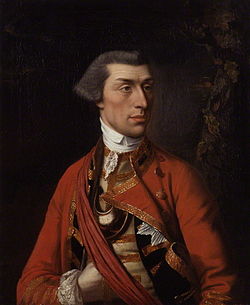 Henry Robert Morland. Portrait of Ayre Kuta. Around 1763 | ||
| Date of Birth | 1726 | |
| Place of Birth | Limerick , Ireland | |
| Date of death | April 28, 1783 | |
| Place of death | Madras , India | |
| Affiliation |  Kingdom of Great Britain Kingdom of Great Britain | |
| Type of army |  British army British army | |
| Years of service | 1745-1783 | |
| Rank | Lieutenant general | |
| Commanded | 84th Infantry Regiment (1759-1761) British troops in India (1761–1762, 1779–1783) | |
| Battles / Wars | Second jacobit rebellion Second Carnatic War Indian Campaign of the Seven Years War Second Anglo-Mysore War | |
| Awards and prizes |
| |

Biography
Eyre Kut was born in 1726 near Limerick in the family of Reverend Chidley Kuta. After serving in the 27th Infantry Regiment (27th Regiment of Foot), in 1745 he took part in suppressing the Jacobite rebellion , and later became captain of the 39th Infantry Regiment - the first regular regiment of the British Army sent to India.
In 1756, part of the regiment, stationed at Madras by that time, was sent to join Robert Clive's forces to help him recapture Calcutta , recently taken by Bengal Siraj ud-Dawla . The city was taken by the British in January 1757, while Coot and Clive were so angry about who would take Fort William , that they almost started shooting at each other; this incident led to rivalry and enmity between them.
Having received from Europe the news of the beginning of the Seven Years War , the British East India Company decided to focus on the struggle against the French trading posts in India , concluding a truce with the Bengali Navah. The success of the British did not like Siraj ud-Daule, and he wrote off with the French “soldier of fortune” Bussy-Casteln in South India. As a result, fighting between the British and the Bengalis resumed, and on June 23, 1757, Clive defeated Siraj-ud-Daulu in the battle of Plessis . At this time, Kut received a local equivalent of the rank of major for his success.
While Clive was active in Bengal, Bussy-Castelnau invaded Orissa , seized British trading posts and became the host in most of the coastal regions between Madras and Calcutta. In the winter of 1758–1759, Clive sent a detachment of Kuta back to the south. Having traveled several hundred kilometers in extraordinary conditions, which affected his health, Kut, receiving the rank of lieutenant colonel, headed the 84th infantry regiment sent from Great Britain and began to concentrate forces for the defense of Madras, from which the French had just departed after an unsuccessful siege .
In October 1759, the French commander Comte de Lally , having suppressed a riot in his own troops, again spoke out against Madras. On January 22, 1760, the battle of Vandiwash was held , after which, having lost a quarter of its forces, including the wounded Bussy, Lally retired to Pondicherry . In the autumn, after careful preparation, Kut began the siege of Pondicherry .
Shortly after the surrender of Pondicherry, which occurred on January 15, 1761, Kut was appointed commander of the forces of the British East India Company in Bengal. In 1762, he returned to the UK, having received an honorable sword decorated with jewels from the Company for his service. In 1771, Air Kut became a knight of the Order of the Bath .
In 1779, Air Kut returned to India as a lieutenant-general and as commander-in-chief. He quickly found a common language with Governor-General Warren Hastings , who granted him free hand in military matters. When the Second Anglo-Mysore War began , Kut, having carefully prepared, on June 1, 1781, defeated the Mysore ruler Haider Ali in the battle of Pollipur. On August 27, the battle of Porto-Novo followed, where the British again defeated the Mysore.
The hard campaign of 1782 finally undermined the already broken health of Kuta, and on April 28, 1783, he died in Madras.
In memory of Air Kuta, a monument was erected at Westminster Abbey in London . His nephew, also named Ayre Kut and who was also a knight of the Order of the Bath, served as governor of Jamaica in 1806–1808.
Links
- Paper Eyre Kuta at the William L. Clements Library, University of Michigan, USA