The Styx (from Greek Στύξ , Latin Styx ) is a small river in Perm , the left tributary of Yagoshikha - according to the existing gradation of small rivers, it belongs to the smallest, called streams [1] . Judging by the plan of Perm in 1898, the source of the stream was in the area of the current house No. 53 on Sibirskaya Street .
| Styx | |
|---|---|
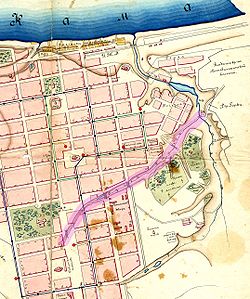 Styx on the plan of Perm in 1898 Styx on the plan of Perm in 1898 | |
| Characteristic | |
| Watercourse | |
| Mouth | Yagoshikha |
| • Coordinates | |
| Location | |
| Water system | Jagoshikha → Kama → Volga → Caspian Sea |
| A country |
|
| Region | Perm region |
| Area | Permian |

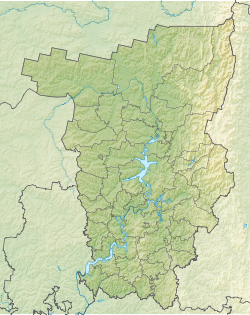

This stream was officially named at the end of the 18th or the beginning of the 19th century (on the Perm plan of 1823) under the name of the Styx River from ancient Greek mythology , since it separated the city from the Egoshikhinsky cemetery founded at that time [2] . On the plan of Perm approved on January 16, 1784, it is designated as “Klyuchevaya channel”. According to local historians, the name Styx could appear in an enlightened environment among teachers of the local digital school [3] . The author of the Chronicle of the City of Perm, V. N. Trapeznikov , describing the events of the end of 1784, points out [4] :
Read in Greek mythology, the "educated" Perm society called the stream separating the cemetery from the city, "Styx" - after the river through which, according to the Greeks, the legendary carrier Charon transported the souls of the dead to " Hades ".

In 1804, by decree of Perm Governor Karl Fyodorovich Moderakh , a moat and rampart were created to divert melt and rainwater from fields to the Styx and Danilikha rivers . The moat and rampart ran parallel to the modern streets of Krasnov (along the present territory of Gorky Park, south of the rotunda) and Pushkin (along the present territory of the Central Market) [5] . In 1858, a wooden bridge was built across the Styx [4] .
17 thousand years ago, near the mouth of the Styx, there was a paleolithic site " Egoshikha ", examined in 2003 by the Kama archaeological expedition of Perm State University under the leadership of Andrei Fedorovich Melnichuk . During the excavation, several thousand various stone tools were collected. It was established that the inhabitants of the site hunted deer and horses [6] .
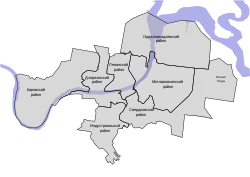
Currently, the brook is almost completely enclosed in the collector, open areas are located after crossing the street Klimenko (former Cherdynskaya), where the Styx flows near the cemetery. A part of the border of the Leninsky district of the city of Perm passes along the Styx.
Notes
- ↑ Dvinskikh S.A., Kitaev A. B. Ecological condition of small rivers in the city of Perm // Geographical Bulletin, Scientific Journal of Perm State University. - 2011 .-- T. 2 (17). - S. 32-43. (inaccessible link) . Date of treatment July 4, 2017. Archived December 14, 2014.
- ↑ Perm Necropolis Perm Necropolis - Document . refdb.ru. Date of treatment July 4, 2017.
- ↑ Polyakova E. N. Ancient names on the map of Perm. PSNIU, 2013 .-- S. 40.
- ↑ 1 2 Trapeznikov V.N. Chronicle of the city of Perm
- ↑ Korchagin P.A., Cherepanova E.S., Gogoleva M.V., Balyberdina P.A. Cartographic modeling of the historical and architectural environment of the city of Perm according to cartographic sources of the XVIII — XX centuries. // Bulletin of PNIPU. Applied Ecology. Urban Studies No. 3 (23). 2016. - S. 169—171
- ↑ Portal "Cultural Heritage of Prikamye". News archive. May 2003 (unreachable link) . Archived on September 29, 2006.