Skolopendrovye [1] [2] ( lat. Scolopendromorpha, Scolopendrida ) is a detachment of carnivorous centipedes from the class of the leg - footed ( Chilopoda ). Meet around the world. All species are poisonous [2] . Over 800 species. The most aggressive and noticeable predators of all millipedes [3] .
| Scolopendra | |||||||||||||||||||||||||||
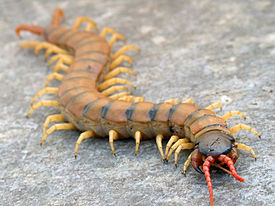 Ringed Scolopendra ( Scolopendra cingulata ) | |||||||||||||||||||||||||||
| Scientific classification | |||||||||||||||||||||||||||
|---|---|---|---|---|---|---|---|---|---|---|---|---|---|---|---|---|---|---|---|---|---|---|---|---|---|---|---|
| |||||||||||||||||||||||||||
| International scientific name | |||||||||||||||||||||||||||
Scolopendromorpha | |||||||||||||||||||||||||||
Content
Description
Antennae 17–34 segmented (usually 17–21). The body consists of 21 or 23 (rarely 39 or 43) segments with the same number of pairs of legs. The eyes are reduced, consist of 4 or one ocellium , or are completely absent (in Cryptopidae ) [4] . The length of the dorsoventrally flattened body is from 12 mm ( Cryptops ) to 270 mm ( giant scolopendra , Scolopendra gigantea ). Painted in a variety of bright colors, more often, yellow, orange and brown; in the tropics are also red, green, purple and other colors. On the head are a pair of antennas, a pair of jaws and two pairs of maxillas . Poisonous glands open at the ends of the first pair of legs, transformed into the maxilla. Skolopendrovy belong to epimorphic millipedes, that is, they have a juvenile appears with a full (adult) number of legs. They lead a secretive lifestyle in the cavities of the soil, under stones, logs, predators [2] .
Paleontology
In a fossil state, scolopendra are extremely rare. Apart from finds in Cenozoic amber, representatives of the order are known from the Carboniferous , Permian and Cretaceous sediments, whence altogether six species of scolopendra were described [5] .
Systematics
There are 3 (or 4) families. More than 800 species [3] , 13 forms from 4 genera were indicated for the countries of the former USSR [2] .
- Cryptopidae
- Cryptopinae
- Plutoniumidae [6] (or Plutoniuminae as part of Cryptopidae )
- Scolopendridae
- Scolopendrinae
- Otostigminae (or Otostigmidae )
- Scolopocryptopidae
- Scolopocryptopinae
- Newportiinae
- Kethopinae
Cryptops hortensis ( Cryptopidae )
Millipede Cormocephalus aurantipes with egg laying ( Scolopendridae , Australia)
Ethmostigmus rubripes ( Scolopendridae , Australia)
Notes
- ↑ Gilyarov M.S. Superclass Centipedes (Myriapoda) // Animal Life. Volume 3. Arthropods: trilobites, chelicerae, tracheal breathing. Onychophors / ed. M.S. Gilyarova , F.N. Pravdina, Ch. ed. V. E. Sokolov . - 2nd ed. - M.: Education, 1984. - S. 118. - 463 p.
- ↑ 1 2 3 4 Zalesskaya N. T., Shileiko A. A. Scolopendra centipedes (Scolopendromorpha) / B. R. Striganova . - Educational publication. - M .: Nauka, 1991 .-- 1032 p. - 400 copies. - ISBN 5-02-005476-3 .
- ↑ 1 2 Edgecombe Gregory D. and Gonzalo Giribet. (2007). Evolutionary Biology of Centipedes (Myriapoda: Chilopoda). - Annu. Rev. Entomol. 2007. 52: 151–70
- ↑ Chagas-Junior, A .; Edgecombe, GD; Minelli, A. (2008). Variability in trunk segmentation in the centipede order Scolopendromorpha: a remarkable new species of Scolopendropsis Brandt (Chilopoda: Scolopendridae) from Brazil. - Zootaxa , 1888: 36-46.
- ↑ The first Permian centipedes from Russia - Acta Palaeontologica Polonica . www.app.pan.pl. Date of treatment April 17, 2019.
- ↑ Shelley, RM (1997). The Holarctic centipede subfamily Plutoniuminae (Chilopoda: Scolopendromorpha: Cryptopidae) (nomen correctum ex subfamily Plutoniinae Bollman, 1983). Brimleyana, 24, 51-113.
Literature
- Zalesskaya N.T., Titova L.P. (1980). Lepidopodic millipedes (Chilopoda) // Itogi Nauki i Tekhniki. VINITI. Zool. invertebrates. 1980. - T. 7. - S. 63-131.
- Akkari, N .; Stoev, P .; Lewis, JGE (2008). The scolopendromorph centipedes (Chilopoda, Scolopendromorpha) of Tunisia: taxonomy, distribution and habitats. - ZooKeys, 3: 77-102. doi: 10.3897 / zookeys.3.51
- Edgecombe, GD; Koch, M. (2008). Phylogeny of scolopendromorph centipedes (Chilopoda): morphological analysis featuring characters from the peristomatic area. - Cladistics, 24 (6): 872-901. doi: 10.1111 / j.1096-0031.2008.00220.x
- Koch, M .; Pärschke, S .; Edgecombe, GD (2009). Phylogenetic implications of gizzard morphology in scolopendromorph centipedes (Chilopoda). - Zoologica scripta, 38 (3): 269-288. doi: 10.1111 / j.1463-6409.2008.00372.x