Siversky is a military airfield in the Gatchinsky district of the Leningrad Region , located in the village of Siversky .
| Siversky | ||||||||||
|---|---|---|---|---|---|---|---|---|---|---|
 Su-24 at the runway in front of the village of Mezhno , 2007 | ||||||||||
| IATA : no - ICAO : - Ext. code : LLL | ||||||||||
| Information | ||||||||||
| Type of | military | |||||||||
| A country |  Russia Russia | |||||||||
| Location | town Siversky Leningrad region | |||||||||
| Owner |  Ministry of Defense of Russia Ministry of Defense of Russia | |||||||||
| NUM height | +100 m | |||||||||
| Timezone | UTC + 3 | |||||||||
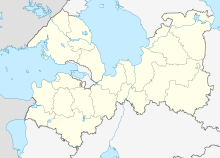
| Map | ||||||||||
| Runways | ||||||||||
| ||||||||||

As a military airfield, it can take IL-76 , Tu-134 and increasingly light aircraft, as well as all types of helicopters.
Planned site for cargo and civil aviation.
Content
- 1 History
- 1.1 Pre-war period, World War II
- 1.2 Peace period of the USSR
- 1.3 Russian Federation
- 2 notes
History
Pre-war period, World War II

The airfield in the village of Siversky [1] was built in 1936-1937; originally had a primer coating.
In 1937-1941, I-153 , I-16 fighters were based here. In April 1938, the 35th high-speed bomber regiment (35 sbap) [2] and the 50th high-speed bomber air regiment (50 sbp) were formed here — SB bombers who took part in the Polish Red Army campaign . Later they made sorties during the Finnish war . 35 sbap was included in the Special Air Group (OAS); his SB flew out from Siversky with the task of destroying ports in the Gulf of Bothnia and railway junctions in Finland [3] . In 1939, the 10th high-speed bomber regiment was formed here - SB bombers; also taking part in the Finnish war . At this time, the 9th railway oxygen station, which provides high-altitude flights, is based in Siversky [4] .
In January 1940, the 35th sbap left for Estonia , the Sinalap airfield. The 9th railway oxygen station also decreases to Estonia, at the Tartu airfield [4] . The 50th sbap was based in Siversky until December 1940, when it was relocated, this time, to the Estonian SSR - the Ungra ( Haapsalu ) airfield.
At the beginning of the Great Patriotic War, in Siversky there were SB-10 bombers and fighters who took part in the battles of the summer of 1941.
On June 30, a long-range bomber DB-3 landed here of the 1st KBF mine-torpedo regiment (commander - Lieutenant Leonov), which was damaged when it struck a group of German troops in the area of the city of Dvinsk . After the technicians repaired a number of damages, on July 2, DB-3 flew to its place of basing - Carefree airfield [5] .
Throughout the whole of August 1941, the 26th heavy fighter squadron (ZG 26), twin-engine Bf 110 fighters flying from the Zarudinie jump site (100 km east of Lake Peipsi) strike at Siversky airfield [6] .
After leaving the territory of the Red Army on August 28, 1941, the airfield was used by German aircraft.
On September 5, 1941, Bf 109 of the 54th Luftwaffe fighter squadron arrived here [7] .
Since September 17, 1941, the main tasks of the 54th Luftwaffe fighter squadron, its command sets out flights for "free hunting" [7] .
On the same day, headquarters, groups I and II of the 77th Luftwaffe bombing squadron , Ju 88A bombers [7] arrive in Siversky [8 ] .
In October 1941, the following were based here:
- Groups I and III, an additional fighter group of the 54th Luftwaffe fighter squadron , Bf 109 fighters , who accompanied the bombers during the raids on the Leningrad Front and flew out for free hunting;
- Group I of the 77th Luftwaffe Bomber Squadron , Ju 88A bombers [7] , who raided the Leningrad Front [9] [10] .
On October 29, Siversky airdrome was included in the main tasks of the 1st KBF mine and torpedo regiment , which completed 64 sorties before the end of the year, in total with two other main tasks - Pskov and Dno airfields [5] .
In early November, reconnaissance aerial photography of the Air Force of the Leningrad Front on the airfield of Siversky, in addition, 40 Ju 88 bombers were spotted; Arrived at the "airfield jump" for the big bombardment of the "cradle of revolution" November 7, 1941. A. Zhdanov, on the basis of this information, raised the question of preventing the Luftwaffe from flying to Leningrad during the days of the revolutionary holiday . Front Air Force headquarters has developed a plan of attacks on enemy airfields - including Siversky; additional reconnaissance of targets was carried out and, on November 6, at 11.25 seven seven Pe-2 planes (commander Major V. Sandalov ), accompanied by ten MiG-3s, dropped bombs from an altitude of 2500 m at Siversky airfield. Following them, a strike at the airfield was struck by six IL-2 attack aircraft of the 174th assault air regiment [11] , accompanied by ten I-153 fighters, which suppressed anti-aircraft artillery and fired at aircraft parking lots. After two and a half hours, another seven Pe-2s again dropped bombs on the Siversky airfield. Destruction and damage of about 20 German aircraft are reported [12] .
The IL-2 attack aircraft of the 174th assault air regiment (from March 1942 - the 15th guards assault air regiment ) in November and later, until the spring of 1942, repeatedly raided the Siversky airfield - the “hornet’s nest” of the 54th Luftwaffe fighter squadron [11 ] .
In January 1943, at the airport were:
- II group of the 54th Luftwaffe fighter squadron , FW 190 fighters;
- I group of the 5th squadron of diving Luftwaffe bombers , diving bombers Ju 87 ;
- VIII group of air reconnaissance, reconnaissance aircraft FW 189 ;
- 12th courier squadron, connected aircraft Fi 156 "Storch" [9] . [10] .
From August 1943 to January 1944, the 1st squadron of the 200th night fighter squadron, (1./NJG 200), twin-engine Bf 110 fighters is based in Siversky [6] .
On January 14, 1944, the Siversky airfield was subjected to periodic attacks by aircraft of the Leningrad Front and the Baltic Fleet during Operation January Thunder — the final lifting of the blockade of Leningrad [5] .
January 30, 1944 Siversky was liberated by the Red Army. When leaving here, the airfield was damaged by German sappers who made numerous craters; the damage area reached 200 ha. Despite this, due to the partial use of the territory in February - May, diving bombers of the Pe-2 of the 276th Gatchina Aviation Batching twice Red Banner Orders of the Suvorov and Kutuzov divisions were based at the airport. By the summer of 1944, the airfield was restored.
USSR Peace Period
Since 1947, the 927th Koenigsberg Order of Alexander Nevsky was based at the airport, the fighter aviation regiment of the 330th fighter aviation division on La-7 aircraft. In 1950, retrained for MiG-15 aircraft. In March 1952 he left for Hungary .
In 1951 and 1961, the airfield expanded; in 1954-1957, an artificial-covered runway (artificial runway) was built. Su-7 fighters arrived at the airport.
In 1957-1960, the future "cosmonaut No. 2" German Titov served here.
Air regiment at the airport Siversky Gatchinsky district of the Leningrad region. was formed in August-December 1968, as an aviation regiment of fighter-bombers (67 apib). On December 8, 1968, the regiment began flying on MiG-17 aircraft.
In 1970, arched shelters for aircraft (fighters and fighter-bombers) were built at the airport.
On July 15, 1975, the personnel of the regiment began and in 1976 they completely retrained for fighter-bomber Su-17 M2.
In 1977, a backup runway was built; the main runway was lengthened, which, as a result, rested on the southern threshold in the village of Mezhno , now divided into two parts by the terminal safety strip.
On April 2, 1981, the power plant ignited on the only take-off fighter-bomber Su-17 M2, pilot Major Nesterov V.P. At the cost of his own life, the pilot prevented the crash of the plane on the village of Kurovitsy , located within the air approach strip of the airfield of the Siversky airport, taking the falling plane away from the village. A memorial sign was placed at the site of the death of Major Nesterov V.P. [13] .
From 1983 to 1987, the future Hero of the Russian Federation, honored test pilot of the Russian Federation Sergey Bogdan served in the 67th apib.
In July-August 1989, the 67th Apib was reorganized into the 67th Bomber Aviation Regiment. The first 10 Su-24 front-line bombers landed at the Siversky airfield on July 28. In August, the unit was awarded the Battle Banner. On September 4 of that year, the regiment began flying on new aircraft.
The combat training of the 67th BAP flight crew was carried out by firing, launching missiles and bombing on the land and sea target fields of the Kingisepp training ground (78 and 118 km west of the airfield, respectively).
Russian Federation
On June 1, 1992, the regiment began theoretical retraining for the Su-24M aircraft, and on June 5 the first five Su-24M aircraft arrived from Voronezh airfield. On July 7, 1992, pilots of 67 battalion forces, led by division commander Colonel V.P. Cherny, made a flight on 20 Su-24M aircraft from the Shprotava airfield of the Northern Group of Forces ( Poland ) to the Siversky airfield. Aircraft and part of the pilots became part of the regiment. The personnel of 67th BAP began practical retraining for Su-24M aircraft. In July 1993, the flight crew began the development of the most complex type of combat training - refueling in the air.
In 1996, the main runway was extended to its current size by an extension to the northern threshold of the “pocket”.
Until 2009, the 67th Bomber Aviation Regiment (front-line bombers Su-24M ) of the 6th Army of the Air Force and Air Defense, as well as flight support units — an aviation technical base , a separate battalion of radio-technical support was based at the airport. The airfield was used by military transport aircraft during the transportation of DCBF personnel between St. Petersburg and the Baltic ( Kaliningrad region ).
From 2000 to 2002, the future test pilot of the 1st class of the MiG RSK Sergey Viktorovich Rybnikov served in the regiment.
On September 15, 2005, a group of aircraft landed here for refueling, flying over the Baltic Sea to the airfield of Chkalovsk in the Kaliningrad Region , during which one of the planes ( Su-27 of Major V. Troyanov) went astray and crashed in the territory of the Shakyaysky region of Lithuania , in 55 kilometers from Kaunas ; the fall did not result in casualties or destruction, but caused an international scandal.
In 2006, at the Siversky airfield there was a Su-27 squadron, which ensured the safety of the G8 St. Petersburg summit .
In August 2007, pilots and planes of the 67th BAP were involved in the exercises of the CIS Air Defense Forces “Combat Commonwealth-2007”. During the exercises, the crew flew from here to Belarus ; Su-24 Belarusian Air Force landed at Siversky airfield. In September 2007, 20 Su-24M aircraft with weapons flew to the Voronezh region, where they attacked training targets and landed at an out-of-base aerodrome. After refueling and armament, the regiment attacked targets at another training ground.
Upon the transition to the new look of the Russian army, the 67th BAP was disbanded, the aircraft partially (12 sides) were transferred to Monchegorsk ;
the remaining military personnel of the BAP and the RTO battalion were transferred to the aviation technical base, reorganized into the aviation commandant’s office with a significant reduction in staff. The tasks of the aviation commandant’s office are the protection and maintenance of the airfield, and the take-off / landing of individual planes and helicopters.
In 2011, the technical and technical development of the aerodrome was partially provided to warehouses of aviation technical property that were “evicted” from St. Petersburg .
In August 2011, flights from four MiG-31DZ fighters arriving from Khotilovo ( Tver Region ) flew in to develop “excess” aviation fuel reserves.
Repeatedly in society, questions were raised about the use of the Siversky airfield by business aviation , about the reconstruction with the construction of the Pulkovo- III terminal. These issues have not yet been developed.
The Ministry of Defense decided to disband the air commandant’s office on March 1, 2013; with the advent of Sergey Shoigu as Minister of Defense, this issue was inhibited, but not resolved. Formally, the commandant’s office was transferred to Gorelovo . Despite the upcoming reconstruction of the Air Force structure announced in August 2013 with the abolition of the “ Serdyukov bases ” and the restoration of the “airfield network”, the return of the Siversky airfield to the number of operating airfields of the Russian Air Force is not expected.
In the winter of 2012–2013, the Gatchinsky ASK DOSAAF , L-410UVP aircraft were based at the airport, parachute jumps were conducted.
During a sudden check of the combat readiness of the Air Force of the Western Military District at the end of May 2013, the former Su-24M 67 airplanes from the Monchegorsk air group and the Su-27P airplanes from the Besovets air group performed combat maneuvers over the Siversky airfield for several days.
In December 2013, tanks appeared on the airfield of the Siversky airfield - the airfield, which had been in a satisfactory condition until that moment, was allocated for the rehearsal of tracked military equipment for the military parade, scheduled for early 2014, dedicated to the 70th anniversary of the lifting of the siege of Leningrad, but then received a ban on damage to the main runway and only taxiways and a spare runway were used. Empty barracks were provided to accommodate tankers.
In June 2014, reports appeared that in St. Petersburg it was planned to build a separate airport for low-cost carriers. As the most suitable of the sites considered military airfield Siversky. Among the advantages of Siversky is the presence of runways, transport accessibility, and the development of air approaches. However, the Ministry of Defense has not yet agreed to include the airdrome in the civil registry.
In July 2016, during the flight and tactical exercises, the Siversky airfield was used by the 549th separate helicopter regiment. Helicopters made flights to the Kingisepp training ground.
As of 2016, part of the 333 radio regiment is deployed at the Siversky airfield. Frontline aircraft regularly maneuver over the airfield. The airfield is owned by the Moscow Region.
In 2017, information appeared that the airport of the Leningrad region could appear on the basis of a military airfield - the land passed from the Ministry of Defense of the Russian Federation to the ownership of the subject. In this case, the joint use of military and civilian aircraft is assumed. [fourteen]
Until 2030, it is planned to create an airport. [15] The roadmap will be implemented in 3 stages:
- Establishment of cargo airport (cargo aviation)
- Business aviation
- Creation of a platform for low-cost companies.
Notes
- ↑ Until November 27, 1938 - obtaining the status of “urban-type settlement” was called “Siverskaya”; later this name remained at the railway station of the village
- ↑ Maslov M. A. High-speed bombers of Stalin SB and Ar-2 - M .: Collection: Yauza: EKSMO: 2010.
- ↑ Maslov M. A. Fighting "gulls" of Stalin. I-15, I-15bis, I-153 - M .: Collection: Yauza: EKSMO: 2008.
- ↑ 1 2 Meltiukhov M.I. The Baltic bridgehead (1939-1940). The return of the Soviet Union to the shores of the Baltic Sea - M .: Algorithm Publishing House, 2014.
- ↑ 1 2 3 Morozov M.E. Torpedo bombers of the Great Patriotic War. They were called "suicide bombers" - M .: Collection: Yauza: EKSMO, 2011.
- ↑ 1 2 Kharuk A. I. “Destroyers” of the Luftwaffe Bf 110, Me 210, Me 410 - M .: Collection: EXMO: Yauza, 2011.
- ↑ 1 2 3 4 Degtev D. M., Zubov D. V. Aerial battle for the city on the Neva. Defenders of Leningrad against the aces of the Luftwaffe. 1941-1944. - M .: CJSC Publishing Center Centerpolygraph, 2014.
- ↑ In this case, the Germans called the village "Siverskaya" - similar to the railway station.
- ↑ 1 2 Haupt W. Army Group North. The battles for Leningrad. 1941-1944. - M .: CJSC Centerpolygraph, 2005. - (Beyond the front line. Memoirs).
- ↑ 1 2 Bishop K. Squadron of the Luftwaffe 1939-1945. A quick reference guide to identifying aircraft / Chris Bishop. - M .: Eksmo, 2006. - (Military equipment of the III Reich).
- ↑ 1 2 Rastrenin O.V. Legendary IL-2. Как «летающий танк» стал «чёрной смертью» — М.: ЭКСМО: Яуза, 2012. — (Легендарные машины войны)
- ↑ Иван Иноземцев «Под крылом — Ленинград»
- ↑ Т. Можаева «Дорога в облака лётчика Нестерова» // Гатчинская правда № 92 (20236) 18.08.2012 Архивировано 29 октября 2013 года.
- ↑ Военный аэродром Сиверский станет гражданским (рус.) . Date of appeal September 17, 2017.
- ↑ Алексей Громов. В Ленобласти началась работа над аэропортом «Сиверский» . Невские Новости. Date of treatment January 15, 2019.