Vladislav Alekseevich Shut (born 1941) - British and Russian academic composer , one of the founders of the new Association of Contemporary Music .
| Vladislav Shut | |
|---|---|
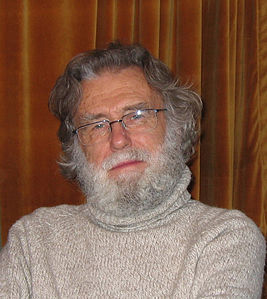 Vladislav Shut, 2008 | |
| basic information | |
| Full name | Vladislav Alekseevich Shut |
| Date of Birth | March 3, 1941 (78 years old) |
| Place of Birth | Voznesensk , Ukrainian SSR |
| A country |  USSR , USSR ,  Great Britain Great Britain |
| Professions | composer |
Content
Biography
In 1967 he graduated from the Russian Academy of Music .
He worked at the publishing house "Soviet Composer" (1967-1982), in the last Soviet years he left the service, working as a freelance artist, wrote music for films. [1] One of the founders of the new Association of Contemporary Music (AFM-2), was a member of E. Denisov’s circle.
Since 1992, lives in the UK, in 1999 received British citizenship.
Creative Feature
The music is marked by the influence of romanticism , but also polystylistic (both inside each of the works, and when comparing different opuses), like the work of Pärt or Schnittke . [1]
Of the works in the cinema, the most famous is the music for Karen Shakhnazarov ’s film “The Killer ” ( 1991 ). At the same time, Vladislav Shut is one of the (last Soviet) generations of composers whose representatives are not widely known.
“... I consider our generation to be ignored. It is interesting that a very long time ago, about 27 years ago, when I was still a student, Butsko told me a prophetic phrase that a generation born in the 30s ( Schnittke , Shchedrin , Gubaidullina, etc.) “will not give you a go” . At the same time, he did not mean any purposeful actions of this generation, but he meant that all niches, all places will be occupied by this generation. And he was right. It took the departure of Schnittke, Denisov , Gubaidullina , Shchedrin to suddenly discover that it turns out that there is a composer Yekimovsky , who is in no way inferior to the above, there is a composer Karaev , there is Vustin ... I always wondered why the name Gubaidullina is widely known and popular and nobody knows the music of Shutter, which is in no way inferior to the music of Gubaidullina ... ” [1]
- Nikolai Korndorf , July 1996
Selected Works
- Two songs of Robert Burns for mezzo-soprano and piano ( 1964 , new edition - 2002 )
- Fantasy Sonata for Violin and Piano ( 1969 , new revision - 2001 )
- Sonata for Cello ( 1970 , revised 1999 )
- Six poems by Sergei Gorodetsky ( 1970 )
- "Youth Album" for violin and piano ( 1971 )
- Chamber Symphony No. 1 for 4 cellos, double bass and timpani ( 1973 )
- Silhouettes for Piano ( 1973 )
- Sonatina for Piano ( 1974 )
- Children's Album for Piano ( 1975 )
- Chamber Symphony No. 2 for flute, oboe, clarinet, saxophone, bassoon, viola and double bass ( 1975 )
- Short Sonata for Flute ( 1977 )
- Three for bassoon, cello and percussion ( 1978 )
- Bassoon Solo ( 1978 )
- Chamber Symphony No. 3 for flute, oboe and two ensembles ( 1978 )
- “Romantic Messages” for bassoon, flute, prepared piano and strings ( 1979 )
- “Metamorphoses” for saxophone, harp, double bass and percussion ( 1979 )
- Grand Symphony for Organ and 15 Performers ( 1981 )
- Parable for 6 Percussion ( 1983 )
- “Warum?” For 15 artists ( 1986 )
- Mini Partita for Viola and Piano ( 1987 )
- “Ex Animo” for a large orchestra ( 1988 )
- “Offering” for violin, cello and piano ( 1991 )
- Chamber Symphony No. 4 for tom-tom and string orchestra ( 1992 )
- “Premonition” for soprano and chamber ensemble verses by R. M. Rilke ( 1993 )
- “Confession” for the organ ( 1993 , new edition - 2000 )
- Three Songs to Poems by O. Mandelstam for Voice, Flute, Clarinet and String Quartet ( 1994 )
- Four Songs to Poems by P. B. Shelley ( 1994 )
- Chamber Symphony No. 5 for 16 performers ( 1995 )
- Pantomime for flute and harpsichord ( 1995 )
- Con Passione for Piano and String Quartet ( 1995 )
- Serenade for String Orchestra ( 1995 )
- Amoroso for clarinet and string quartet ( 1996 )
- Divertissement for Baroque flutes, vibraphone and string orchestra ( 1997 )
- Chaconne for Accordion ( 1999 )
- “Night and Day” for voice, baroque flute and string quartet to verses by F. Tyutchev ( 2000 )
- Pastoral for flute, oboe, clarinet, bassoon and piano ( 2002 )
- Eternal Peace for Three Percussion ( 2002 )
- Suite for String Quartet ( 2003 )
- Two Sacred Sonnets for Mixed Choir on verses by J. Donna ( 2003 )
- Chamber Symphony No. 6 for string orchestra and percussion ( 2005 )
- “Three meetings with Shostakovich ” ( 2006 )
Notes
- ↑ 1 2 3 Ekimovsky V. “Autonography”. - second. - M .: Muzizdat, 2008 .-- S. 115. - 480 p. - 500 copies. - ISBN 978-5-904082-04-8 .