The Russian General Staff ( abbr. General Staff , General Staff of the Armed Forces ) is the central organ of military command of the Russian armed forces .
| Russian General Staff | |
|---|---|
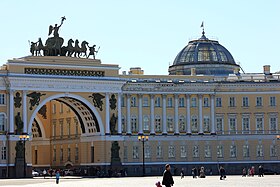 The building of the General Staff of the Russian Empire on Palace Square in St. Petersburg | |
| Years of existence | 1763 — present |
| A country |  Russian empire Russian empire  the USSR Russia the USSR Russia |
| Commanders | |
| Current commander | V.V. Gerasimov |
| Famous commanders | P.K. Sukhtelen |
Content
History of the Russian General Staff
Before Catherine II, the expression of the General Staff had a common meaning, that is, it was a collective name for all staff ranks; the very service of the General Staff was performed by the quartermaster ranks, which were first mentioned in the military charter of Peter the Great ( 1698 ), compiled by Adam Weide [1] .
The first quartermaster general of the Russian army was Prince Andrei Fedorovich Shakhovskoy († 1705), appointed in February 1702 by Peter I.
In February 1711, Peter I approved the first “Staff Regulations of the General Staff”, in which the establishment of the post of Quartermaster General as the head of the special Quartermaster unit (later became a service) was fixed. The states determined 5 ranks of the quarter-master unit; later their number increased or decreased: in 1720, 19 ranks; in 1731 - 5 ranks for peacetime and 13 ranks for the military. These ranks almost exclusively controlled the vanguards and advanced parties [1] . In the state, the quartermaster part consisted of 184 different ranks, belonging not only directly to the composition of the command and control bodies of the troops, but also to other parts and departments of the military administration (commissariat, provision, military court, military police, etc.).
Initially, the quartermaster unit was not a separate institution and was created by the highest military commanders only at the headquarters of the army (for the period of hostilities). In fact, the quartermaster ranks were, as it were, “temporary members” of the army (its field control), the preparation of which in peacetime received little attention. And the General Staff itself was then understood not as an organ of military command, but as a meeting of the highest military ranks. This situation negatively affected the state of command of the Russian army during the Seven Years War (1756-1763), despite a number of victories won by Russia [2] .
Under Catherine II, the ranks of the quarter-master unit were allocated to a special institution named by the General Staff and placed under the direct responsibility of the vice president of the military collegium: on January 14 (25), 1763, Catherine II approved the staff of the General Staff. For the first time in the history of the Russian army, a permanent military command and control body was created, which was charged with the duty in peacetime to deal with preparations for future wars [2] .
In 1772, the General Staff, led by Zakhar Chernyshev , was transformed according to the project submitted by General Baur ; the officers of the General Staff were given a position independent of the commander in chief of the army. This was the reason for the failure of the Baur reform, provoking displeasure in many military leaders.
("The Military Encyclopedia of Sytin ")
Emperor Paul, upon accession to the throne, abolished the General Staff, after which, however, he was revived under the name of the retinue of His Imperial Majesty in the quartermaster part . This subsidiary organ of the central military administration carried out some basic functions of the former General Staff. Her chief, with the rank of Quartermaster General, was appointed Infantry General Ivan Ivanovich German [3] , and then Arakcheev . The condition of the quarter-master unit under Herman was deplorable, in a letter to Paul I [4] he described the "poor condition" of officers who "still do not receive a salary, because the Commissariat Depot does not know exactly what they should let go during peace."
In peacetime, the ranks of this institution were on the “set” in Finland and Lithuania , engaged in His Majesty’s drafting and, in a small number, were with the troops, where in the event of war they carried the duties of the former General Staff.
With the accession to the throne of Alexander I , the engineer-general Quartmeister was appointed engineer-general Sukhtelen , whose management ( 1801 - 1810 ), as well as his successor, Prince P.M. Volkonsky ( 1810 - 1823 ), brought very important results, especially in recruiting The retinues are well-educated officers and their further improvement. The composition of the Suite increased as the army strengthened, so that in 1825 there were already 317 officers in it, against 163 in 1812. They were appointed from the tower-followers , for the preparation of which in 1811 a school of tower-followers was opened in St. Petersburg - the prototype of the future Academy of the General Staff, under the leadership of Lieutenant Colonel A. I. Khatov (future general from infantry), in Moscow - the "Society of Mathematicians", in subsequently converted to a private college of General NN Muravyov (with 1815 for 1823 in 1812, Finland topographical corps was organized in the breech. geymate Gaopaneshi Kuopiokskoy province, [5] converted in Hamina Cadet school (since 1817 ), and then - at rezhdonny in Mogilev 2-classroom school officer , existed prior to 1832 .
Since 1815, in accordance with the decree of Alexander I, the Main Headquarters of His Imperial Majesty was established and control of the entire military department was transferred to it, and a special office of the Quartermaster General of the General Staff began to function (in parallel with the Suite).
The participation of some of the ranks of the Suite in the Decembrist uprising cast a shadow over the entire department, which resulted in the closure of the Moscow school of columnar leaders, as well as the prohibition of transferring officers to the quartermaster part below the rank of lieutenant . On June 27, 1827, the retinue was renamed the General Staff. In 1828, the leadership of the General Staff was entrusted to the Quartermaster General of the General Staff, E. I. V. With the abolition in 1832 of the General Staff as an independent governing body (the name was retained by a group of senior officials) and the transfer of the entire central administration to the Minister of War. The General Staff, called the Department of the General Staff, became part of the War Ministry. In 1863, he was transformed into the General Directorate of the General Staff.
Further transformations of the General Staff, under the Quartermaster General A. I. Neidgardt , resulted in the opening of the Imperial Military Academy in 1832 and in the establishment of a department of the General Staff; the General Staff includes a body of topographers . The exit from the General Staff to other departments was prohibited, and only in 1843 it was allowed to return to duty, but only in those parts where someone had previously served.
With the transformation of the Ministry of War in 1836, the Quartermaster General was relegated to the post of Director of the Department of the General Staff and, losing his former military significance, gradually acquired a bureaucratic direction. This state of affairs continued from 1834 to 1855 . Of the works of the General Staff during this time, the first place is occupied by statistical works undertaken in 1836 . The Crimean War prevented them from ending, so only 69 provinces were published.
In the reign of Emperor Alexander II, the General Staff was given wide development; Initiative in this case belonged to the adjutant generals Rostovtsev and Gershntsveigu . Thanks to the first, the military academy was expanded and received the right to accept an unlimited number of students. Gershtenzweig (who took the place of the duty general) belongs to the initiative in bringing the General Staff officers closer to each other by serving in divisional headquarters, commanding companies and battalions and tactical exercises with officers, as well as compiling and publishing mass textbooks, manuals and manuals for the troops.
In 1864, the Guards General Staff merged with the General General Staff. [6]
On December 31, 1865 ( January 12, 1866 ), by merging the Inspection Department with the Main Directorate of the General Staff, the General Staff was formed, which was in charge of the management of the armed forces, mobilization, affairs on personnel and staffing of troops and military institutions, their device, service, deployment , combat training and farming.
With the assistance of the Military Scientific Committee of the General Staff and the Nikolaev Academy of the General Staff , many works of officers of the General Staff in various departments of military history and military art were published. The participation of the General Staff in comparison with the previous one is less significant in the filming and cartographic work, which went into the corps of military topographers.
In 1905, the General Staff under the name " Main Directorate of the General Staff " (GUGSH) was allocated, following the example of Germany, to an independent body led by a chief independent of the Minister of War (with the right, like the Minister of War, to give a personal report to the emperor). The Ministry of War, as it already took place in 1815-1832, was left mainly with the solution of administrative and economic issues, including the use of loans, but the rest became the prerogative of the General Staff. The working body of the chief of the General Staff (he is also the chief of the GUGSH) was the administration of the quartermaster general. In 1908, the GUGSH was returned to the Ministry of War, and the chief of the General Staff was subordinate to the Minister of War.
In 1905, the directorates of the 2nd Quartermaster General (without the Mobilization Department), the Military Communications, and the Military Topographic Administration were transferred from the General Staff to the Central Administration of Civil Defense. In 1910, the General Quartermaster unit was transferred from the Main Headquarters to the State Administration for the Armed Forces, as well as the editorial staff of the Military Collection magazine and the Russian Invalid newspaper, and the Cossack department, created from the General Directorate of the Cossacks, entered the General Headquarters troops. According to the regulations of 1911, the General Staff consisted of the following departments: General on duty, Pension, Cossack and units: Asian and Administrative (in 1914 it was renamed the Administrative Department).
On the eve of World War I, the General Staff consisted of 5 departments (Quartermaster General, for the arrangement and service of troops, mobilization, military communications of the military topographic) and 2 commissions (serfdom and committee of the General Staff).
With the outbreak of World War I, the Headquarters of the Supreme Commander was created with the headquarters of the Supreme Commander. The main leadership of the fighting was carried out by this body.
The General Directorate of the General Staff was liquidated on March 8, 1918.
Chiefs (before being approved as managers) of the General Staff
- Volkonsky P. M. (1810-1823, chief of staff from 1815)
- Dibich I.I. (1823-1828)
- Chernyshev A. I. - managing director of the General Staff (1828-1832)
Chiefs of the General Staff:
- Heiden F.L. (1866-1881)
- Obruchev N.N. (1881-1897)
- Sakharov V.V. (1897-1904)
Chiefs of the General Staff:
- Palitsyn F.F. (1905-1908)
- Sukhomlinov V.A. (1908-1909)
- Myshlaevsky A.Z. (1909)
- Gerngross E.A. (1909-1911)
- Zhilinsky J.G. (1911-1914)
- Yanushkevich N.N. (1914)
- Belyaev M.A. (1914-1916)
- Averyanov P.I. (1916-1917)
Officers of the Russian General Staff
Officers of the General Staff in the Armed Forces of the Russian Empire (Russian Imperial Army) in the last third of the 19th century - beginning of the 20th century were considered officers who completed the full course of the Nikolaev Academy of the General Staff and were assigned to the General Staff (that is, who had the right to obtain a post in the General Staff over time) . They served directly in the units where they were seconded after graduating from the Academy, mainly in the headquarters of units and subunits. At the same time, they were listed in the ranks of ranks both for the General Staff and for the type of troops where they served directly.
At the headquarters (from the military district — from 1864 to the division), as well as the directorates of individual brigades and fortresses, there were special posts that should only be replaced by the ranks of the General Staff. The duties of officers of the General Staff included maintaining journals of military operations (traveling, siege, and others).
The officers of the General Staff were mostly unfamiliar with the military service; only in the Caucasus was always a significant number of officers of the General Staff (30–40). In 1851, only 7 officers entered the military academy; to attract a larger number of people, officers of the General Staff were given various benefits, after which an average of 36 people began to enter the academy.
General Staff in Soviet Russia and the USSR
On May 8, 1918, the All-Russian General Staff (All-Headquarters) was created (chiefs - N. N. Stogov (18.5 - 2.8.1918), A. A. Svechin (2.8 - 10.22.1918), N. I. Rattel ( 10/22/1918 - 10/02/1921)).
The headquarters of the Revolutionary Military Council of the Republic became the organ of operational management on September 6, 1918, and from November 8 the Field Headquarters of the Republican Revolutionary Military Council (chiefs - September 6, 1918 - N. I. Rattel , 10/21/1918 - F.V. Kostyaev , 06/18/1919 - M. D Bonch-Bruevich , 07/22/1919 - P.P. Lebedev ).
By order of the Revolutionary Military Council of the Republic (PBC) of February 10, 1921, the All-Headquarters was merged with the Field Headquarters and was named the Headquarters of the Workers 'and Peasants' Red Army ( RKKA ). The headquarters of the Red Army became the unified command and control body of the armed forces of the RSFSR and was the executive body of the Republican Revolutionary Army, since 1923 - the Revolutionary Military Council of the USSR.
The chiefs of staff of the Red Army were:
P.P. Lebedev , February 1921 - April 1924.
M.V. Frunze , April 1924 - January 1925.
S. S. Kamenev , February - November 1925.
M.N. Tukhachevsky , November 1925 - May 1928.
B. M. Shaposhnikov , May 1928 - June 1931.
A.I. Egorov , June 1931 - September 1935.
Until 1924, the Commissioner of the Headquarters of the Red Army was I. C. Unshlikht , Deputy Chairman of the OGPU . With the appointment of Mikhail Frunze as the Chief of Staff, the position of Commissioner of the Staff was abolished - thus unity of command was established in the leadership of the headquarters, and the Bolshevik (communist) party control over the Red Army Headquarters was carried out by other methods.
Reorganization of 1924
In 1924, the Headquarters of the Red Army was reorganized and a new military body was created with narrower powers under the same name. Since the Main Directorate of the Red Army (the Red Head of the Red Army) and the Inspectorate of the Red Army were created, a number of functions and powers were transferred from the Headquarters of the Red Army to the new structures of the higher military command of the Russian Republic.
In March 1925, by a decision of the NKVM, the Red Army Directorate was formed (from January 1925 - the Main Directorate of the Red Army), from which the functions of the administrative leadership of the current activities of the Armed Forces of the Republic were transferred from the headquarters of the Red Army: combat training, military mobilization, manning and a number of other functions.
Headquarters Structure since July 1926
Приказом НКВМ от 12 июля 1926 года Штаб РККА был утвержден в составе четырёх Управлений и одного Отдела:
Первое (I Управление) — Оперативное;
Второе (II Управление — с июля 1924 года) — Организационно-мобилизационное;
Третье (III Управление) — Военных сообщений;
Четвёртое (IV Управление) — Информационно-статистическое (Разведывательное);
Научно-уставной Отдел.
Штаб РРККА подчинялся НКВМ и являлся его структурным подразделением.
Органзационно-мобилизационное управление (ОМУ) было создано в ноябре 1924 года путём слияния Организационного и Мобилизационного управлений Штаба РККА. ОМУ возглавлял начальник и военком бывшего Оргуправления С. И. Венцов. С июля 1924 года Организационно-мобилизационное управление стало носить название II Управление Штаба РККА. В 1925—1928 годах II Управление возглавлял Н. А. Ефимов.
Создание Генерального штаба РККА
22 сентября 1935 Штаб РККА был переименован в Генеральный штаб РККА. Начальниками Генерального штаба были:
А. И. Егоров , сентябрь 1935 — май 1937.
Б. М. Шапошников , май 1937 — август 1940.
К. А. Мерецков , август 1940 — январь 1941
Г. К. Жуков , январь 1941 — июль 1941
Подготовка к Большой войне и создание фронтовых управлений
В связи с ускоренной милитаризацией СССР и интенсивной подготовкой РККА к Большой войне Иосиф Сталин в январе 1941 года во главе Генерального штаба ставит молодого выдвиженца Георгия Жукова , который занимал этот пост до июля 1941 года. Назначение было связано как с личными симпатиями Сталина, так и с учетом итогов советско-японского вооруженного конфликта в районе озера Халхин-Гол, где Г. К. Жуков руководил подготовкой и ведением боевых действий.
В июне 1941 года Начальник Генерального штаба РККА Георгий Жуков отдал приказ о преобразовании западных военных округов в Европейской части СССР во фронты с образованием Фронтовых полевых управлений (ФПУ) и выводе Управлений на заблаговренно подготовленные Полевые пункты управления (ППУ фронта).
Нападение Германии на СССР и образование Восточного фронта
С нападением Германии на СССР 22 июня 1941 года на советско-германском Восточном фронте в годы Второй мировой войны в период 1941—1945 годов Генеральный штаб являлся основным органом Ставки Верховного Главнокомандования стратегического планирования и руководства Вооруженными силами СССР на фронтах. Начальниками Генерального штаба были:
Б. М. Шапошников , июль 1941 — май 1942.
А. М. Василевский , май 1942 — февраль 1945.
А. И. Антонов , февраль 1945 — март 1946.
Генеральный штаб в 1945—1991 годах
Начальниками Генерального штаба в послевоенное время были:
А. И. Антонов, февраль 1945 — март 1946.
А. М. Василевский, март 1946 — ноябрь 1948.
С. М. Штеменко , ноябрь 1948 — июнь 1952.
В. Д. Соколовский , июнь 1952 — апрель 1960.
М. В. Захаров , апрель 1960 — март 1963.
С. С. Бирюзов , март 1963 — октябрь 1964.
М. В. Захаров, ноябрь 1964 — сентябрь 1971.
В. Г. Куликов , сентябрь 1971 — январь 1977.
Н. В. Огарков , январь 1977 — сентябрь 1984.
С. Ф. Ахромеев , сентябрь 1984 — декабрь 1988.
М. А. Моисеев , декабрь 1988 — август 1991.
В. Н. Лобов , август — декабрь 1991.
В составе ГШ ВС СССР имели следующие Главные управления:
- Главное оперативное управление
- Главное разведывательное управление
- Главное организационно-мобилизационное управление
- Главное управление АСУ и РЭБ (расформировано в 1989 году)
- 10-е Главное управление
В 1991 году Генеральный штаб Вооруженных сил СССР прекратил своё существование в связи с ликвидацией Союза Советских Социалистических Республик после подписания 8 декабря 1991 года в Республике Беларусь Беловежских соглашений — Межгосударственного соглашения Беларуси, России и Украины.
С образованием нового государства — Российской Федерации — Генеральный штаб СССР реорганизован в Генеральный штаб Вооружённых Сил Российской Федерации.
Генеральный штаб Вооружённых сил Российской Федерации
See also
- Генеральный штаб
- Главный штаб Русской императорской армии
- Морской генеральный штаб
- Main Naval Headquarters
- Ministry of War of the Russian Empire
- Main Intelligence Directorate of the General Staff of the Armed Forces of the Russian Federation
Bibliography
- Glinotsky N.P. History of the Russian General Staff. In 2 volumes, Volume I: 1698-1825 - St. Petersburg: Type. The headquarters of the troops of the Guard and the St. Petersburg Military District, 1883. - VIII, 427, [2] p.
- Glinotsky N.P. History of the Russian General Staff. In the 2 volumes of Volume II: 1826-1855. - SPb .: Type. The headquarters of the troops of the Guard and the St. Petersburg Military District, 1894. - II, 284, [2] p.
Notes
- ↑ 1 2 General Staff // Brockhaus and Efron Encyclopedic Dictionary : in 86 volumes (82 volumes and 4 additional). - SPb. , 1890-1907.
- ↑ 1 2 General Staff of the Russian Army: history and modernity. - M. Academic Project, 2006. - 480 p. - S. 20-26.
- ↑ Military Encyclopedia “Russian Warlords”, edition of I. D. Sytin, reprint edition of St. Petersburg, 1996, volume I, p.22
- ↑ s: Letter from Ivan Ivanovich German to Paul I
- ↑ Rychkov S. Yu. “Card Depot and Quartermaster Unit on the Eve of the War of 1812” // Military History Journal, No. 4, 2006
- ↑ Russian military costume of the 18th - early 20th centuries. / Author V. M. Glinka
- ↑ Fig. 25. General Staff. General in a field uniform, General Staff Officer in ordinary uniform and Ober-Officer in full dress uniform. prik. by military. Vedas 1882, Nos. 31 and 64. // Illustrated description of changes in the uniform and equipment of the troops of the Imperial Russian Army for 1881–1900: in 3 volumes: in issue 21: 187 fig. / Comp. in Tech. com Ch. quartermaster - SPb. : Cartographic institution of A. Ilyin , 1881–1900.
Links
- General Staff // Brockhaus and Efron Encyclopedic Dictionary : in 86 volumes (82 volumes and 4 additional). - SPb. , 1890-1907.
- General Staff - an article from the Great Soviet Encyclopedia .
- Chief of the General Staff of the Armed Forces of the Russian Federation - First Deputy Minister of Defense of the Russian Federation Army General Nikolai MAKAROV. The main body of military administration. On the anniversary of the formation of the General Staff
- Shaposhnikov, Boris Mikhailovich The brain of the army. - M.: Voengiz, 1927
- GUGSH funds in the Russian State Television and Radio Broadcasting Agency
- Funds of the General Staff in the RGVIA
- Foundations of the General Staff E. I. V.
- Funds of the Department of the General Staff and the Main Directorate of the General Staff in the RGVIA
- Shtemenko Sergey Matveevich “General Staff during the war” (memoirs)