Trinity Cathedral ( Cathedral Church in the Name of the Holy Life-Giving Trinity ) - the lost main temple of the city of Kurgan , Russia . In addition to the main cold temple, there were the following aisles: from the north in the name of Demetrius of Solunsky , from the south of the Nativity of Christ . Located on Trinity Square .
| Orthodox church | |
| cathedral church in the name of the Holy Life-Giving Trinity with two chapels | |
|---|---|
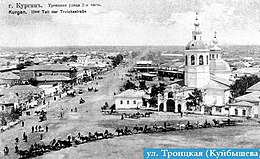 View of the cathedral, Trinity street and the 2nd fire station | |
| A country |  Russia Russia |
| City | Mound |
| Denomination | Orthodoxy |
| Diocese | Tobolsk and Siberian |
| Established | 1767 year |
| Building | 1767 |
| Date of Abolition | 1937 year |
| condition | destroyed in 1957 |
Description
Deanery , later the Cathedral of the Kurgan Vicar diocese as part of the Tobolsk and Siberian diocese .
After another fire, it was decided to build a stone cathedral on three thrones: the central one in the name of the Holy Life-Giving Trinity, the right side throne in the name of the Nativity of Christ and the left side throne in the name of St. Great Martyr Dmitry Solunsky, who was revered as the patron saint of Siberia. The temple is usually named after the central throne and should have been called Trinity. But in the XVIII century, it is everywhere written as the Nativity of Christ - on the plans of the city, on metric books, in documents. Perhaps this is due to the fact that the city could not afford to erect the entire temple immediately, only the right chapel was erected and consecrated in 1767 . Peter Simon Pallas in 1771 noted that in Tsarevoye Gorodishche “instead of the old wooden church they began to build a stone one, but since there is a lack of lime in this neighborhood and should be brought from Shadrinsk and Tyumen, the construction is slow.”
The Grand Duke, the heir to the throne, Alexander Nikolayevich, the future emperor Alexander II, was present at the Trinity Church. He arrived in Kurgan on the night of June 5-6, 1837. He was accompanied by V.A. Zhukovsky , a former educator of the Grand Duke.
Trinity Cathedral had a composition traditional for 18th-century churches, elongated along the longitudinal axis: a temple, a refectory, a bell tower. According to the layout, the one-story church resembled some Tobolsk baroque churches, which are characterized by a wide refectory with aisles, a large octagon on a quadruple, a fairly large upper octagon with light windows and a five-sided design of the main altar with a chapel above it. There is a noticeable similarity of the Kurgan temple with the one-story Church of the Nativity of the Virgin of the city of Tobolsk.
In 1890, the dome of the main temple was redone, for which technician A.P. Yushkov made a plan of the church. Crosses painted with potala in 1821 (golden powder) were later gilded. The last time, in 1914, he gilded chapters and crosses throughout the church of A.E. Krasnov. In 1830 the wooden fence was replaced with a brick one, in 1864 it was expanded (in accordance with the drawing of the former college secretary M.E. Levchenko), and in 1890 according to the plan of A.P. Yushkov is building a stone corridor connecting the narthex with the church gate, as well as a fence on the west side (from the bell tower) which was built by the Kurgan tradesman K. Nazarov. An icon of the Trinity hung above the entrance gates, and in 1901, 5 soldered crosses made of tinplate made by the Kurgan tradesman M.A. were placed over the gate. Goloviznin. There were lanterns around the building, as well as trees planted in 1885. In 1901, after the permission of Bishop Anthony , altars were removed in the altars in order to lay the foundation under them, to raise them. After the work was completed, murals were made in the church, the side altars were consecrated, and the main throne was prepared for the consecration next year.
Murals
In the dome in 1857 was an image of the All-Seeing Eye of God with six cherubs, made by the tradesman of Turin, Ivan Telepnev. In 1879, wall painting was renewed by the Shadrinsk tradesman Ivan Vasilievich Pryamonosov. The paintings on the walls of the main temple and in the altar were made in 1901 by the provincial secretary Vasily Vasilievich Loginov, who was awarded the title of teacher of painting by the Academy of Arts. Shadrinets Ivan Vasilyevich Prymonosov performed ornamental works, and in the dome he painted the image of God of hosts.
Icons
In 1832, the iconostasis in Dmitrievsky chapel and clerical kiotes were made by Ivan Nikitin, a carver, peasant of the Vvedensky volost of the Kurgan district, and the painting was done by Vasily Permyakov, a courtyard of Mr. Putkovsky.
In 1849, the iconostasis was made in a cold temple by the residents of the Nevyansk plant of the Yekaterinburg district, Gregory and George Chernobrovin, representatives of one of the most famous dynasties of Nevyansk icon painters from the 18th century, working in the so-called "Greek" style. The iconostasis is carved, gilded to the cement, with carved cherubs. In the local row there are icons under silver 84 samples of robes: the Lord Almighty, the Virgin and Child, the Old Testament Trinity, Nikola the Wonderworker, the archangels Michael and Gabriel, several small icons (with New Testament and Old Testament images) on the deacon and ponomary gates. Above the royal gates is the scene of the Last Supper, depicted on the canvas and 2 apostles on oval boards. In the third stronghold, the Almighty on the throne and the prophets, at the top of the Resurrection of Christ. The two earlier low detached iconostasis of Chernobrovina were connected in one connection with the main one.
In 1901, the workshop of P.F. Korotkova built three new iconostasis under a contract concluded in 1890. The new iconostasis of the Trinity Church was 12 meters high and 9 m. 25 cm long, the side walls are much smaller: 6 m. 40 cm. X 3 m. 56 cm. Most likely, the iconostases of the Trinity Church, made by this workshop, were richly gilded carvings and with academic painting. Pavel Feoktistovich Korotkov, a native of the famous icon-painting crafts of the Vyaznikovsky district of Vladimir province, opened an icon-painting and icon-painting workshop in Yekaterinburg. In 1891, the iconostasis from the Trinity Church was transferred to the Simeonovsky Church of the village of Kolesnikovo (Korobeinikovo), belonging to the deanery of the Kurgan [1] .
Earth
Trinity Church did not have its own land - neither manor, nor arable, nor haymaking. Only the courtyard adjacent to the temple. The houses of the priests were hired, and if one of them built their own house, then on urban land. The church rented urban land, on which 7 stone shops were built. Shops were leased to merchants and received 505 rubles annually in favor of the church. In 1900, a large store was built, adjacent to the church fence - a brick, covered with iron, with large windows. This shop was rented from the church by a wealthy merchant Ivan Ivanovich Deryagin.
Parish
For a long time the Trinity Church was the only temple of the city, and all nearby villages belonged to its parish. In 1783 it was - Pimenovka, B.-Chausov, Kurgan, Smolina , Novaya (Ryabkovo) , Kolesnikov, Voronov, Pesterev, Sheveleva, Glinskaya, Pervukhina, Dubrovnaya, Patronnaya, Sycheva, Galkin, Parfenyev, Shchuchya, Chesnokov, Pesterev, M.-Chausova, Pavlutskaya, Mikhnyakova, Zarechnaya.
In 1884, the Trinity Parish included: Smolino, Malo-Chausovo, Glinka, Voronovka, Bolshoi Chausovo, Ryabkovo. In 1884, there were 930 households in the parish, which included 2,393 men and 2,699 women. Church capital was 20127 rubles, and circle income was up to 5137 rubles per year, and interest on permanent deposits in the amount of 1545 rubles was added to them. 81 kopecks The church staff consisted of three priests, a deacon and three psalm-goers.
Use of the building after the temple closes
In Soviet times, service at the Trinity Church lasted until May 25, 1937 . On June 10, 1937, the property of the Trinity Church was handed over to a commission led by Pichugina Efrosinya Kornilovna. 152 items were entered into the inventory. Part of the church utensils from this inventory was sold out of bidding, part was given to the museum (it burned down the same year), part was taken home.
The building was used for urban needs, during the war years it housed the dining room of the evacuated Stalingrad Military Tank School , after the war - shops and a dining room, in the church gatehouse was the Komsomol city committee. In 1953, the church building was occupied by the Glavkinoprokat and Hunter bases.
Immediately after the war, believers begin active efforts to open the Trinity Church and, in order to prevent this, the local authorities in 1956 decide "On the demolition and dismantling of the building of the former Trinity Church in connection with its emergency condition." On the night of May 24, 1957, they tried to break the bell tower with tractors, bringing the wire cables to the dormer windows, but could not. The church was blown up on May 25, 1957 [2] .
Now in its place is the Kurgan Regional Philharmonic Society and a monument erected in July 1961 to Natasha Argentovskaya (1900-1919).
Toponymic Traces
The name of the cathedral now bears Trinity Square in Kurgan and a public transport stop near it;
Previously, in honor of the cathedral were named:
- Troitskaya street (now Kuibyshev street );
- Trinity Lane (now Lenin Street ).
- Trinity cemetery .
Priests
- 1820 Archpriest Narkiss Prokopyevich Nikitin
- 1821 priest John Antonov
- 1899-1919 priest Seraphim (Korovin)
- 1926-1932 Archpriest Fedor Afanasevich Chemagin. He was counted among the new martyrs and confessors of the Russian Orthodox Church by the Local Council of 1990 [3] .