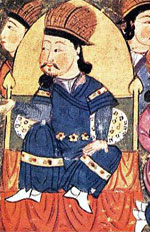
Altan Khan (Amda) ( 1507 - 1582 ) - Khan of the Tumet Khanate ( 1548 - 1582 ), the second son of the great Mongol Khan Bars Bolad Jinong and the grandson of the famous Mongol Khan Dayan Khan .
| Anda (Sayn Gagan Altan Khan) | |||||||
|---|---|---|---|---|---|---|---|
 | |||||||
| Predecessor | Bars Bolad Jinong | ||||||
| Successor | Sange Dugurgen Khan | ||||||
| Birth | 1507 Mongolia | ||||||
| Death | 1582 Mongolia | ||||||
| Kind | 1) Genghisides 2) North Yuan | ||||||
| Father | Barsbolod-Ginon | ||||||
| Spouse | |||||||
| Children | 8 sons | ||||||
Biography
After the death of his father, Barsbolad, the Jinong, Altan Khan became the ruler of the Tumet Tumen, which was part of the right wing of the Mongol Empire. His older brother, Gun Bilig-Mergen-Jinong, ruled the Ordos Tumen. In 1542, after the death of his older brother Gong, Bilig Amda became the leader of the right wing of the Mongol tribes.
In 1547, after the death of the great Mongol Khan, Bodi-Alag Khan, Altan Khan began to fight with his successor, Daraisun-Goden Khan, and forced him to retreat east. In 1551, the rivals concluded a peace agreement between themselves. Daraisun-Goden Khan recognized the leadership of Altan Khan and ceded him the title of Goden Khan . Altan Khan, who controlled the territory of Ordos until the Yellow River , had every opportunity to put pressure on the Oirats and China . In 1571, the Chinese emperor appropriated the title of Shanuy-wan (" obedient and righteous king ") to Altan Khan. In 1554, Altan Khan founded the city of Hohhot (" Blue City " or " Blue City "). Hohhot was originally his main headquarters, the center of craft and trade in his possessions.
In 1529 , 1530 and 1542, Altan Khan, at the head of a large Mongolian army, made three devastating raids on the territory of China, robbing and killing the local population. In 1550, Altan Khan broke through the Great Wall of China and approached the environs of Beijing , which were burned by the Mongols. In 1551, he entered into a peace treaty with the Chinese government, according to which horse markets in Datong and Xuanfu were opened for trade with the Mongols. Soon, however, they were closed by the Chinese government, and Altan Khan resumed hostilities on the border with China. In 1552, Karakorum , the ancient capital of the Mongol Empire , gained control. In 1571, after the signing of the peace treaty, the Chinese emperor was forced to grant special trade rights to the Tumet Khanate .
During his reign, Altan Khan conducted several successful military campaigns against Oirat tribes. Altan Khan repeatedly tried to achieve a new unification of the Mongols. In 1552 he made a campaign against the Oirats, which resulted in a new series of Oirat-Mongol wars after 100 years of peaceful coexistence. The Oirats went west, leaving the nomads they had mastered in the upper reaches of the Orkhon . In 1562, Altan Khan inflicted a new blow on the Oirats, forcing them to retreat even further west, to the Irtysh River . The first of the Mongol feudal lords to establish relations with the third Dalai Lama and laid the foundation for the spread of Buddhism and the strengthening of the Buddhist church in Mongolia. Under Altan Khan, the Mongolians completed the development of the territory of Ordos .
Children
Altan Khan had eight sons: Sange Duguren-khagan, Bayan Bagatur-taiji, Tubet-taiji, Bintu Yelden-taiji, Dalat Kuluke-taiji, Budashira-taiji, Kunchuk-taiji, Jamso-taiji. In 1582, after the death of Altan Khan, he was succeeded by the eldest son of Senga Dugurgen Khan , who became Khan of the Tumets ( 1582 - 1583 ).