Yakov Ivanovich Ozolin ( Latvian. Jēkabs Ozoliņš ; June 20, 1883 - September 27, 1938 ) - Soviet naval leader, commander of the Amur military flotilla, deputy head of the Navy of the Red Army , flagship of the 2nd rank .
| Yakov Ivanovich Ozolin | |
|---|---|
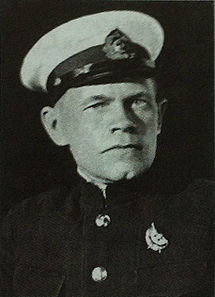 J. I. Ozolin | |
| Date of Birth | June 20, 1883 |
| Place of Birth | Verro Livonia province Russian Empire (now Võru in Estonia ) |
| Date of death | September 27, 1938 (55 years old) |
| Place of death | the USSR |
| Affiliation |
|
| Type of army | USSR Navy |
| Years of service | ... - 1938 |
| Rank |  |
| Commanded | Amur Flotilla |
| Battles / Wars |
|
| Awards and prizes |  |


Biography
Origin and primary education
Latvian , member of the CPSU (b) since 1919. Yakov Ivanovich Ozolin (Ekab Yanovich Ozolin or Ozolin) was born on June 20 (July 2), 1883 in the city of Verro, Livonia province (now Võru in Estonia) into a peasant family. He graduated from two classes of the school of the Ministry of Education of Russia.
Service in the Royal Navy
After graduating from school in 1906, he went to his uncle, a worker at the Putilov factory in St. Petersburg, where on September 1, 1906 he entered the feldsher school at the Kronstadt Maritime Hospital at public expense. After graduating from it on April 27, 1910, he served in the Baltic Fleet, went on transport "Nikolaev" and the cruiser "Diana". In 1911, Ya. I. Ozolin was transferred to the Kars gunboat of the Caspian Flotilla, on which then served as midshipman E. S. Pantserzhansky, future commander of the Naval Forces of the USSR. Soon, “Kars” with the crew relocated to the Caspian Sea, where the boat was used to transport the Persian Shah troops involved in the suppression of peasant uprisings in Persia. The cruelty with which the loyal to the Shah’s troops dealt with the rebels forced the young sailor to take a different look at life, and in December 1911, Yakov Ivanovich, while in Baku, joined the party of Socialist Revolutionaries (SRs), which he was until 1919. . Since 1914, the Black Sea Fleet - a sanitary conductor on the ship (floating workshop) "Kronshtadt" and the destroyer "Hasty". Subsequently, Ya. I. Ozolin pointed out that in 1917 he was promoted to college registrars and became a “class assistant”, but this information has not been confirmed to date.
Participation in Revolutions and Civil War
After the February Revolution, Ya. I. Ozolin served as a member of the Sevastopol Council, then deputy chairman of the Tauride Provincial Union of Medical Assistants. From October 1917 to January 1918, Ya. I. Ozolin was in Petrograd and took part in the All-Russian Conference of Navy Officers3. Then he, along with other military commanders under the leadership of A. G. Zheleznyakov, the head of the guard of the Tauride Palace, took part in the dispersal of the Constituent Assembly. In February 1918, Yakov Ivanovich returned to Sevastopol. After the Germans captured Crimea, Y. I. Ozolin made his way through Moscow occupied by Germany to Moscow. In July 1918 he left for Vitebsk, where a detachment of watercraft of the Zapadnaya Dvina River was formed (created on the basis of a platoon of boats of the former Tsarist 5th Army). In December 1918, Ozolin was appointed the temporary acting military commissar of the detachment; on January 3, 1919 he returned to the post of senior lekpom. After the start of the formation of the Flotilla of Soviet Latvia in March 1919, the 2nd flotilla detachment was created on the basis of the detachment, where on March 15 Ya. I. Ozolin was a junior lekpom, and on May 15 - temporarily acting as military commissar. On May 28, 1919 he was appointed senior lekpom of this detachment. There, in Vitebsk, Ya. I. Ozolin was elected a member of the Vitebsk City Council. April 1, 1919 he joined the ranks of the RCP (b). From August 10 to 12, 1919, he again temporarily replaced the military commissar of the detachment. After the defeat of the troops of Soviet Latvia in November 1919, the West Dvina military flotilla was created on the basis of the 2nd (West Dvina) flotilla unit, where Y. I. Ozolin was at first the senior medical assistant, and since February 1920 - the assistant to the military commissar, Since May 19, 1920, Ya. I. Ozolin temporarily replaced the military commissar of the West Dvina Flotilla. Flotilla ships participated in military operations against Polish and Latvian nationalist troops, minefields on the Western Dvina, landing, and the fight against gangs. The conflict between Ozolin and the flotilla commander G. M. Tyryshkin, whom Y. I. Ozolin accused of sabotage and counter-revolutionary activity, dates back to this period. October 19, 1920 G. M. Tyryshkin was arrested by the Special Division of the Cheka, but a month later released for lack of evidence. According to G. M. Tyryshkin, personal hostile relations and persecution by Y. I. Ozolin continued after the Civil War, because of which Tyryshkin in 1924 was forced to leave service in the Navy.
On July 14, 1920, Ya. I. Ozolin was transferred to the south and appointed military commissar of the recreated Azov military flotilla, commanded first by S. E. Markelov, then E. S. Gernet. The flotilla, based on Taganrog and Mariupol, provided fire support to the ground forces, conducted successful military operations against the White Guard ships, in particular, gained victories on July 9, 1920 at Krivaya Kosa, on August 24 - at Primorsko-Akhtarskaya and September 15 - at Obitnochnaya Kosa ( the flotilla was already commanded by S. A. Khvitsky). In this battle, Ozolin distinguished himself: being shell-shocked, he continued to fulfill his duties, which contributed to the coherence of the actions of ship commanders. Commander of the Naval Forces of the Soviet Republic A.V. Nemitz, the future vice-admiral (1941), noted the energetic and skillful control of the ships in this battle and thanked all the personnel of the flotilla5. The battle at the Inner Spit is the only naval battle of the Civil War in Russia. However, individual awards came much later. Thus, Y. I. Ozolin received the Order of the Red Banner for this battle only on February 1, 1923, although the commander of the flotilla S. A. Khvitsky was awarded back in December 1920.
Fleet Reconstruction
In April 1921, the Azov military flotilla was disbanded, personnel and ships were transferred to the Black Sea Fleet. Ya. I. Ozolin was appointed to the post of military commissar of the Coastal Defense of the Caucasian Black Sea coast. True, an increase soon came: in August, Yakov Ivanovich was appointed military commissar of the headquarters of the Black Sea Maritime Forces (MSCM) 7. Here he again served with E.S. Pantserzhansky, then with I.K. Kozhanov, A.S. Maksimov, V. Yu. Rybaltovsky. In addition to current naval affairs, Yakov Ivanovich found time to work in local authorities, in 1920-1921. was a member of the Sevastopol City Council. I had to carry out very unpleasant instructions, or rather orders. So, in 1921, after the Kronstadt mutiny in the Navy, "purges" began. They did not pass the Black Sea. Here, I. I. Ozolin was appointed chairman of the commission. On November 26, 1921, Yakov Ivanovich was transferred to Moscow to the post of military commissar of the Combat Command of the Marine Headquarters of the Republic (RVSR Order No. 323), and on February 5, 1923, he also headed the department itself. The work of the combatant command consisted mainly in staffing and accounting for personnel, but even being in this position, Y. I. Ozolin realized that he did not have enough experience in participating in the revolution and the Civil War: he needed deep theoretical knowledge in the field of military affairs. And Yakov Ivanovich asked to let him go to school. On November 6, 1925, Y. I. Ozolin was enrolled in the Naval Academic Courses at the RKKF Naval Academy, and already on the 12th he began training. Such prominent naval figures as V. M. Orlov, M. V. Viktorov, L. M. Galler and others studied with him. April 16, 1926 the graduation of the "academicians" took place.
Far Eastern Flotilla Command
On October 25, 1926, Ya. I. Ozolin was appointed commander of the Amur Flotilla (from April 1927, the Far Eastern Flotilla). Arriving in Khabarovsk, he immediately set to work. The successes in the combat training of the flotilla were positively noted by the higher command. R. A. Muklevich, then heading the Naval Forces, gave the Commander of the Far Eastern Far East such certification: “I. I. Ozolin is an energetic, hard and persistent worker. Proactive and very efficient. Demanding equally to both himself and his subordinates. Only 6 months in the position, but nevertheless he managed to do a lot for the flotilla, both in terms of raising its technical power (rearmament) and in terms of combat training ... It corresponds to the position held. Namorsi R. Muklevich. " Ya. I. Ozolin also found time to work in the elected organs of the Soviet government and party organizations. In 1927-1930 he was a member of the Dalkray executive committee, a candidate (from 1927) and a member (from 1928 to 1930) of the Dalkraykom of the CPSU (b), a member of the Khabarovsk Regional Council (in 1929). For active work at the elected posts on February 23, 1928, Y. I. Ozolin was awarded a revolver from the Komsomol Central Committee and a gold watch from the Revolutionary Military Council of the USSR. But the main result of his service in the Far East was his participation in the conflict on the CER, in the defeat of the White China Sungaria flotilla. FEF, comprising 14 ships (monitors, gunboats and armored boats), a group of minesweepers, 14 aircraft and an airborne battalion, successfully landed several landing forces, suppressed enemy defenses with the help of its artillery and ultimately defeated the White China Sungarian flotilla. The main events unfolded in October and early December 1929. On the night of October 12, 4 monitors and 2 gunboats took up firing positions at the mouth of the Sungari River. At 6 hours 10 minutes, the bombers were the first to strike at Lahasus, after 2 minutes the ships opened strong artillery fire on the coastal fortifications and enemy ships. The enemy flotilla, having lost 5 ships, hurriedly went up the Sungari. DVF minesweepers stormed the fairway, through which gunboats and armored boats broke into the Lahasusu raid and landed troops. By 15 o’clock he took possession of the city and the fortress, capturing rich trophies. However, the Chinese command, counting on revenge, did not accept the Soviet proposals for negotiations and began to pull together large forces in the area of the city of Fugdin - a strong fortified area on the Sungari River. Here were the remains of the Sungarian flotilla. The Revolutionary Military Council of the Special Far Eastern Army (ODVA) instructed the commander of the Far Eastern Front to defeat the enemy's Fugdin group. For this purpose, the flotillas were quickly subordinated to the 4th Volochaevsky and 5th Amur rifle regiments and an aviation group. The main forces of the flotilla were involved in the operation: 4 monitors, 4 gunboats, a mine layer, 2 minesweepers, 3 armored boats, 5 transports and 3 barges with an amphibious assault. On October 30, ships began to move up the Sungari. At dawn on October 31, they approached Fugdin. A stubborn artillery battle ensued with coastal batteries and enemy ships. At this time, the minesweepers pushed approaches to the landing points. At about 11 o’clock, the “Strength” mine-layer was the first to launch a landing force. The actions of landing and ships were actively supported by aviation. All night on November 1, street battles were going on. In the morning the surrounded units of the enemy surrendered. The remnants of the Chinese flotilla were sunk, the Chinese fortifications were blown up. On November 2, FEFD ships with a landing party left Fugdin. Events near Fugdin accelerated the end of the conflict. On December 22, 1929, a protocol was signed in Khabarovsk on the restoration of the legal rights of the Soviet state to the CER. Noting the contribution of the Far Eastern Front to the defeat of the enemy, the commander of the Far Eastern Fleet, V. K. Blucher, noted: “In the twenty-first year, the Amur Flotilla was in a miserable state ... Several years have passed, and recently the flotilla has shown that it is one of the best flotillas in the world.” During the Soviet-Chinese conflict of 1929, Y. I. Ozolin fully confirmed the characteristic given to him by R. A. Muklevich: his subordinates successfully acted together with the aircraft against the Chinese Sungarian flotilla, as a result of which it was completely destroyed. The commander of the flotilla for military merit was ordered by Order of the Revolutionary Military Council of the USSR No. 154 of February 22, 1930 to be awarded the Second Order of the Red Banner.
Service in the Naval Forces of the Red Army
On December 2, 1930, Ya. I. Ozolin was enrolled as a student of the Special Course of the Naval Academy in Leningrad. On January 15, 1931, he arrived at the academy and began his studies. On February 1, 1933, Ya. I. Ozolin successfully completed his studies and, after his leave, on March 4 of the same year he was appointed deputy head of the 2nd Directorate (combat training) of the Red Army Air Force. On December 2, 1935, by the order of NPO No. 2500, he was awarded the military rank of flagship of the 2nd rank. April 21, 1937 Ya. I. Ozolin was appointed acting assistant to the newly created Headquarters of the Navy of the Red Army.
Service in Sevastopol
Since May 25, 1937, the 2nd-rank flagship Ya. I. Ozolin served in Sevastopol as the head of the 2nd Naval School (order of the Non-Commercial Organization No. 0551), simultaneously from August 10 of the same year temporarily held the post of head of the Sevastopol Naval Artillery School of Coastal Defense (VMAU BO) them. LKSMU. March 22, 1938, together with a large group of sailors Ya. I. Ozolin was awarded the medal "XX years of the Red Army."
Political Repression
The flagship of the 2nd rank Y. I. Ozolin was arrested on March 14, 1938 . By order of the NKVMF No. 0187, he was dismissed from service under article 44 paragraph “c” (in connection with the arrest). He died during an investigation in the Sevastopol prison on June 6, 1938 (it was mistakenly reported that Y. I. Ozolin was sentenced by the Supreme High Command of the USSR on September 27, 1938 to the VMN and was shot on the same day). The criminal case against Y. I. Ozolin was dismissed by the Special Department of the Black Sea Fleet “in connection with death”.
Awards
- Order of the Red Banner (two awards - in 1920 and 1930 )
- Medal of the 20th Red Army (02.22.1938)
Notes
Literature
- Bliznichenko S. S. On the 120th birthday of the flagship of the 2nd rank (rear admiral) Yakov Ivanovich Ozolin // Military History Archive. 2008. No. 6. P. 58-73.
- Bliznichenko S. S. Flagships of the Navy of the Azov and Black Seas 1917-1945 Krasnodar: Range-B, 2010 .-- 336 p.
- Bliznichenko S. S., Lazarev S. E. The Sevastopol Naval Artillery School during the Great Terror // History. Moscow, 2013. No. 5. P. 135-143.
- Bliznichenko S. S. “Energetic, firm and persistent worker” // Military History Journal. 2016. No. 3. P. 50-53.
- Cherushev N. S. , Cherushev Yu. N. The executed elite of the Red Army (commanders of the 1 st and 2 nd ranks, com-corps, divisional divisions and their equal): 1937-1941. Biographical dictionary. - M .: Kuchkovo field; Megapolis, 2012 .-- S. 312-313. - 496 s. - 2000 copies - ISBN 978-5-9950-0217-8 .
- Saberov F.K., Churakov D.R. “Flagship of J. I. Ozolin” // Military Historical Archive. 2008. No. 12. P. 25-35.
- Gorokhov V.V., Milbakh V.S., Saberov F.K., Churakov D.R. Political repressions of commanding and commanding staff. 1937-1938. Black Sea Fleet. - St. Petersburg, publishing and printing complex "Gangut". 2017. See index.
Links
- List of flagships of the fleet of the 1st rank, flagships of the fleet of the 2nd rank, flagships of the 1st rank, flagships of the 2nd rank of the Naval Forces of the Red Army of the USSR (1935-1940)
- BLIZNICHENKO S.S. "Energetic, hard and persistent worker." // Military History Journal. 2016. No. 3. P. 50-53. .