Vanivar Bush ( Eng. Vannevar Bush , March 11, 1890 - June 28, 1974 ) - American scientist, engineer, developer of analog computers , methodologist and organizer of scientific research and the scientific community. Science Advisor to President Roosevelt . The author of the article “ How we can think ” ( English ), in which he proposed a prototype of the Metex hypertext device. In 1940, Vanivar Bush was appointed chairman of the National Defense Research Committee of the United States [5] , and from 1941 to 1947 he headed the organization of the committee’s successor, the Bureau of Scientific Research and Development ( English ), coordinating the efforts of the scientific community for military defense, the development of nuclear weapons and the Manhattan Project . [6]
| Vanivar bush | |
|---|---|
| English Vannevar bush | |
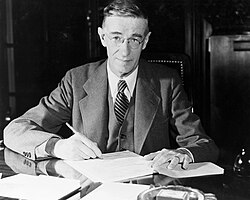 Vanivar Bush (photo 1940-44) | |
| Date of Birth | |
| Place of Birth | Everett , Massachusetts , United States |
| Date of death | |
| Place of death | Belmont , Massachusetts , United States |
| A country | |
| Scientific field | Futurology |
| Place of work | |
| Alma mater | Massachusetts Institute of Technology |
| supervisor | |
| Known as | one of the initiators of the National Science Foundation [4] |
| Awards and prizes | Medal of Louis Levy (1928) Gibbs Lecture (1935) Edison Medal (1943) The John Scott Medal (1943) Holly Medal (1943) Hoover Medal (1946) Washington Prize (1946) John Fritz Medal (1951) John Carti Award (1953) William Procter Award for Scientific Achievement (1954)  National Science Medal of the USA (1963) National Science Medal of the USA (1963) NAE Founders Award (1966) |
| Signature | |
Awarded the Edison Medal (1943). He was a member of the Masonic Lodge of Richard K. Maclorin in Cambridge, Massachusetts. [7]
Biography
Vanivar Bush was born in ( Massachusetts , USA) on March 11, 1890. In the family of Perry Bush, a local universalist pastor , and Emma Linwood (nee - Payne), he was the third child and only son. He was named after John Vanivar, an old family friend who studied with Perry at the same college. In 1892, the family moved to [8] (Massachusetts), where in 1909 Vanivar graduated from the local school [9] , after which, like his father, he entered Tufts College . Among the students, he was popular: in the second year Vanivar became the vice-president of his class, and in the third year - the president. In the last year, he was the manager of a football team. He became a member of the Society and met with Phoebe Clara Davis, who was also from Chelsea. In 1913, Vanivar received simultaneously bachelor's and master's degrees, as the Tufts College allowed it to his students. [10] For his master’s thesis, Venvar invented and patented [11] the “contour recorder” ( eng. Profile tracer ) in 1912. This device was designed for surveyors , it looked at the same time as a bicycle and a lawn mower , consisted of two bicycle wheels and a box with a writing mechanism and allowed to sketch the terrain of the area along which it was carried. [12] Despite the fact that this invention did not become commercially successful [13] , many of the principles laid down in it formed the basis of analog devices developed later by students of Vanivar. [14] [15]
After graduating from college, Bush worked at General Electric in Schenectady , New York , for $ 14 a week as a testing specialist: his job was to evaluate equipment safety. He was later transferred to the General Electric factory in (Mass.) To work with high-voltage transformers , but after a fire broke out there, Bush and other testers were suspended from work. In October 1914, he returned to Tufts, where he began to teach mathematics ; he spent the summer vacation of 1915 working as an electrical equipment inspector at the Brooklyn Naval Shipyard . Bush received a $ 1,500 scholarship to study for a doctorate ( Worcester , Mass.) From . But Webster wanted his new student to study the acoustics , and Vanivar chose to leave than to study an uninteresting topic. Later, Bush entered the electrical engineering department at the Massachusetts Institute of Technology . Desiring to secure financial stability for an emerging wedding [16] , in April 1916, he presented his dissertation entitled “AC Circuits: An Extension of the Theory of Generalized Angular Velocity, with Applications for Connected Circuits and Artificial Power Lines” [17] . His academic adviser, , insisted on conducting more in-depth research, but Bush refused, and Kennelli, influenced by the head of the department, succumbed. As a result, Bush received a combined Ph.D. from MIT and Harvard University , and in April 1916 he and Phoebe married. [16] Two sons were born in this marriage: Richard Davis Bush ( Richard Davis ) and John Hathaway Bush ( John Hathaway ). [18]
Bush accepted a job offer at Tufts College, where he took part in the American Radio and Research Corporation (AMRAD), which began music broadcasting from the campus on March 8, 1916. The station’s owner, Harold Power, hired him to head the lab with a salary higher than Bush received at Tufts. In 1917 , after the United States entered World War I , he went to work for the . Here Vanivar tried to develop a means of detecting submarines by disturbing the Earth’s magnetic field . His device functioned, but only from wooden ships; Attempts to make the system work with metal ships, such as destroyers , have failed. [nineteen]
In 1919, Bush left teaching at Tufts and moved to the electrical engineering department at MIT, where he began working under the leadership of . In 1922, in collaboration with William G. Timbie, a university colleague, he wrote an introductory textbook called Principles of Electrical Engineering . All this time, Bush continued to work at AMRAD, but lucrative contracts concluded during the war were now canceled. Vanivar tried to correct the company's position by developing a thermostat in his spare time, invented by AMRAD technician, Al Spencer. The company's management did not become interested in the device, but did not object to its sales. With financial support from Lawrence C. Marshall and , Bush helped set up the Spencer Thermostat Company and became its consultant. Soon the new company had an income of over a million dollars. [20] In 1931, it merged with the General Plate Company and became known as Metals & Controls Corporation. In 1959, she joined Texas Instruments , and in 2006, was bought. Finally, in 2010, it again became an independent company and became known as Sensata Technologies . [21]
In 1924, Bush and Marshall teamed up with physicist Charles Smith ( Charles G. Smith ), who invented the gas rectifying tube (S-tube). This device allowed radios , for which two different types of batteries were previously needed, to operate from a home electrical network . On July 7, 1922, the foundation of the new company, the American Appliance Company , and the promotion of the invention on the Marshall market invested $ 25,000; Bush, Marshall and Smith joined the five directors. The risky business made Bush rich, and the company now known as Raytheon eventually became a major electronics manufacturer and supplier to the US military. [20] [22]
Starting in 1927, Bush began creating a differential analyzer , an analog computer that could solve differential equations with 18 independent variables. This invention arose as a continuation of the work of one of the undergraduates of Bush, Herbert R. Stewart, who, at the suggestion of his supervisor, developed the integrafe , a machine for solving differential equations of the first order. Another student of Bush, , proposed an improvement to this device to be able to solve second-order equations. Vanivar immediately realized the potential of this invention: second-order equations were much more complicated, and, moreover, they were often met in physics. Under the leadership of Bush, Hazen was able to construct a differential analyzer, a table-like set of axes and handles, which mechanically simulated and traced a given equation. But, unlike previous developments, which were purely mechanical, the differential analyzer also had an electronic part. [23] Among the engineers who found the use of the new device was from General Electric, who with his help solved the problems associated with the transmission of electrical energy. [24] In 1928, Bush was awarded the Medal for the creation of a differential analyzer . Louis Levy from . [25]
An offshoot of the work carried out at MIT was the beginning of the development of the theory of digital circuit design by one of Bush’s graduate students, Claude Shannon . [26] Working on an analytical machine, Shannon described the application of Boolean algebra to electronic circuits in his historical master's thesis, “ ”. [27] In 1935, contacted Bush (Section G of the 20th Division of the Navy Communications Directorate within the Office of Naval Operations, dealing with communications security), who wanted to receive an electronic device for breaking ciphers . For the Rapid Analytical Machine model, Bush received a fee of $ 10,000. The project exceeded the budget and was not completed until 1938, and the car itself turned out to be unreliable in operation. Nevertheless, it was an important step towards the creation of such a device. [28]
In 1930, the reorganization of the MIT management began, and Carl T. Compton was appointed President of the Institute. Soon, Bush and Compton were confronted with the question of limiting external counseling for professors, and Bush quickly lost this confrontation; however, they soon built strong professional relationships. In 1932, Compton appointed Bush to the newly approved post of vice president. In the same year, Vanvar became also the dean . The total salary of Bush was 12 thousand dollars (not counting 6 thousand costs) per year. [29]
War years
Carnegie Institute of Science
In May 1938, Bush accepted a prestigious appointment as president of the newly formed Carnegie Institute of Science in Washington. The institute's fund was $ 33 million, and every year it invested $ 1.5 million in research, most of which went to one of its eight major laboratories. The inauguration took place on January 1, 1939, Bush’s salary was 25 thousand. The appointment allowed him to influence the policy on research in the United States at the highest level, and also, informally, to advise the government on scientific issues. [30] Soon, Bush discovered that the institute had serious financial difficulties, and had to ask Carnegie Corporation for additional funding. [31]
Bush had a conflict over leadership with chairman William Forbes and his predecessor John Merriam , who continued to give unwanted advice. Harry H. Laughlin , the head of the Eugenics Record Office , was a major hindrance to all of them, whose activities Merriam tried unsuccessfully to curtail. Bush made his first priority to remove Laughlin, because he considered him a rogue scientist, and one of the first orders of Vanivar was a request for an assessment of his activities. In June 1938, Bush asked Laughlin to resign, proposing an annual payment, which Laughlin reluctantly agreed. The “Eugenic Government Archive” was renamed the “ Genetics Record Office ”, its funding was radically reduced, and in 1944 it was completely closed. [31] Senator Robert Reynolds tried to reinstate Laughlin, but Bush informed board members that investigating Laughlin’s case would only “show his physical inability to manage the archive, and studying his academic reputation would be equally convincing” [nr 1] [32] .
Bush wanted the institute to focus on the hard sciences . He actually destroyed the archaeological program of the Institute, dropping this trend in the United States for many years ago. He did not see much sense in the humanities and social sciences , and he cut funding for Isis , which was devoted to the history of science and technology and their cultural influence. [31] Later, Bush explained: “I had serious doubts about these activities, where someone goes and interviews a handful of people, reads many things, writes a book, and then puts it on the shelf, and no one ever will read ” [note 2] [33] .
National Aeronautical Advisory Committee
On August 23, 1938, Bush was appointed to the position of the National Advisory Committee for Aeronautics (NACA), the predecessor of NASA . [30] His chairman, Joseph S. Ames , fell ill, and Bush, as his deputy, was soon forced to fulfill his duties. In December 1938, NACA asked for $ 11 million to create a new research laboratory for aeronautics in Sunnyvale, California, designed to help the existing Aeronautical Laboratory named after Langley ( Langley Memorial Aeronautical Laboratory ). The location was chosen due to its proximity to some of the largest aviation corporations. The decision was supported by Major General Henry H. Arnold , the head of the United States Air Corps , and Rear Admiral Arthur B. Cook , the head of the US Navy Aeronautics Administration , who planned to spend 225 million on the creation of a new aircraft. The US Congress , however, was not convinced of the significance of this project, and on April 5, 1939, Bush had to appear before the Appropriations Committee of the US Senate . For Vanivar, this was a disappointing experience, as he had never spoken before Congress before and had failed to incline the senators to his point of view. Additional lobbying was required before funding for the new laboratory, now known as the Ames Research Center , was finally approved. By that time, war broke out in Europe, and the inferiority of American aircraft engines became apparent, so NACA asked for funding for a third center in Ohio (now the Glenn Research Center , the Glenn Research Center ). After Ames retired in 1939, Bush became chairman of NACA, and George J. Mead ( George J. Mead ) - his deputy. [34] At this position, Vanivar remained until November 1948.
National Defense Research Committee
Even during the First World War, Vanivar Bush experienced the problems of interaction between the army and civilian scientists. Worried about the inconsistency of scientific research and defense mobilization requirements, Bush, after consulting with colleagues, proposed the creation of a general governing agency in the federal government . He instructed the NACA secretary to prepare a draft National Defense Research Committee ( NDRC ) for submission to the US Congress, but after the German invasion of France in May 1940, Bush decided that speed is critical in this matter and tried to meet with President Franklin D. Roosevelt personally. Through his uncle Roosevelt, Frederick Delano , Bush was able to gain an audience with the president on June 12, 1940, for which he took a single piece of paper describing the project. After 15 minutes, Roosevelt approved the proposal, writing on the “OK - FDR” sheet. [35]
Notes
- ↑ In the original: it was physically incapable .
- ↑ In the original: I’ve been reading it .
Sources:
- ↑ 1 2 http://www.ieeeghn.org/wiki/index.php/Vannevar_Bush
- ↑ 1 2 Encyclopædia Britannica
- ↑ SNAC - 2010.
- ↑ David F. Channell. The Computer at Nature's Core (Eng.) . Wired 12.02 (February 2004). The appeal date is March 26, 2010. Archived February 19, 2012.
- ↑ Events in the Life of Vannevar Bush
- ↑ Vannevar Bush Papers. (Library of Congress) (inaccessible link from 14-03-2014 [1960 days] - history , copy )
- ↑ Freemasons in Space
- ↑ Zachary, 1997 , pp. 12-13.
- ↑ Zachary, 1997 , p. 22
- ↑ Wiesner, 1979 , pp. 90-91.
- ↑ Bush V. Patent US 1,048,649 A: Profile-tracer (Eng.) . Google Patents (2 February 1912). The appeal date is October 5, 2014.
- ↑ Vannevar Bush's Profile Tracer (English) . National Museum of American History. The appeal date is October 5, 2014.
- ↑ Dalakov G. Biography of Vannevar Bush (English) . History of Computers and Computing. The appeal date is October 5, 2014.
- ↑ Kahn P. Profile Tracer (English) . Hypertext in Historical Context: Vannevar Bush and Ted Nelson Revisited . Massachusetts Institute of Technology (October 1, 1998). The appeal date is October 5, 2014.
- ↑ Zachary, 1997 , pp. 25-27.
- ↑ 1 2 Zachary, 1997 , pp. 28–32.
- ↑ Puchta, 1996 , p. 58.
- ↑ Zachary, 1997 , pp. 41, 245.
- ↑ Zachary, 1997 , pp. 33—38.
- ↑ 1 2 Zachary, 1997 , pp. 39-43.
- ↑ History of Our Company (English) (inaccessible link) . Sensata Technologies (2014). The date of circulation is October 8, 2014. Archived June 2, 2014.
- ↑ History of Raytheon Company (English) . FundingUniverse. The appeal date is October 8, 2014.
- Ens Owens L. Vannevar Bush and The Differential Analyzer: From the Memex to Hypertext: Vannevar Bush and The Mind's Machine / Ed. by V. Bush, JM Nyce, P. Kahn. - Boston: Academic Press, 1991. - P. 3-38. - ISBN 0125232705 .
- ↑ Brittain JE Electrical Engineering Hall of Fame: Vannevar Bush (Eng.) // Proceedings of the IEEE. - 2008. - Vol. 96, no. 12 - P. 2131-2133. - ISSN 0018-9219 . - DOI : 10.1109 / JPROC.2008.2006199 .
- ↑ Wiesner, 1979 , p. 106
- ↑ Shannon CE An Interview Conducted by Robert Price (Eng.) . Oral-History . IEEE Global History Network (28 July 1982). The appeal date is October 19, 2014.
- ↑ MIT Professor Claude Shannon dies; is a founder of digital communications . MIT News . Massachusetts Institute of Technology (February 27, 2001). The appeal date is October 19, 2014.
- ↑ Zachary, 1997 , pp. 76-78.
- ↑ Zachary, 1997 , pp. 55-56.
- ↑ 1 2 Zachary, 1997 , pp. 83-85.
- ↑ 1 2 3 Zachary, 1997 , pp. 91-95.
- ↑ Zachary, 1997 , p. 93.
- ↑ Zachary, 1997 , p. 94.
- ↑ Zachary, 1997 , pp. 98-99.
- ↑ Zachary, 1997 , pp. 104–112.
Literature
- On the Roof of Mathematics and Aims, IEEE Annals. - 1996. - Vol. 18, no . 4 . - P. 49-59. - DOI : 10.1109 / 85.539916 .
- Wiesner JB Vannevar Bush, 1890–1974 // Biographical Memoirs. - Washington, DC: 1979 National Academy of Sciences of the United States. - Vol. 50. - p. 88-117. - OCLC 79828818
- Zachary GP Endless Frontier: Vannevar Bush, Engineer of the American Century. - New York: The Free Press, 1997. - 528 p. - ISBN 978-0684828213 . - OCLC 36521020
Links
- Vanver Bush, How can we think
- Vannevar Bush
- Dalakov G. The MEMEX of Vannevar Bush (English) . History of Computers and Computing (2014). The appeal date is October 5, 2014.