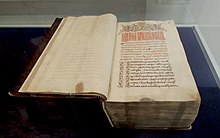
The Steppe Book is one of the largest monuments of Russian historical literature of the 16th century , telling about Russian history from ancient times until the 1560s. It incorporated a significant number of works of Old Russian bookishness, sometimes partially, and sometimes even completely. It also contains a number of unique news, the reliability of which has not been clarified.
It was written with the blessing of Metropolitan of Moscow and All Russia Makarii , probably for Tsar Ivan IV Vasilyevich the Terrible . The compiler of the Degree Book is the archpriest of the Annunciation Cathedral of the Moscow Kremlin, the confessor of Tsar Andrei (future Metropolitan Athanasius ) [1] .
Content
- 1 Ideological content
- 2 Historiography
- 2.1 Volkovsky list
- 2.2 Collecting Powerlists Lists
- 2.3 Vasenko's research
- 2.4 Tomsk list
- 2.5 Thematic areas
- 3 History of the manuscript tradition (text history)
- 3.1 Three types of text
- 4 See also
- 5 notes
- 6 Editions
- 7 Literature
Ideological Content
The Graduate Book was an attempt to systematically expound Russian history . It is divided into 17 faces or degrees and covers the time from the reign of Vladimir Svyatoslavich to Ivan IV (inclusive). The “Power Book” glorifies the Moscow monarchy and affirms the idea of the divine origin of autocratic power . The “Power Book” connects the origin of the reigning family with the Roman emperor Augustus , whose heirs were declared Kiev, and then Vladimir and Moscow princes. This 'August legend' is based on the Tale of the Princes of Vladimir .
The second set of ideas of the Power Book is devoted to the union of secular and spiritual power . The descriptions of the Russian princes and rulers are of a hagiographic character (the glorification of their “holy deeds” and “true piety”). Each facet also includes a biography of the "holiest" of the Russian metropolitans. The Power Book was in the 17th century one of the most popular historical works. The plots placed in it were previously reflected in the monumental wall painting of the 16th – 17th centuries (painting 1564–1565 of the Moscow Archangel Cathedral , etc.).
Historiography
A systematic study of the Degree Book began in the 19th century. In the XVIII century, Stepennaya was often attracted by researchers, but the content, and not the features of the monument as a historical source, was of most interest. V.N. Tatishchev suggested that the Degree Book was written at the end of the XIV - at the beginning of the XV century by Metropolitan Cyprian . This assumption was subsequently repeated by 18th century historians, but remained without argument.
At the end of the 18th century, the text of the Degree Book was published by G. F. Miller , who shared the point of view of V. N. Tatishchev regarding Stephenna’s authorship, but besides Cyprian, he named the second author, Metropolitan Makarii , in the title. During this period, scientists often turn to the information contained in the Degree Book. One of the assumptions about the authorship of the book: it was compiled on the initiative of Metropolitan Makarii, confessor of Ivan IV Vasilyevich Grozny, Andrei (future Metropolitan Athanasius ) between 1560 and 1563 .
So, MV Lomonosov uses it as one of the sources for his work “Ancient Russian history from the beginning of the Russian people to the death of Prince Yaroslav I or until 1054”. On the manuscripts that Lomonosov used, his litters are preserved. They are present, in particular, on the list of the Power Book, which was used by the scientist.
To the achievements of researchers of the XVIII century. should also include the first scientific characteristic of the Degree. So, G.Z. Bayer called the Stepbook the “main Russian chronicle” (das russische Haupt-Chronikon), and also pointed to the authority enjoyed by the work among Russian scribes.
The earliest surviving lists of the Degree Book are the mid-17th century.
For the first time, an attempt to study the actual text of the Degree Book was made in the 19th century . So, in 1813, in the " Herald of Europe " published by MT T. Kachenovsky, KF Kalaidovich published an article on the authorship of the Degree Book, where he first criticized the opinion on compiling the Degree Book in the time of Cyprian. The researcher also believed that he was not involved in the creation of the Degree Metropolitan Macarius.
Volkovsky list
Through the mediation of Kalaidovich, the Moscow Main Archive of the Ministry of Foreign Affairs acquired from the poet A. A. Volkov a collection of manuscripts, among which was a list of the Degree Book (now: Russian State Autonomous Academy. F. 181 (compiled MGAMID) 185). The researcher gave a description of the manuscript: “The book of the Degree of Tsarist Genealogy, containing Russian history; interrupted by the reign of Alexander Nevsky. From the table of contents it can be seen that the whole book was brought to the death of Tsar Vasily Ivanovich. “It is written in four semi-chasto and cursive writing in the XVI-XVII centuries.”
P.G. Vasenko, who familiarized himself with this manuscript a century later, dated it to the 17th century. Subsequently, A. V. Sirenov found that the Volkovsky list is a manuscript containing a draft of the Degree Book.
Graduate List Collection
The oldest lists of the Power Book are considered Tomsk, Chudovsky, and also the Volkov list.
P. M. Stroyev (1796-1876) made his first attempt at collecting Stepennaya lists in his Bibliographic Dictionary. 16 manuscripts are listed. I.P. Sakharov also indicated that he had a list of the Degree Book "without lives and words," which he considered the "Kiprianov Degree." Subsequently, P. G. Vasenko tried to find the list mentioned by Sakharov, but his attempt was not successful. In 1845, news was published of the discovery of another important list of the monument - the Chudovsky list. The find was not regarded as a sensation. I. P. Snegirev pointed to the presence in it of the mark “The book of the Chudov Monastery was compiled by the humble Athanasius, Metropolitan of All Russia.” In 1903, a monograph by N. S. Derzhavin on the sources of the Degree Book was published. The researcher identified Stephennaya with the hypothetical vault of the XIV century, “Vladimir Polychron.” This and some other conclusions seem incredible.
Vasenko Research
A new stage in the study of the Degree Book is associated with the activity of P. G. Vasenko , who for the first time publishes a monographic study on the history of the text of the monument (“The Book of the Degree of the Tsarist Genealogy” and its Importance in Old Russian Historical Writing "), and somewhat later - prepares the text of the Degree (It was carried out in 1908-1913.) The researcher compared 64 manuscripts containing the text of the monument, identified three main types of text.The criterion was the presence of certain articles in manuscript texts, as well as text defects. He was also inclined to believe that the author of the Degree Book was Metropolitan Athanasius, in particular, pointing to dating signs that fit between 1555-1563. The Degree Book is mentioned in the Life of Mikhail Klopsky, created in 1531. P. G Vasenko reviewed the earliest editions of the Life and noted that they did not mention Stephenna.
In 1904, a monograph dedicated to the Degree Book was published, which combined the material of previous articles. It was planned to publish its second volume, devoted to the influence of the Degree Book on Russian book writing. Materials for such a study were available, but P. Vasenko did not proceed with his analysis.
After the 1917 revolution, the study of the Degree Book was addressed only in the middle of the 20th century. N.K. Gudziy in "History of Ancient Russian Literature" in 1945 emphasized the need to study Stephennaya. In 1952, under his leadership, the dissertation of V.V. Kuskov , dedicated to the sources of the Degree Book, was defended.
Tomsk List
An important moment in the history of studying the manuscript tradition of the Degree Book was the discovery by N. N. Pokrovsky of a manuscript containing the text of the monument and stored in the Tomsk Museum of Local Lore (now TOKM 7903/2). The Tomsk list is one of the most ancient lists of the Stephenaya and, possibly, is somehow connected with Ivan IV the Terrible.
He first turned to the systematization of the manuscript tradition of the monument since the time of P. G. Vasenko D.O. Serov . His dissertation, “The Graduate Book of the Editorial Board of Ivan Yuriev” (L., 1991), is devoted to one of the later editions of the monument. The researcher, systematizing the manuscripts that comprise Stepennaya, examined the texts of additional articles and monuments that were next to Stepennaya in a particular manuscript. This classification differed from that proposed by P. G. Vasenko.
Thematic areas
Thus, in science there are several main thematic areas in the study of the Power Book. The first group of works examines the handwritten tradition of the Degree Book. Research in this direction was initiated by the efforts of P. G. Vasenko. Subsequently, D.O. Yuryev addressed the problem. However, his classification of the lists does not affect the features of the text of the Stepnaya herself, only pointing to the features of the manuscripts containing it. The history of the text of the Degree Book was reflected in the study of A. V. Sirenov, "The Degree Book: The History of the Text." On the basis of this textual classification of manuscripts with the text of the Graduation, the publication “The Graduate Book of the Most Ancient Lists” was produced (T. 1, T. 2).
The second direction was the study of the sources that were used in compiling the monument. After the work of V.V. Kuskov, this topic has not exhausted itself. The works of A. A. Zimin , D. N. Alshits , I. V. Kurukin, G. D. Lenhoff and A. S. Usachev are devoted to her. In the works of G. D. Lenhoff, D. N. Alshits, and others, the question of reflecting the ideology of the 60s of the 16th century is also touched upon.
Finally, the last direction can, with some exaggeration, be recognized as the question of studying the influence of the Degree Book on the literary and historical tradition of the 17th-18th centuries. The topic of such a study was announced by P. G. Vasenko, but the first study devoted to Stephenna’s connections with the later monuments of book writing - A. V. Sirenov ’s doctoral dissertation “The Power Book and Russian Historical Thought of the 16th – 18th Centuries.” - was published as a monograph in 2010 year.
The history of the manuscript tradition (text history)
To date, 145 Powerbook lists have been identified [2] . According to the features of the text, they can be divided into several groups.
It is believed that the oldest lists of the Degree Book, Tomsk and Chudovsky, were created in the Chudovsky scriptorium in 1566-1568. The text of the Miracle List is sometimes secondary to Tomsky [3] . Another important list, Piskarevsky, was made at the turn of the XVI-XVII centuries. [2] .
The so-called contaminated lists, in which the texts of various lists are mechanically connected, fall into a special category. Thus, they contain the features of lists of different groups.
Three types of text
In total, there are three main types of text. Type I includes lists, which contain a lengthy text with three introductory articles, the note "New Miracle Workers" and the Tale of the Miracles of Metropolitan Alexy. This is the so-called Wide Edition of the Power Book. A total of 33 manuscripts with similar features of the text of the Power were identified. Inside this type, two groups can be identified that have slight stylistic differences.
Type II includes manuscripts in which, on the contrary, there are no introductory articles, notes “New Miracle Workers” and Tales of the Miracles of Metropolitan Alexei. These manuscripts were copied from the oldest copies of the Degree Book - Tomsk and Chudovsky lists of it. In science, they are all classified as lists of the Brief Edition of the Degree.
Finally, type III includes manuscripts containing a text that is completely similar to the second, but with some gaps. This edition received the name of the edition of Jonah Dumin.
The MGAMID 185 (Volkovsky) list occupies a special position. The manuscript is written in 11 handwritings. The text of the Power Book in it sometimes seems to be abbreviated. The list dates from about the same time as the oldest lists - Chudovsky and Tomsky. The editor’s hand made corrections to the Volkovsky list of Stepnaya, which were subsequently taken into account when creating the Chudovsky and Tomsk lists. This gives reason to believe that the Volkovsky list was a draft (original) of the Degree Book.
First, a draft was made, in which the revision was made. The draft text was rewritten in the Chudovsky and Tomsk lists. These two lists served as archetypes for the two species of the Brief edition of the Stephenaya (respectively, for the Chudovsky and Tomsk species). In addition, with a draft in the late XVI-early XVII centuries. the so-called Piskarevsky list was made, to which the lists of the Wide Edition of the Degree Book go back.
Also at the end of the XVI century. a group of manuscripts is formed with the text of the Power Book, which does not go back to the archetype, but to the Short Edition of the Power Book. This is the edition of Jonah Dumin. Manuscripts with a similar text by Stepenna contain the text of the Dumina edition of the Life of Alexander Nevsky. In addition, a distinctive feature is some gaps in the text of the Power Book.
See also
- Russian annals
- Russian pre-Soviet historiography
- Latuhinskaya Degree Book (1676)
Notes
- ↑ DEGREE BOOK • Great Russian Encyclopedia
- ↑ 1 2 USACHEV A.S. (2008), MODERN RESEARCHES OF THE DEGREE BOOK. Russian History, ISSN: 0869-5687
- ↑ Pokrovsky N.N. (2012), Athanasius (Andrey in the world), Metropolitan of Moscow.
Editions
- "The book is a power ... Part I. 1775 "
- “The book is a power ... Part II. 1775 "
- The book of the Power of the Tsarist Genealogy // PSRL. St. Petersburg, 1908-1913.
- The Power Book of Tsarist Genealogy: Texts and Commentary / ed. ed. N.N. Pokrovsky, G.D. Lenhoff. M., 2007-2008. T. 1: The Life of St. Princess Olga, Degrees I — X; T. 2: Degrees XI — XVII. Applications Pointers.
Literature
- Tatishchev V.N. Russian History . M .; L., 1962.V.1. S. 84
- Kalaidovich KF News of the antiquities of the Slavic-Russians and Ignatius Ferapontovich Ferapontov, the first collector thereof. M., 1811.S. 14-15.
- Ikonnikov V.S. Experience of Russian historiography. Kiev, 1908. T. 2. book. 2, p. 1331.
- Vasenko P. G. Who was the author of the “Book of the Royal Tsarist Genealogy”? // ZhMNP . 1902. December. S. 289-306.
- Vasenko P. G. Printed edition of the “Book of the Royal Tsarist Genealogy” and the types of its lists // Izvestiya ORYAS. SPb., 1903. T. 8. book. 3.P. 99-126.
- Vasenko P. G. “The book of the Power of the Tsarist Genealogy” and its significance in the Old Russian historical writing. St. Petersburg, 1904, part 1.
- Okolovich N.F. Lives of saints placed in the Degree Book / Enters. article, publ. and comment. A. S. Usacheva . M .; SPb., 2007.
- Kuskov V.V. The power book as a literary monument of the 16th century: dis. for a job. student step. Cand. Phil. sciences. M., 1952.
- Kurukin I.V. Sylvester and compilation of the Life of Olga Degree Book // Theory and Practice of Source Studies and Archeography of Russian History. M., 1978.
- Sirenov A.V. Power book: history of the text / Otv. ed. N. N. Pokrovsky . - M .: Languages of Slavic cultures, 2007. - 544 p. - 800 copies. - ISBN 5-9551-0212-4 . (in per.)
- Sirenov A.V. Degree book and Russian historical thought of the XVI-XVIII centuries. / St. Petersburg State University. - M .; St. Petersburg: Alliance-Archeo, 2010 .-- 552 p. - 500 copies. - ISBN 978-5-98874-051-3 . (in per.)
- Pokrovsky N.N. Athanasius (Andrey in the world), Metropolitan of Moscow.
- Usachev A.S. Power book and monuments of Russian medieval lexicography // Ladder: Materials of a scientific conference on the problems of source study and historiography in memory of Professor V.P. Makarikhin. Nizhny Novgorod State University N.I. Lobachevsky (May 22, 2003). N. Novgorod, 2005.S. 248–258.
- Usachev A. S. International scientific conference "The book of the Power of the Tsarist Genealogy and Russian Historical Consciousness" (Los Angeles, February 26-28, 2009) // Ancient Russia. Questions of Medieval Studies . 2009. No. 2 (36). S. 121-124.
- Usachev A. S. “The Long XVI Century” of Russian Historiography // Social Sciences and the Present. 2008. No. 2. P. 104-115.
- Usachev A. S. Power book and Old Russian book writing of the time of Metropolitan Makarii / Otv. ed. Doctor of History A. A. Gorsky ; Российская государственная библиотека , Научно-исслед. отдел книговедения. — М.; СПб.: Альянс-Архео, 2009. — 760 с. - 1,000 copies. — ISBN 978-5-98874-039-1 . (в пер.)
- Богатырёв С. Н. Датировка Степенной книги // Древняя Русь. Questions of Medieval Studies . 2012. № 4 (50). С. 77-94.
- Ленхофф Г. Учреждение Казанской епархии и проект создания Степенной книги // Древняя Русь. Questions of Medieval Studies . 2012. № 4 (50). С. 95-107.
- Усачев А. С. Комментарии к Степенной книге: некоторые дополнения // Древняя Русь. Вопросы медиевистики. 2012. № 4 (50). C. 108—119. [one]
- Усачёв А. С. Личность составителя Степенной книги // Древняя Русь. Questions of Medieval Studies . 2009. № 2 (36). С. 34-47
- Усачёв А. С. К вопросу о датировке степенной книги // Древняя Русь. Questions of Medieval Studies . 2005. № 4 (22). С. 28-40.
- Усачёв А. С. Древнерусская книжность эпохи митрополита Макария: Книга степенная царского родословия: автореф. дис. … д-ра ист. наук. М., 2010 (недоступная ссылка) .
- «Юрьевская степенная книга» — памятник исторической мысли
- На иностранных языках
- Gail Lenhoff, «How the Bones of Plato and Two Kievan Princes Were Baptized: Notes on the Political Theology of the Stepennaja kniga.» Welt der Slaven 46, 2 (2001): 313—330.
- Gail Lenhoff, «The Tale of Tamerlane in the Royal Book of Degrees.» The Place of Russia in Eurasia. Lorand Eotvos University Press, Budapest, 2001: 121—129.
- The Book of Royal Degrees and the Genesis of Russian Historical Consciousness / Ed. by G. Lenhoff, A. Kleimola. Bloomington; Indiana, 2011.