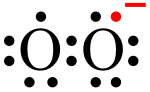
Superoxide (superoxide radical, superoxide anion) is an ion of an oxygen molecule with an unpaired electron. Formula . Refers to free radicals , short-lived (from milliseconds to seconds), is able to spontaneously dismute with water into oxygen and hydrogen peroxide . It has paramagnetic properties.

Superoxide is formed when an oxygen molecule captures one additional electron and is partially reduced (fully reduced oxygen is in the water molecule), as well as under the action of ionizing radiation . Superoxide is formed, for example, by the interaction of potassium superoxide with water or by the interaction of paraquat with some enzymes of the photosynthetic system of plants in green leaf cells.
Superoxide belongs to the active forms of oxygen and plays a huge role in oxidative stress .
Superoxides are also called superoxides .
Cell Education
Superoxide radical is constantly formed in the cell under normal physiological conditions . The main source of superoxide is the respiratory chain of mitochondria . In addition, it can be formed enzymatically by the action of enzymes such as NADPH oxidases , and in some pathophysiological conditions, xanthine oxidase and NO synthases .
See also
- Singlet oxygen
- Active oxygen species
- Reactive Nitrogen Forms
- Chloride Channel 3