Benghazi Cathedral ( arab. كاتدرائية بنغازي, ital. Cattedrale di Bengasi ) is a former Catholic church located in the city of Benghazi , Libya . The temple was the cathedral of the apostolic vicar of Benghazi .
| The cathedral | |
| Benghazi Cathedral | |
|---|---|
| كاتدرائية بنغازي, Cattedrale di Bengasi | |
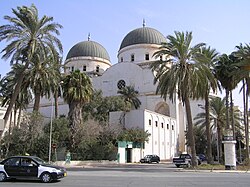 Catholic cathedral in benghazi | |
| A country |  Libya Libya |
| City | Benghazi |
| Denomination | |
| Diocese | |
| Architectural style | |
| Architect | and |
| Construction | 1929 - 1939 |
| condition | former cathedral closed today |

Content
- 1 History
- 2 Architecture
- 3 Source
- 4 References
History
The construction of the temple began in 1929, when Libya was a colony of Italy and was completed in 1939. The church in the neoclassical style was designed by Italian architects Ottavio Cabiati and Guido Ferrazzi.
After independence, the cathedral was nationalized and used as the headquarters of the Arab Socialist Union . The church is currently abandoned.
Architecture
The temple was built in the form of a basilica with an area of 65 by 30 meters. The facade is framed by two square towers, each of which is crowned with small domes. The main dome, located above the apse , is surrounded by eight spiers. The interior is divided by three nefami , which are separated by arches, decorated with stucco molding in the style of arabesque. Stained glass windows are also decorated with arabesques. The bell of the church weighs about 6 tons.
Source
- Alexandre Pons, La nouvelle Église d'Afrique ou le catholicisme en Algérie, en Tunisie et au Maroc depuis 1830. ed. Librairie Louis Namura, Tunis, 1930