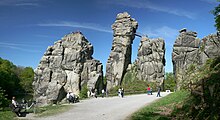

Exer stones (as well as the Egster, Eger or Eger stones) are a group of rocks in the Teutoburg Forest near Horn-Bad Meinberg , in the Lippe region of North Rhine-Westphalia . It consists of a series of colossal pillars and blocks of sandstone stretching from the northwest to the southeast for almost a kilometer, collapsing in some places and representing huge, almost sheer walls.
At the bottom of the highest and widest of these rocks, a cave chapel was cut down, consecrated, as can be seen from the inscription that fell with it, in 1115 . Outside, at the entrance to this chapel, most likely, around the same time, a figure of the Apostle Peter was carved on a rock, on the one hand, and on the other, a relief about 5 meters high, about 4 meters wide, depicting in its upper part Descent from the Cross ”is one of the most remarkable works of Byzantine-Romanesque art .
Despite the fact that the stone has greatly weathered and some places of the relief have been beaten off or fell off, it still amazes with the grandeur of the composition and gives an excellent idea of the great step forward made by the sculpture at the beginning of the XII century compared to the previous time. The figures in it are not as short as before, and the Savior is presented even too long. Two bearded figures ( Nicodemus and Joseph of Arimathea ) take off the lifeless body of Christ from the cross; The Virgin Mary supports the head of her Son, and in her pose an attempt is made for expression (the face of the Virgin has completely erased). On the other side of the cross stands the gloomy Apostle John . Above is a picture of God the Father bending over the body of Christ, he blesses His right hand, and in a shuytsa keeps His spirit, flew out of the body, and a triumphant banner .
To the right and left of God the Father are common in the era to which this monument of art belongs, the personifications of the crying Moon and Sun. The rest of the Byzantine influence can be seen here only in the correct location and in the pettiness of dressing folds on draperies, yet the rest has a purely Roman character: the sculptor performed his task, albeit with infant ineptitude, but apparently with sincere animation, freedom and meaning.
The lower part of the relief was an allegorical image of the Last Judgment , but it was damaged to such an extent that it is completely impossible to recognize its composition.
Both the Exterian Chapel and the reliefs with it are probably the essence of the work of the monks of the Addingof Monastery located near it.
During World War II, these places were actively studied by the head of the SS, Heinrich Himmler .
Literature
- Exer stones // Brockhaus and Efron Encyclopedic Dictionary : in 86 volumes (82 volumes and 4 additional). - SPb. , 1890-1907.