Diademodon [1] ( lat. Diademodon ) is a genus of Early Triassic therapside from the group of cynodonts .
| † Diademodons |
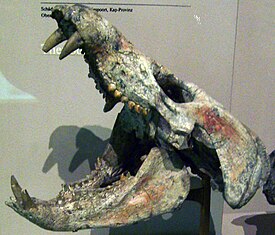
Skull Diademodon mastacus at the Berlin Museum of Natural History |
| Scientific classification |
|---|
| No rank : | Bilateral symmetrical |
| Infrastructure : | † Eucinodonts |
|
| International scientific name |
|---|
Diademodon Seeley , 1895 |
| Kinds |
|---|
- Diademodon laticeps Brink, 1955
- Diademodon tetragonus Seeley, 1894
|
Geochronology252.2-228.0 Ma | million years | Period | Era | Aeon |
|---|
| 2,588 | Even | | | Ka | F
but
n
e
R
about
s
about
th | | 23.03 | Neogene | | 66.0 | Paleogen | | 145.5 | a piece of chalk | M
e
s
about
s
about
th | | 199.6 | Yura | | 251 | Triassic | | 299 | Permian | P
but
l
e
about
s
about
th | | 359.2 | Carbon | | 416 | Devonian | | 443.7 | Silur | | 488.3 | Ordovician | | 542 | Cambrian | | 4570 | Precambrian |
◄ Nowadays◄ Cretaceous-Paleogene extinction◄ Triassic extinction◄ Mass Permian Extinction◄ Devonian extinction◄ Ordovician-Silurian extinction◄ Cambrian explosion |
|---|
|

Diademodon sp. (
reconstruction )
They were of different sizes, the largest ones reached the size of a large dog (however, they had fairly short paws), were 2 m long with a tail, and were one of the largest cynodonts. Like other cynodonts, they were probably omnivores, fed on plant foods as well as other animals and carrion. Fossil remains of various members of the genus, estimated at 228–252 Ma (Early Triassic ), were found in South Africa ( Namibia , Zambia ), southern South America ( Argentina , the geological formation Rio Seco de la Quebrada) and Antarctica ( Fremouw formation).
