Erich Mendelssohn ( German: Erich Mendelsohn - Erich Mendelsohn , March 21, 1887 , Allenstein , East Prussia - September 15, 1953 , San Francisco , USA ) - German architect, expressionist (in the 1920s) and functionalist - in later works .
| Erich Mendelssohn | |
|---|---|
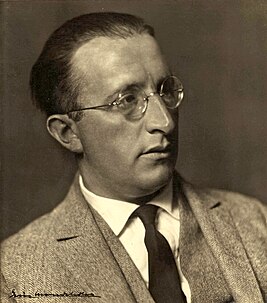 Erich mendelsohn | |
| Basic information | |
| A country |  German Empire German Empire  Weimar Republic Weimar Republic  USA USA |
| Date of Birth | March 21, 1887 |
| Place of Birth | Allenstein , East Prussia , German Empire |
| Date of death | September 15, 1953 (66 years old) |
| Place of death | San Francisco , USA |
| Work and Achievements | |
| Study | |
| Worked in the cities | Potsdam , Stuttgart , Nuremberg , Chemnitz , Luckenwalde , Breslau , Berlin , Essen , Königsberg , Tilsit , Gliwice , Duisburg , Cologne , Oslo , Bexhill-on-Sea , Buckinghamshire , London , Leningrad , Jerusalem , Haifa , Rehovot , Yag Francisco , St. Louis , Washington , Baltimore , St. Paul , Grand Rapids , Cleveland , University City |
| Architectural style | Expressionism , New Construction , Functionalism |
| The most important buildings | |
| Awards | Guggenheim Fellowship |
Content
Biography
Born in the city of Allenstein in a family of Jewish immigrants from Poland . He studied at the Higher Technical Schools in Charlottenburg , ( Berlin ) and the Higher Technical School in Munich (1907-11) with Theodor Fischer . In 1911-1914 he became close to the group of V. Kandinsky "The Blue Horseman ". In 1919, together with Ludwig Mies van der Rohe , Walter Gropius and Peter Behrens, he organized the “ November Group ” ( German Novembergruppe ), uniting like-minded architects. Then he opened his workshop in Berlin , which soon became one of the most famous architectural bureaus in Germany. His first works - the famous Einstein Tower in Potsdam (1917-21), the Shocken department stores in Stuttgart (1926), Nuremberg and Chemnitz (1926-29) provided the architect with public attention.
Soon, Mendelssohn visited the Netherlands, and here he was impressed by the work of expressionist architects. Upon his return to Germany, he built the hat factory in Luckenwald (1921-23), reminiscent of the early work of the architect Dudok . The study of the design features of materials was reflected in the projects of department stores built by Erich Mendelssohn in Breslau , Stuttgart , Chemnitz and Berlin (1927-31).
In 1933 he fled from Nazi Germany, lived for some time in Great Britain (1933-1934 and 1939-1941) and in Palestine (1934-1939), and from 1941 he finally moved to the United States .
In his first constructions, which brought the author international recognition, Mendelssohn was clearly influenced by expressionist modernism. These include, first of all, the Einstein Tower , later attached to the Astrophysical Institute in Potsdam (1920-1924) and the building of the hat factory in Luckenwald (which at that time belonged to Brandenburg , 1921-1923), as well as the Shocken department stores in Nuremberg (1926 ), Stuttgart (1926-1928) and other cities and Columbushaus in Berlin , (1929-1933).
In the same way, expressionist modernism was embodied in Mendelssohn's projects for the Soviet Union . This is, first of all, the innovative project of the complex of constructions of the Krasnaya Znamya knitting factory in Leningrad (1925), on which the building of the power substation of this factory was built (the rest of the project was subsequently changed by other architects), as well as the unrealized competitive design of the Palace of Soviets in Moscow ( 1932).
Mendelssohn’s projects in Eretz Israel , thanks to their courtyards, covered walkways, as well as the contrasting combination of concrete and local stone species, are well suited to climate conditions and terrain features and blend in seamlessly with the environment. These include: Shocken's house and library, 1936-1937; Hadassah Hospital on Mount Scopus , 1936-1938; Anglo-Palestinian Bank, 1938-1939, now Leummy Le Israel Bank, and others (all of the listed buildings are in Jerusalem ). Also, according to Mendelssohn's projects, two hospitals were built in Haifa , 1937-1939; the house of Chaim Weizmann , 1936-1937; Hebrew University Agricultural Department, Wolf Lab, now part of the Chaim Weizmann Research Institute in Rehovot , 1939-1941; Titz trade school in the kibbutz Yagur, 1937-1939. They constituted an important milestone in the development of Israeli architecture.
Mendelssohn's American projects include: the Maimonides Hospital in San Francisco ( 1948 ), the synagogue center in St. Louis ( Missouri , 1950 ), as well as the synagogues in Washington , Baltimore ( Maryland ) and St. Paul ( Minnesota) ) In the USA, Mendelssohn also taught a lot: in 1941-1945. at Columbia , Yale , Harvard and Michigan universities, since 1947 - at the University of California .
Selected Architectural Projects and Buildings
Germany
- Workers 'colony for the builders' union in Luckenwald ( 1919 - 1920 )
- Garden Pavilion for the Gerrmann Family, Luckenwalde ( 1920 )
- Factory building of the hat factory of Gerrmann, Luckenwalde ( 1919 - 1920 )
- Reconstruction of the administrative building of the Hausleben Insurance Company, Berlin ( 1920 )
- Einstein Tower (Observatory on Mount Telegrafenberg in Potsdam , 1917 or 1920 - 1921 .
- Double villa on the Carolingerplatz square in Berlin ( 1921 - 1922 )
- Steinberg Hat Factory Building, Luckenwalde ( 1921 - 1923 )
- Mosse House, Berlin ( 1921 - 1923 )
- Weichmann Silk Factory, Gliwice , Silesia ( 1922 )
- Villa of Dr. Steenefeld, Berlin ( 1923 - 1924 )
- knitting factory "Red Banner" in Leningrad ( 1924 - 1926 )
- The building of the fur factory “C. A Herpich and Sons”, Berlin ( 1924 - 1929 )
- Department stores Shocken, Nuremberg ( 1925 - 1926 )
- Reconstruction of the Cohen & Epstein Department Store, Duisburg ( 1925 - 1927 )
- Cottage of Dr. Beiach , Steinshtukken ( 1926 - 1927 )
- Shocken Department Store in Stuttgart ( 1926 - 1928 )
- Exhibition Pavilion of the Rudolf Mosse Publishing House at the Pressa Exhibition in Cologne ( 1928 )
- Rudolph Petersdorff's Store, Breslau ( 1927 - 1928 )
- The Woga and Universum-Kino complex in Berlin ( 1925 - 1931 )
- Jewish cemetery, Koenigsberg , East Prussia ( 1927 - 1929 )
- Shocken Department Store, Chemnitz ( 1927 - 1930 )
- Own house on Am Rupenhorn Street in Berlin ( 1928 - 1930 )
- German Metalworkers Union Building, Berlin-Kreuzberg ( 1928 - 1930 )
- Columbus House , Potsdamer Platz , Berlin ( 1928 - 1932 )
- Jewish Youth Center, Essen ( 1930 - 1933 )
- The Masonic Lodge of the Three Patriarchs, Tilsit (1925-1926)
Norway
- Dobloug Garden Store, Oslo , Norway ( 1932 ), designed by Mendelssohn
UK
- The De La Warr Pavilion, Bexhill-on-Sea , Sussex , England ( 1934 )
- Nimmo House, Buckinghamshire , England ( 1933 - 1935 ).
- Cohen House, Chelsea, London ( 1934 - 1936 )
- Gilby Building Camden , London ( 1935 - 1936 )
Israel
- Villa Weizmann, campus of the Ziv Institute (now the Weizmann Institute), Rehovot near Tel Aviv ( 1935 - 1936 )
- at the same time, a complex of three buildings of the Weizmann Institute was built
- Salman Shocken's Villa and Library, Jerusalem ( 1934 - 1936 )
- Hebrew University of Jerusalem ( 1934 - 1940 )
- University of Hadassah Hospital, Jerusalem ( 1934 - 1939 )
- Anglo-Palestinian Bank Building, Jerusalem ( 1936 - 1939 )
- The building of the government hospital, Haifa ( 1937 - 1938 )
USSR
- Textile factory " Red Banner ", Leningrad architectural monument (newly discovered object) [2] ( 1925 - 1926 ). According to the Mendelssohn’s project, only a power substation was built, now recognized as a local architectural monument. The rest of the factory complex was completed in 1926-1928 and 1934-1937 according to the modified project [3] (the project’s senior architect was I. A. Pretro , with the participation of architect S. O. Ovsyannikov and engineer E. A. Tretyakov ).
- Competitive project of the Palace of Soviets (1932, not implemented).
USA
- The B'Nai Amoona Synagogue, currently the Center for Creative Arts, University of the City of Missouri ( 1946 - 1950 )
- Maimonides Hospital, San Francisco ( 1946 - 1950 )
- Synagogue Park, Cleveland , Ohio ( 1946 - 1953 )
- Russell House, San Francisco ( 1947 - 1951 )
- Emanu-El Synagogue, Grand Rapids , MI ( 1948 - 1954 )
- Synagogue Mount Zion, St. Paul, Minnesota ( 1950 - 1954 )
Notes
- ↑ https://www.berlin.de/landesdenkmalamt/denkmalpflege/erkennen-und-erhalten/wohnhaeuser/haus-dr-bejach-639726.php#1
- ↑ Included in the “List of newly discovered objects of historical, scientific, artistic or other cultural value” (approved by order of the KGIOP dated February 20, 2001 No. 15 as amended on December 1, 2010).
- ↑ M.L. Makogonova. Erich Mendelssohn in Leningrad: factory “Red Banner” // In coll. Nevsky Archive, issue II. - M; St. Petersburg: Atheneum; Phoenix, 1995. ISBN 5-85042-033-9 , ISBN 5-85042-032-5 (erroneous) ; see also [1] , [2]
Links
- Wikimedia Commons has media related to Erich Mendelssohn
- Mendelzon, Erich - article from the Great Soviet Encyclopedia .
- Mendelzon, Erich // Encyclopedia " Around the World ."
- Mendelssohn, Erich - article from the Electronic Jewish Encyclopedia