Hidetaka Nishiyama (西山 英 峻 Hidetaka Nishiyama) is a famous Japanese karate master, Shotokan . The owner of the 10th Dan Karate. He was one of the students of the legendary master Funakoshi Gitin (Gichin Funakoshi), the founder of the karate style Shotokan. A world-famous teacher, author of numerous educational films, books about karate. President of the International Federation of Traditional Karate (ITKF).
| Hidetaka Nishiyama | |
|---|---|
| jap. 西山 英 峻 | |
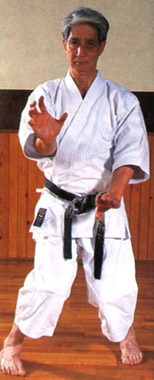 | |
| Date of Birth | October 10, 1928 |
| Place of Birth | Tokyo |
| Date of death | November 7, 2008 (aged 80) |
| Place of death | Los Angeles |
| A country | |
| Occupation | |
Biography
Hidetaka Nishiyama was born on October 10, 1928 in Tokyo.
My father worked as a lawyer, and they say he was a good kendo master. In addition to Hidetaki, the family had two more daughters, Sumiye and Michiko. Nishiyama, like many in Japan, began to engage in martial arts rather early. Since karate in those years was not yet as popular as it is now, children were usually sent to judo or kendo schools. At the age of five (1933), his father brings him to one of the most prestigious kendo schools in the city, where he begins to study under the guidance of master Moorio Mochida.
At 10 years old (1938) he also began to study judo, having received a black belt by the age of 14.
In 1943, Nishiyama receives 1 dan in kendo (in this type of martial arts he will reach 3rd dan) and begins to study karate Shotokan under the guidance of the founder of the style, the legendary master Funakoshi Gitina (Gichin Funakoshi).
During World War II, until its end, Nishiyama served in the Imperial Navy of Japan .
After the war (1945), he entered Takushoku University in Tokyo, where he continued his studies of karate. Becomes a member of the university karate team and actively trains under the guidance of Sensei Nakayama Masatoshi . Four years later (1949), he was elected captain of the team. In the same year, he actively participated in the creation of the Japan Karate Association (JKA), became one of the founders and the first chairman of the All Japan Collegiate Karate Union.
1946 - the first dan in karate. 1948 - the second dan in karate. 1950 - Funakoshi Gitin certifies him for 3 dan karate.
After graduating from university in 1951, Nishiyama received a master's degree in economics, and for some time worked at Shell oil company. But active participation in JKA required more and more free time, so there was no longer any talk of any other work and he finally decided to devote his life to karate. In the same year he becomes a co-founder of JKA and is a member of the Board of Directors of the Association. He takes an active part in the development of the first rules for kata and kumite competitions. Develops a JKA instructor training program.
In 1952, Nisiyama, along with Masatoshi Nakayama and Isao Obata, taught karate to U.S. military personnel on a strategic basis for the United States Air Force (SAC).
The following year, U.S. Air Force General Curtis LeMay invites a group of martial arts professionals, including Nishiyama, to tour the U.S. air bases on mainland North America. The group included six judo masters, led by a Kotani master (Sumiyuki Kotani, chief instructor of the Kodokan international department), Aikido master Kenji Tomiki, and three karate experts - twenty-five-year-old Hidetaki Nishiyama, forty-year-old Toshio Kamada and six Isao Obata is the oldest and most experienced student of Funakoshi. For three months, the group visited 53 military bases, flying around almost the entire country. This was the first official visit to the United States by karate experts.
In 1960, Nishiyama co-authored with R. Brown published his first book, Karate: The Art of Empty-Hand Fighting. The book became popular only, which is only in English, was reprinted more than 80 times, and is still one of the best-selling karate books.
In June 1960, Nishiyama received 5th dan in karate Shotokan.
At the invitation of his students from the SAC (American Strategic Military Air Base) in July 1961, Nishiyama moved to the United States, where under his leadership the All American Karate Federation (AAKF) would be created. Four years later, in 1965, under the auspices of the federation, the first international karate tournament was held, where athletes from the USA and Japan met.
And in 1968 he organized the first World Karate Tournament, which took place at two venues: in Los Angeles (California, USA at the Los Angeles Memorial Sports Arena) and in Mexico City (Mexico). Representatives of teams from Asia, Europe, North and South America were invited to the tournament.
In 1973, Nishiyama became the co-founder and first chairman of the Pan American Karate Union (PAKU).
The popularity of karate by that time had increased markedly, many national karate federations had appeared all over the world, and the question of creating an international organization was urgently needed. September 27, 1974 at the constituent assembly in New York, the International Amateur Karate Federation (IAKF) was created. Nishiyama was elected Executive Director of IAKF. In 1975, the IAKF holds its first World Karate Championships in Los Angeles. (In May 1986, the IAKF was renamed the International Federation of Traditional Karate (ITKF)).
In 1979, in accordance with the American law governing social, national, amateur, sports organizations, the All American Karate Federation, retaining the acronym AAKF, was renamed the American Amateur Karate Federation, which became public a nonprofit corporation, and Nishiyama was elected its first president.
Throughout the 1980s, Hidetaka Nishiyama has held various managerial posts, including the president of JKA International, chairman of AAKF, president of ITKF. Travels around the world conducting karate workshops.
In 1986 appears on the cover of Black Belt magazine.
In 1989, he published the “Traditional Karate Coach's Manual”.
On October 10, 1999, in recognition of Nishiyama's ten-year effort in Traditional Karate, and his contribution to the physical and psychological health of Americans, the US national flag was raised above the Capitol in Washington, in honor of Nishiyama’s seventy-first birthday.
In May 2000, in Moscow, for the first time in Russia, a representative international tournament in Traditional Karate was held, named in his honor the “Nishiyama Cup”.
In November 2000, the Emperor of Japan awarded Nishiyama the Order of Merit of the fourth degree, decorated with the Order of the Holy Treasure, for his great contribution to the spread of Japanese culture through Traditional Karate.
In October 2001, he was awarded the Polish Republic Prize - the President of Poland, Alexander Kwasniewski, presented him with one of the highest awards in Poland, the Cross of the Officer of the Order of Merit for the Republic of Poland, on the occasion of the first World Cup in Traditional Karate.
Despite his fairly advanced age, Nishiyama led a rather active lifestyle: he trained at the National Karate Institute (also known as the Los Angeles Central Dojo), traveled through seminars, exams and competitions around the world and personally led the administrative staff of the ITKF International Bureau and AAKF National Office.
Hidetaka Nishiyama passed away at the age of 80 on November 7, 2008 in Los Angeles, California. He left his wife Yoko (Yohko), and daughters: Yumi, Amy and Nami (Yumi, Amy and Nami).
On October 10, 2009, ITKF posthumously awarded Sensei Hidetaki Nishiyama the 10th dan; his daughter Nami accepted this honor on his behalf. ITKF Chairman Richard Jorgensen recalls: “Nishiyama always said that he didn’t want to reach the level of 10th dan, because he believed that getting the highest rank would mean the end of his studies, life ... In life, he would never have accepted him. ”