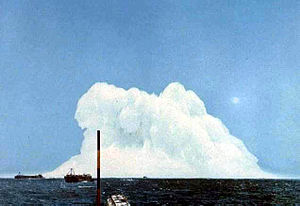
Underwater nuclear explosion - a nuclear explosion in water at a certain depth. Such explosions can be used to destroy underwater and surface targets, hydraulic structures and other objects. [one]
Content
Classification
The given height (depth) of the charge in meters per ton of TNT equivalent in a cubic root (in brackets is an example for an explosion with a capacity of 1 megaton) [lit 1](C. 146 et al.) [ Specify link ] , [lit 2] (S. 26) :
- At shallow depths: less than 0.3 m / t 1/3 - water evaporates to the surface and no column of water (explosive sultan) is formed, 90% of the radioactive contamination leaves the cloud, 10% remains in the water (less than 30 m)
- With the formation of an explosive sultan and a cloud of the sultan: 0.25–2.2 m / t 1/3 (25–220 m)
- Deep-sea: deeper than 2.5 m / t 1/3 - when the bubble forms on the surface with the formation of the sultan, but without a cloud, 90% of the radioactive products remain in the water in the region of the explosion and no more than 10% come out with splashes of the base wave (deeper than 250 m).
A transitional case between an underwater and ground nuclear explosion is also possible, in which an underwater bottom funnel is formed and water and soil are ejected:
- during an underwater bottom explosion [lit 3] (P. 308) , and if the explosion is in a shallow body of water and at a distance from the bottom to 0.1–0.2 m / t 1/3 (up to 10–20 m), then the soil from the underwater funnel enters the cloud of the explosion and serves as a source of infection.
Features of the manifestation of an underwater explosion
In an underwater explosion, the heat wave leaves the charge no further than a few meters (up to 0.032 m / t 1/3 or 3.2 m for 1 Mt) [lit 1] (P. 747) . An underwater shock wave forms at this distance. Initially, the front of the shock wave is also the boundary of the bubble, but after several meters of expansion, it ceases to evaporate water and breaks away from the bubble.
Light radiation during an underwater explosion does not matter and may not even be noticed - water absorbs light and heat well.
Shockwave
An underwater shock wave is a very effective damaging factor for military watercraft (ships and especially submarines), since the aquatic environment conducts oscillations almost without loss and the shock wave preserves destructive energy over long distances. The radius of destruction of durable surface ships at a low air and shallow underwater explosion is approximately the same, but submarines when submerged are vulnerable only to an underwater explosion. The exit of a shock wave to the surface is accompanied by several phenomena.
Bang Dominic Swordfish.
Dome and "smooth surface".
Nuclear submarine explosion Dominic Swordfish.
"White flash" around the dome.
Dominic Swordfish - the surface of the water before the explosion.
Dominic Swordfish - shockwave and spray exit.
Dominic Swordfish - A spray dome appears.
Hardtack Wahoo Blast Spray Dome up to 270 m high
In the region of the epicenter, due to the reflection of the wave from the water-air boundary, the surface layer dispersed by the reflected wave up to several tens of cm thick comes off with the phenomenon of cavitation and forms a dome from the spray.
Further from the region of the epicenter, the shock wave manifests itself in the form of a dark circle on the surface, called a “slick” or “smooth surface” —the phenomenon of smoothing out small waves and ripples by a shock wave. After the passage of the shock wave in the underwater column, one can see another manifestation of cavitation due to the stretching of the water and the appearance of many bubbles in the form of a bright ring-shaped cloud and individual short-term flashes around, called the “white flash” and “crackle”; the phenomenon is akin to the appearance of a dome at the epicenter, but here the water does not throw up, but shifts to the sides.
Bubble
The vapor-gas bubble remaining under water continues to expand, depending on its depth, its fate may be different.
If the explosion depth is large (hundreds of meters), and the power is relatively small (tens of kilotons), then the bubble does not have time to expand to the surface and begins to collapse. The compression is explained by the fact that the last stage of expansion does not come from internal pressure, but by inertia and the pressure inside the bubble becomes less than the pressure of the surrounding water. Compression from the bottom is faster due to the higher pressure there: a stream of water converging in a cone rushes into the bubble ( cumulative effect ). The flow hits the upper wall, forms a water column inside the bubble, and the spherical bubble turns into a rotating ring (like a toroidal cloud of an air explosion). In a compressed state, the bubble has a small drag and quickly pops up.
The last stage of compression also occurs by inertia and the pressure in the bubble becomes much larger than the surrounding: the annular bubble is compressed to the limit and abruptly begins to reverse expansion. The jump between compression and expansion is so short that it resembles a second explosion and causes a repeated water hammer. Due to the flow around water, the gas-vapor ring acquires a kidney-shaped shape, with as much expansion as possible, the ascent almost stops. There could be infinitely many such fluctuations in an infinite ideal incompressible fluid, but in reality there are about ten, and most often, if the size of the bubble is not much less than the depth, no more than 3-4 pulsations. During compression, the vortex vapor-gas mass is divided into separate bubbles.
With each pulsation, the bubble loses energy, which is spent mainly on hydraulic shocks. At the first expansion, 41% remains in the bubble (the rest leaves with a shock wave and heat loss), with the second 20%, with the third only 7% of the explosion energy. Of all the hydraulic shocks, the first shock wave is of primary importance, since the next shock has a pressure pulse 5–6 times weaker, the third one is 15–18 times smaller [lit 5] (P. 68, 157) . Repeated strikes can cause decisive destruction only if the pop-up bubble during the jump is near the target (eg a submarine) [lit. 6] (P. 155) .
Phenomenon at the exit of the bubble to the surface depends on what stage this occurs. If the low-power explosion was very deep, then the annular vortex finally decays, the accumulation of bubbles floats for a long time, loses energy along the way and only a mountain of foam appears on the surface. However, with a sufficiently powerful explosion (several kilotons or more) and not too deep (up to hundreds of meters), a very spectacular phenomenon is thrown into the air above the dome - an explosive sultan, fountain or water column (the latter name is not always applicable).
Sultan
The sultan consists of several successive outbursts of water, which are blown out by the bubble emerging on the surface, with the first central outbursts being the fastest and the subsequent outlying ones all slower due to the pressure drop in the bubble.
The shape and size of the Sultan may be different. If the bubble comes to the surface during the first, second, etc. maximum expansion, then the sultan turns out to be wide and round, but from pulsation to pulsation it can only be less. If the bubble bursts at the moment of compression and rapid ascent, then the stream shot by high pressure forms a tall and narrow pillar. [lit 7] (S. 16, 315, 445)
A special case is the exit of the bubble during the first accelerated expansion, when the gases of a shallow explosion have not yet cooled. Immediately after the explosion, a very high and relatively narrow sultan appears, similar to a goblet. Glowing gases break through it, create a sufficiently powerful air shock wave and form a cabbage-shaped cloud ( Sultan's cloud ).
In the vicinity of the epicenter, a rapidly growing sultan can be a damaging factor and cause damage to a ship comparable to an underwater shock wave [lit 8] (p. 210) ; in a shallow nuclear explosion, streams of water and steam break and carry the vessel into small parts.
Sultan with a cloud 2–3 km high: a 23 kt Baker explosion at a depth of 27 m ( 1 m / t 1/3 ).
Fountain of the first expansion, but already without a cloud: Hardtack Umbrella 8 kt at a depth of 46 m ( 2.3 m / t 1/3 ).
Sultan at max. bladder expansion Dominic Swordfish <20 ct at a depth of 198 m ( 7.4 m / t 1/3 ).
The identical sultan with a height of 520 m of the explosion of Hardtack Wahoo 9 kt at a depth of 150 m ( 7.2 m / t 1/3 ).
Narrow and tall pillar during compression of the bubble (normal powerful explosion).
Sultan with a height of 440 m of the Wigwam 30 kt explosion at a depth of 610 m after 3 pulsations ( 19.6 m / t 1/3 ).
Explosion sultans of 100 kt at depths from 100 to 500 m ( 2.2, 4.3, 6.5, 8.6, 10.8 m / t 1/3 ) [lit 1] (S. 785) .
Hardtack Umbrella - the beginning of the collapse of the Sultan.
The reverse drop in the water column is unlikely to be drowned by a ship that has appeared near it, since it more closely resembles a plentiful shower or a peculiar small rainfall than a monolithic waterfall. Although the sultan looks impressive and massive, its walls consist of flying fine droplet suspension (like water dust from a spray ) and have an average density of 60–80 kg / m³ [lit 1] (P. 783) . Nevertheless, this droplet suspension descends very quickly: at a speed of 10–25 m / s [lit. 6] (p. 104), it is much faster than a single small drop falling. This is the phenomenon of rapid deposition of a cluster of aerosol particles, when a dense cluster falls together with the air surrounding it as a whole. By the same principle, a dry avalanche falls from a mountain, much faster than a single snowflake falling.
A significant part of the spray cannot immediately return to the sea, since the air containing them is reflected from the surface and spread in all directions: at the very base of the sultan, a ring of drops and fog accumulates from the falling spray, called the baseline wave .
Base Wave
Crossroads Baker - mushroom and base wave.
Hardtack Umbrella - the base wave.
Dominic Swordfish.
Hardtack Umbrella - the base wave and the ship.
A fog-droplet wave in the form of a cake up to several hundred meters high has good fluidity and from the initial impulse moves quite quickly in all directions from the epicenter. After 2-3 minutes, it breaks off the surface and becomes a cloud, the behavior of which is entirely determined by the weather and wind, and after 5-10 minutes, after several kilometers, it practically disappears.
The base wave is a continuation of the sultan and initially is a dense turbulent air-droplet mixture. It has a direct physical danger to humans, but it is not as great as it might seem in spectacular test documentaries: as during a wet wind with breakers , it will be difficult to breathe and navigate for some time, it can be knocked down and thrown off the deck. But since this is a nuclear explosion, the base wave can have a fair amount of radioactivity.
The radiation intensity of the airborne droplet is greatest during shallow nuclear explosions, when fresh detonation products are thrown into the sultan and about 10% of fission fragments remain in the base wave [Lit 9] : up to 0.3–1 Gy / s or up to 30–100 X-rays per second immediately after the explosion [lit 3] (S. 458) [lit 1] (S. 810) . With increasing depth, the yield of radioactivity decreases due to leaching of charge residues from the bubble during its pulsations; it will be minimal when the sultan is ejected during the compression of the vapor-gas volume. The radiation effect of the base wave has two features:
- a rapid set of doses in minutes with the arrival of an airborne droplet flow;
- a rapid drop in radiation due to rarefaction of suspended matter, precipitation and decay of radionuclides, and therefore it is necessary to protect from the base wave only during the first minutes after the explosion, for example, to close in a sealed cabin until the cloud blows [lit 6] (P. 247) )
Gravity Waves
The expansion of the bubble of an underwater explosion causes waves of the surface of the water, similar to a tsunami . They are dangerous for the ship only in the immediate vicinity of the epicenter, where even without them there are enough factors for the flooding of the ship and the death of the crew. But people on the coast, these waves can threaten at such distances where the shock wave would cause only rattling of the glass (see. Example).
Examples of effects from underwater explosions at various distances
A shallow underwater explosion is one of the most spectacular types of nuclear explosion, in addition, an accidental observer can see explosive effects in close proximity from a distance of several kilometers, without losing sight and not being severely damaged by the shock wave. Deadly "surprises" will come to him only after a few minutes in the form of radioactive fog with rain and tsunami- like waves.
Let us look at the action of an underwater explosion of 100 ct at a depth of about 50 m. It corresponds to a reduced depth of 1 m / t 1/3 , for which there is enough information: a 23 kt Baker explosion at a depth of 27 m ( Operation Crossroads in 1946, USA ) and the test of the T-5 torpedo in 1955, 3.5 kt at a depth of 12 m (training ground in Novaya Zemlya , USSR). Explosions of 1 kt at a depth of 10 m, 1 Mt at a depth of 100 m, 100 Mt at a depth of about 500 m, etc., will look similar, differing in the size of the consequences.
| The action of an underwater explosion of 100 kilotons at a depth of ~ 50 m in a reservoir with a depth of ~ 100 m | |||||
| Time [# one] | Distance in water [# 2] | Shock wave in water [# 3] | Distance in the air [# four] | Shock wave in the air [# five] | Notes |
|---|---|---|---|---|---|
| 0 s | 0 m | The bomb falls into the water, plunges to a depth (a torpedo goes to a given point), an explosion, radiation exit. | |||
| 10 −7 −10 −6 s | 0 m | n⋅10 7 MPa n⋅10 6 K | X-rays generate a heat wave that evaporates water around the charge; the brightness temperature of the heat wave is ~ 1000 K [lit 10] (S. 199) , from the outside the glow is like light through frosted glass [lit 6] (S. 40) | ||
| 3⋅10 -6 s | 1,5 m | ~ 10 7 MPa | A shock wave appears in water, with an explosion of 100 kt at a depth of 50 m to a distance of 190 m [lit 1] (S. 747, 761), it will propagate according to the laws of explosion in an unlimited liquid [lit 10] (S. 199, 200), [lit 4] (S. 35) . | ||
| 0,0005s | 12 m | 17000MPa | The radius of the complete evaporation of water by the shock wave [lit 1] (p. 747) [lit 10] (p. 201) . The heat wave is fading. | ||
| 18 m | 5500 MPa 1350 m / s | Effective radius of water evaporation by a shock wave [lit. 10] (P. 200, 201) . When passing through a temperature critical for water, 272 ° С (pressure 7000 MPa), the boundary of the growing bubble is curved [lit 11] (P. 256) . | |||
| up to 28 m | The radius of partial evaporation of water by a shock wave [lit. 10] (P. 200) . The shock wave leaves the boundaries of the bubble, about 50% of the explosion energy is spent on its formation [lit 6] (P. 87) , the remaining 50% is carried by an expanding bubble. | ||||
| 0.01 s | 50 m | 1000 MPa 450 m / s | An underwater shock wave reaches the surface. The boundary of the bubble is 20 m from the surface and from the bottom [lit 8] (S. 210) . The bubble does not float, but expands in all directions at a speed of ~ 1 km / s [lit 11] (p. 257) . | ||
| 70 m | 700 MPa 360 m / s | A shock wave strikes from the inside through a water mirror: a surface layer dispersed by a reflected wave up to 0.3 m thick at the epicenter breaks away and forms a dome from the spray with an initial velocity of the center of the dome of ~ 760 m / s, almost 2 times higher than the water velocity in beats. wave [lit. 12] (p. 65) , a refracted air shock wave appears on the surface [lit 6] (p. 41, 97) [lit 1] (p. 750, 782, 783), [lit 8] (c. 61) . | |||
| 0.03 s | 100 m | 350 MPa 220 m / s | Following the underwater shock wave, a hump of water pushed out by the bubble emerges to the surface: the dome passes into the so-called explosive sultan, which consists of successive ring-shaped ejections of water in the form of jets and increasingly smaller splashes. Meanwhile, a shock wave from below is reflected from the bottom and rushes back to the bubble. | ||
| 150 m | 200 MPa 120 m / s | The sultan initially moves at a supersonic speed of 300–500 m / s [lit 11] (p. 257) and with his push creates a second air shock wave [lit 1] (p. 750, 783) . A bubble approaching the surface pushes new portions of deep water. A ship at the epicenter under the influence of a shock wave and the ejection of water is destroyed into small parts and scattered in a radius of several km. | |||
| ~ 0.1 s | 200 m | 150 MPa 100 m / s | |||
| 390 m | 70 MPa 50 m / s | The front of the water shock wave on the surface almost overtook the front at a depth of 50 m, and then with a small error it can be considered as uniform at all depths in a given radius. The radius of destruction of concrete arched dams and dams from the earth or stone into a draft during an underwater explosion of 100 kt from the upstream side [lit. 14] (P. 96) . | |||
| 500 m | 40 MPa 26 m / s | With the release of explosion products, their glow under water and in the cloud quickly disappears. A breakthrough of products activates the third air shock wave [lit 1] (S. 748, 750) . All three shock waves initially move several tens of meters one after another, but then the first two are absorbed by the strongest and fastest third. | |||
| 580 m | 30 MPa 20 m / s | The radius of destruction of a concrete gravity dam during an underwater explosion of 100 kt from the upstream side [lit. 14] (P. 96) . | |||
| 21 MPa 13 m / s | The sinking of all types of ships (21–28 MPa) [lit 13] (p. 214) . In the absence of a surface and a bottom, the bubble could grow up to 740 m in diameter [lit 1] in 15 seconds (p. 780) , but with a break out the pressure of the vapor-gas mixture in it rapidly drops and the growth of the bubble slows down, it passes into a U-shaped funnel moving along the bottom; soil from the bottom is carried away by streams of water and then thrown with the spray of the sultan into the air. | ||||
| 830 m | 17 MPa | Due to the rapid displacement of the ship's hull by the shock wave, the engine receives severe damage (17.2 MPa) [lit. 13] (p. 214) . For comparison: in an air explosion of 100 kt in a radius of 900 m, the pressure of an air shock wave is less than 0.1 MPa [lit 3] (P. 278) . | |||
| 0.5 s | 950 m | 14 MPa | 400 m | 0.15 MPa | The sinking of submarines and some ships, all ships are irreparably damaged and immobilized, their engines receive moderate damage (from 14 MPa) [lit 13] (p. 214) [lit 6] (p. 156) . |
| 1200 m | 10 MPa | The energy of an air shock wave with such a ratio of power and explosion depth (~ 1 m / t 1/3 ) corresponds to an air explosion 5 times less power (20 kt) [lit 6] (P. 157) . | |||
| 1,500 m | 7 MPa | ||||
| 750 m | 0.07 MPa | ||||
| 2250 m | 3.5 MPa | The Sultan takes a pillar-shaped form. At high atmospheric humidity, a Wilson spherical condensation cloud appears behind the front of the air shock wave, hiding the sultan for several seconds. Ships: damage to light internal equipment (aq. 3.5 MPa) [lit 13] (p. 214) . | |||
| 2 s | 3500 m | 1.5 MPa | 1,280 m | 0.04 MPa | |
| 3 ÷ 4 s | 5 km | 1 MPa | 1.9 km | 0.028 MPa | |
| 3.7 km | 0.014 MPa | Significant destruction of port facilities, warehouses (0.014 MPa) [lit 6] (S. 157) . Subsequently, radioactive sprays and waves of the surface of the water raised into the air come to the fore. | |||
| 5 km | 0.01 MPa | ||||
| Time [# one] | Water wave radius [# 6] | Water wave height [# 7] | Base wave radius [# eight] | Types and schemes [# 9] | Notes |
| 10-12 s | The Sultan reaches a height of ~ 3 km, a diameter of 1 km with a wall thickness of 150 m and begins to collapse. The airborne droplet mass of the sultan does not so much fall into the sea as it spreads to the sides, a basic wave appears (not to be confused with the waves of water on the surface). A radioactive mist wave with an admixture of silt from the bottom of the sea begins to grow and expand [lit 3] (P. 96) . | ||||
| 12 s | 550 m | 54 m | 800 m | | |
| 20 s | 600–800 m | 32 m | 1 km 1 Gy / s | | Large drops of water massively fall out of the upper cloud at a speed of 15 m / s. With the departure of the external spray, the sultan is thinned to a diameter of 610 m and now represents one foggy visibility, and the base wave increases its volume even more, reaches a height of 300 m and moves more and more downwind at a speed of 165 km / h [lit 3] (P. 97) ) A water hill at the epicenter falls: the next ring wave and a hollow appear. The cavity fills and so on, each new wave has an ever lower height. |
| 1 minute. | 1.9 km | 13 m | 2.5 km 0.05 Gy / s | ||
| 2.5 minutes | 3 km | 5.5 m | ~ 4 km 0.01 Gy / s | The base wave breaks away from the surface of the water and is a low cloud pouring rainfall 600 meters high, moving at a speed of 33 km / h. The radioactivity of the base wave is 20 times below the level of the 1st minute. The cloud of the sultan merges with the remnants of a deformed column and also releases rain [lit 3] (P. 98) . The total dose of radiation in a radius of 4 km to 10 Gy (100% death), 90% of the dose is created in the first half hour [lit 6] (p. 246) . | |
| 4.8 km | 4.1 m | The maximum wave height from a hollow to a crest during an explosion is 100 kt at an average depth in a reservoir with the same depth of 120 m [lit 3] (P. 306) . The cloud of the sultan is scattered by the wind. | |||
| 5 minutes | 6.4 km | 3m | St. 5 km 0.001 Gy / s | [lit 3] (S. 306) . After 5 minutes the basal wave cloud begins to dissipate (the droplet suspension dries up), but the explosion products remain in the air for some time [lit 3] (P. 99) and the invisible radioactive cloud can only be seen by instruments, the total dose at distances of up to 5–10 km 1– 4 Gy [lit. 6] (S. 246) . | |
| 11 km | 2 m | [lit 3] (S. 306) . The formation of waves took 0.3–0.4% of the explosion energy, of which more than half the first wave [lit 6] (p. 102) . | |||
| 15 km | 1,5 m | [lit 3] (S. 306) . | |||
| 24 km | 1m | [lit 3] (S. 306) . With access to the shore, a wave can increase its height several times, for example, with a shallow water depth of 2 m, a wave height of 3 m [# 9] [lit 6] (P. 102) . | |||
| 25 min | 50 km | 0.5 m | [lit 3] (S. 306) . | ||
| Time [# one] | Wave radius [# 6] | Wave height [# 7] | Cloud radius [# eight] | Types and schemes [# 9] | Notes |
| |||||
Notes
- ↑ Underwater nuclear explosion - article from glossary.ru
Literature
- ↑ 1 2 3 4 5 6 7 8 9 10 11 12 Physics of a nuclear explosion. In 5 volumes - 3rd, supplemented / Ministry of Defense of the Russian Federation. 12 Central Research Institute. - M .: Publishing house of physical and mathematical literature, 2009. - T. 1. The development of the explosion. - 832 s. - ISBN 978-5-94052-177-8 (T. 1).
- ↑ Protection against weapons of mass destruction. M., Military Publishing, 1989.
- ↑ 1 2 3 4 5 6 7 8 9 10 11 12 13 14 15 16 The action of nuclear weapons. Per. English = The Effects of Nuclear Weapons. Revised Edition. - M .: Military Publishing House , 1963 .-- 684 p.
- ↑ 1 2 Underwater and underground explosions. Digest of articles. Per. with English / V.N. Nikolaevsky. - M .: "The World", 1974. - 414 p.
- ↑ Yakovlev Yu. S. Explosion Hydrodynamics. - L .: Sudpromgiz , 1961 .-- 313 p.
- ↑ 1 2 3 4 5 6 7 8 9 10 11 12 13 14 The action of atomic weapons. Per. from English - M .: Publishing house of foreign countries. lit., 1954.- 439 p.
- ↑ Cole R. Underwater Explosions. per. from English = Cole RH Underwater explosions. 1948. - M .: Publishing house of foreign literature, 1950. - 496 p.
- ↑ 1 2 3 Orlenko L.P. Physics of Explosion and Impact: Textbook for High Schools. - M .: FIZMALIT, 2006 .-- 304 p. - ISBN 5-9221-0638-4 .
- ↑ Khristoforov B.D. Underwater nuclear explosions // Nuclear tests in the Arctic. - 2004 .-- T. 2.
- ↑ 1 2 3 4 5 Mechanical action of a nuclear explosion. - M .: FIZMALIT , 2002 .-- 384 p. - ISBN 5-9221-0261-3 .
- ↑ 1 2 3 Mechanical action of an explosion: Collection / Institute of Dynamics of Geospheres of the Russian Academy of Sciences. - M. , 1994 .-- 390 p.
- ↑ Zamyshlyaev B.V., Yakovlev Yu.S. Dynamic loads in an underwater explosion. - L .: Shipbuilding , 1967. - 388 p.
- ↑ 1 2 3 4 5 6 7 8 9 Nuclear weapons. Per. from English M., Military Publishing House, 1960.
- ↑ 1 2 Physics of a nuclear explosion. - M .: Ministry of Defense of the Russian Federation, TISC, 1997. - T. 1. - ISBN 5-02-015118-1 .