
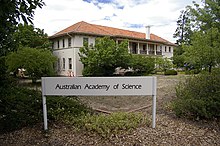
The Australian Academy of Sciences (AAS) was founded in 1954 by a group of prominent Australians, including the Australian representatives of the Royal Society of London. [1] Sir Mark Olyphant became the first president of the Academy. The Academy was created like the Royal Society of London , its authority is confirmed by a royal letter [1] . The Academy is an independent organization and operates with the approval of the Australian Government. The Academy Secretariat is located in Canberra , in a purpose-built “the Shine Dome” building named after John Schein.
The objectives of the Academy are the promotion of science in various ways. Four main program areas are highlighted:
- Recognition of outstanding contributions to science;
- Education and public education;
- Science policy;
- International relationships.
Content
Origin
The predecessor to the Australian Academy of Sciences was The Australian National Research Council (ANRC), founded in 1919 with the goal of representing Australia on the International Science Council . In 1954, the Council ceased to exist and was replaced by the Australian Academy of Sciences. [2]
Membership
Members of the Australian Academy of Sciences are over 420 leading scientists from Australia. For membership in the Academy, colleagues must recognize the significant contribution of the scientist to the development of their field of science. Up to twenty new Academy members can be elected annually [3]
Every three years, no more than two members of the Academy can be additionally elected for their outstanding contribution to the development of science as a whole, and not for individual research. A small number of prominent foreign scholars who have links with the Australian scientific community are elected as Corresponding Members of the Academy.
The acronym FAA (Fellow of the Australian Academy of Science) is added after the name of the Academy member.
Founders
At the time of the founding of the Australian Academy of Sciences, it had 24 members.
| Name | Scientific Specialization |
|---|---|
| Mathematics and Geophysics | |
| Frank Macfarlane Burnet | Virology and Immunology, Nobel Laureate |
| Genetics | |
| Maths | |
| Parasitology and scientific administration | |
| Edmund Alfred Cornish | Statistics |
| John Carew Eccles | Neurophysiology, Nobel Laureate |
| Geology | |
| Physics | |
| Raymond James Wood Le Fèvre | Chemistry |
| Biochemistry | |
| Biochemistry | |
| Physics | |
| Physics | |
| Douglas Mawson | Geology |
| Entomology | |
| Mark Olyphant | Physics |
| Joseph Leid Posey | Radiophysics and Astronomy |
| Agricultural sciences | |
| Chemistry | |
| Maths | |
| Sydney Sunderland | Neuroscientist |
| Zoology | |
| Richard Woolley | Astronomy |
Presidents
- Sir Mark Olyphant (1954-1957)
- Sir John Carew Eccles (1957-1961)
- Sir (1961-1964)
- Sir Frank MacFarlane Burnet (1965-69)
- Dr. (1969-1970)
- Professor (1970)
- Sir (1970-1974)
- Sir Jeffrey Badger (1974-1978)
- Dr. (1978-1982)
- Professor Arthur Birch (1982-1986)
- Professor David Curtis (1986-1990)
- Professor (1990-1994)
- Sir (1994-1998)
- Professor (1998-2002)
- Dr. (2002-2006)
- Professor (2006—2010)
- Professor Susan Corey (2010-2014)
- Professor (2014–)
Academy Awards
- Pawsey Medal - a young physicist;
- Gottschalk Medal - a young medical researcher;
- Fenner Medal ( Eng. Fenner Medal ) - a young biologist;
- Lyle Medal ( eng. Thomas Ranken Lyle Medal ).
The Shine Dome
The residence of the Australian Academy of Sciences, The Shine Dome , originally known as Becker's House, is a well-known landmark in Canberra. The building has an unusual design in the form of a segment of a gentle dome. It was designed by the architect Sir Roy Grounds. The dome has a diameter of 45.74 meters and at the time of completion in 1959 was the largest in Australia.
December 1, 1956 in Adelaide, a meeting of the committee for the construction of the Academy building was held. The projects of six architects were considered. The adopted project was a reinforced concrete dome weighing 710 tons, standing on 16 thin supports. The building is surrounded by a shallow decorative pond, in which the dome "stands" with its supports. The thickness of concrete varies from 60 centimeters at the base to 10 centimeters at the top. The dome is self-supporting, there are no internal supports, the construction cost amounted to 200 thousand pounds. The laying of the first stone took place on May 2, 1958, it was made by Australian Prime Minister Robert Menzies . As the “foundation stone", a part of the support of the 48-inch Great Melbourne Telescope was used, which was constructed in 1869, and since 1940s it was located at Mount Stromlo Observatory .
In 1962, the building was named Becker House, in honor of Academy Member Jack Allerton Becker. In 2000, it was renamed in honor of Academy member John Shine, who donated a million dollars to repair the dome.
Inside the building is divided into three floors. At the middle level - the main hall, the theater and several other meeting rooms; on the upper level are the theater gallery and the Adolf Basser library. The basement level is occupied by an archive of documents on the history of science of Australia.
Other scientific academies
In addition to the Australian Academy of Sciences, Australia has three more academic academies:
- Australian Academy of the Humanities
- Academy of the Social Sciences in Australia
- Australian Academy of Technological Sciences and Engineering
All four academies collaborate through the , established in 1995.
Notes
- ↑ 1 2 The Charter . Australian Academy of Science. Date of treatment September 22, 2008. Archived July 19, 2008.
- ↑ www.eoas.info // Encyclopedia of Australian Science // Australian National Research Council (1919-1954)
- ↑ Election policies and procedures . Australian Academy of Science. Date of treatment April 23, 2012.
Links
- Wikimedia Commons has Shine Dome related media files
- www.science.org.au - Australian Academy of Science
- www.deh.gov.au // Australian Academy of Science Building (inaccessible link) (eng.)