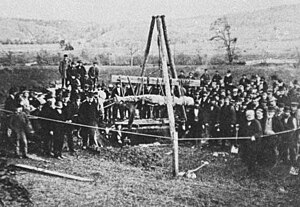


The giant from Cardiff is one of the most famous hoaxes of modern history, a stone sculpture of a man more than 3 meters tall, pretending to be the fossilized remains of a real giant.
History
On October 16, 1869, two workers, Gideon Emmons and Henry Nichols, who worked at William Newell’s farm in Cardiff , New York, USA , digging a well, discovered the supposedly well-preserved fossilized remains of a three-meter-tall man. It was announced that the find dates from biblical times and represents the remains of a native American. The owner of the land, William Newell, a few days after the discovery began to charge a fee for those wishing to look at the find at 25 cents, soon doubling it [1] .
Although archaeologists announced that the remains could not be authentic in any way, the hype of newspapers around the opening could not be stopped, and some Christian preachers even began to defend its authenticity.
The idea of hoaxing belonged to George Hull, an atheist who thus responded to a Methodist priest arguing with him, stubbornly defending the lines in Genesis that spoke of the giants that inhabited the Earth [2] . Hull initially hired workers to retrieve a 3 meter long gypsum block in Fort Dodge, Iowa, which he claimed would be used to build a monument to Abraham Lincoln in New York. He then brought the block to Chicago, where he hired the masons Edward Burchgart, who carved a sculpture of a man from stone, having vowed to keep a secret. The sculpture in November 1868 was delivered to the farm of his cousin William, who hired workers a year later, supposedly to dig a well.
The sculpture was sold by Hall for $ 23,000 to a group of five. At this time, Phineas Barnum became interested in the giant, who, having offered $ 50,000 for him and refused, hired a man who secretly made a copy of the giant. Subsequently, he exhibited it in his museum, claiming that this is a true giant, and Cardiff - a fake [1] . On December 10, 1869, Hull officially admitted to the press that he had committed a hoax, and on February 2, 1870, both giants were found to be fake in court. Despite this, Barnum managed to order and sell several copies of the statue, which caused a lot of complaints about him.
In 1901, the Cardiff giant was exhibited at the Pan American exhibition, but did not attract much attention [1] . It was later bought by a publisher from Iowa to decorate his home, and in 1947 sold it in Cooperstown, New York, where it is still on display.
The Cardiff giant is mentioned in several works of art [3] [4] [5] , and in 2011 it was reproduced [6] .
Notes
- ↑ 1 2 3 Rose, Mark (November / December 2005), " When Giants Roamed the Earth ", Archaeology (Archaeological Institute of America). - T. 58 (6) , < http://www.archaeology.org/0511/etc/giants.html > . Retrieved April 26, 2005.
- ↑ Magnusson, 2006 , p. 188
- ↑ Rizer, Fran A Hoax of a Ghost Hoax . Hoaxes . Columbia, SC: SleuthSayers (April 1, 2013). Archived on June 27, 2013.
- ↑ The True Origin Of The Cardiff Giant
- ↑ Lovecraft, HP and Heald, Hazel Out of the Aeons
- ↑ Syracuse.com: “This is no hoax, it's an artistic copy”
Literature
- Magnusson, Magnus (2006), Fakers, Forgers & Phoneys , Edinburgh: Mainstream Publishing, ISBN 1-84596-190-0
- Mark Twain, The Ghost Story
- Tribble, Scott (2009), A Colossal Hoax: The Giant From Cardiff that Fooled America , Rowman & Littlefield, ISBN 978-0-7425-6050-5
- Jacobs, Harvey (1997), American Goliath , St. Martin's Press, ISBN 978-0312194383
- G. Matveeva American Goliath // I want to know everything. Scientific and artistic collection. Compiled by A.N. Tomilin. L., 1975.S. 277-281. (Excerpt).
- Ray Bradbury, "The Orchestra is Playing Somewhere"