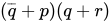
Conditional disjunction is a ternary (having 3 operands ) logical operation introduced by Alonzo Church [1] . The result of a conditional disjunction is similar to the result of a more general ternary conditional operation ( if o1 then o2 else o3 ), which is used in one form or another in most programming languages as one of the ways to implement branching in algorithms. For the operands p , q , and r , which determine the truth of the judgment , the value of the conditional disjunction [ p , q , r ] is determined by the formula:
| Conditional Disjunction | |
|---|---|
 Venn diagram | |
| Definition | |
| Truth table | |
| Normal forms | |
| Disjunctive | |
| Conjunctival | |
| Polina Zhegalkina | |
| Belonging to pre-complete classes | |
| Saves 0 | Yes |
| Saves 1 | Yes |
| Monotone | Not |
| Linane | Not |
| Self-dual | Not |




![{\ displaystyle [p, q, r] ~ \ leftrightarrow ~ (q \ rightarrow p) \ land (\ neg q \ rightarrow r).}](https://wikimedia.org/api/rest_v1/media/math/render/svg/96b24900b1c3c10cb79565a70d64ec6cace1ccef)
In other words, the entry [ p , q , r ] is equivalent to the entry: “If q , then p , otherwise r ”, which can be rewritten as “ p or r , depending on q or not q ”. Thus, for any values of p , q and r, the value of [ p , q , r ] is p if q is true, and is equal to r otherwise.
In combination with constants denoting each true value, the conditional disjunction is functionally complete for classical logic . [2] Its truth table is as follows:
| 0 | 0 | 0 | 0 |
| 0 | 0 | one | one |
| 0 | one | 0 | 0 |
| 0 | one | one | 0 |
| one | 0 | 0 | 0 |
| one | 0 | one | one |
| one | one | 0 | one |
| one | one | one | one |


![{\ displaystyle [a, b, c]}](https://wikimedia.org/api/rest_v1/media/math/render/svg/271e0de769183e4bbbdefee1b0a76a11394eaaba)
In addition to conditional disjunction, there are other functionally complete ternary operations.
Notes
- ↑ Church, Alonzo. Introduction to Mathematical Logic. - Princeton University Press, 1956.
- ↑ Wesselkamper, T., “A solely sufficient operator”, Notre Dame Journal of Formal Logic , Vol. XVI, No. 1 (1975), pp. 86-88.