Johann Baptist Strauss ( German: Johann Baptist Strauss , better known as Johann Strauss-father , German Johann Strauss Vater , March 14, 1804 , Vienna - September 25, 1849 , ibid.) - Austrian composer, violinist and conductor. The founder of the Strauss music dynasty. His three sons - Johann , Joseph and Edward - also became famous composers. The composer's legacy totals 251 creations (152 of them are waltzes). This heritage was carefully preserved by his son Johann Strauss, Jr. and published in 1889 in Leipzig.
| Johann Strauss him. Johann Strauß | |
|---|---|
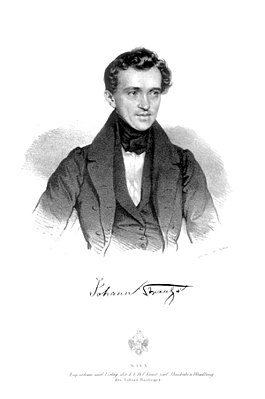 | |
| basic information | |
| Full name | him. Johann Strauß |
| Date of Birth | March 14, 1804 |
| Place of Birth | |
| Date of death | September 25, 1849 (45 years old) |
| A place of death | |
| Buried | |
| A country | |
| Professions | violinist , composer , conductor |
| Instruments | |
| Autograph | |
Content
Life and work
Johann Baptiste Strauss was born on March 14, 1804, in the town of Leopoldstadt - the people's suburb of Vienna, in the family of the hotel owner Franz Borgias Strauss and Barbara Dolman. His grandfather, Johann Michael Strauss (1720-1800) from Ofen , of Jewish descent, adopted the Catholic faith and moved to Vienna no later than 1762 ; the matrimonial record of his marriage in St. Stephen's Cathedral was falsified during the Third Reich [2] .
The boy had a difficult childhood: when he was seven years old, his mother died out of a fever, and another five years later, a bankrupt father drowned in the Danube (according to one version, it was suicide due to debts). The guardian gave him to study bookbinding, although he asked that he be given to study music. He began to take violin lessons on his own. At the first opportunity, he left the workshop and began to play in taverns.
According to the recollections of a friend of the family and his first teacher, A. Polishansky, while still very young, the boy climbed out from under the table of the hotel inn and, picking up the violin, faithfully repeated the melody just played by the tavern musicians. Johann Strauss, the father, owns the birth of the image of the conducting soloist and violinist. Strauss played masterly, at a frantic pace and with great temperament. Contemporaries noted that during the conducting of his movement were all too seductive. Contemporaries compared it with Paganini .
At 23, he recruited his first orchestra. Since 1819, the young musician has been playing in the Vienna Dance Quartet of Michel Pamera, and in 1824 he became assistant conductor of the orchestra Joseph Lanner . At that time, the orchestra played in the “At the Red Rooster” zucchini in the Vienna suburb of Turi. The owner of the establishment, Joseph Streim, had a daughter, Anna, a big lover of music and dance. Johann marries her, and on October 25, 1825, the first successor to the dynasty was born - Johann Strauss (Jr.) . In total, Anna gave birth to five children.
For four years, Johann and Lanner worked together together, but then after a public scandal they parted and Johann went his own way. The first waltz, written by Johann Strauss, the father, sounded like the work of Joseph Lanner (which later, according to legend, caused the breakdown of their relationship). The success of the waltz gave the composer confidence in his abilities - he collects his own orchestra, writes waltzes, polka, gallop ... Yet Strauss was at first always compared with Lanner, who only lost from this. The singing and dancing Vienna split into two camps: the Straussians and Lannerians.
Emperor Franz I still preferred Lanner and appointed him "the manager of the court balls." However, it was Johann Strauss who received the most invitations to local holidays and to performances in other countries.
In 1832, young Richard Wagner came to Vienna. After he heard Strauss, a note appeared in his diary: “Every play that he conducts with a violin in his hands will remain unforgettable. She plunged the amazing Johann Strauss into a completely wild rage bordering on fury. This demon of the Viennese musical folk spirit shuddered at the beginning of any waltz, like Pythia on a tripod. The audience, which was actually more intoxicated by his music than absorbed in drinks, lifted a real howl that lifted the inspiration of the conductor with violin to an incomprehensible height for me. ”
By the age of 28, Strauss became so famous that even during the cholera in 1832 in Vienna, during his performances the hall was crowded.
In 1833, the triumphal procession of Strauss music in Europe began. The composer was the first to introduce dance music to the world - before Strauss they did not perceive it as art. London music critics called him “Mozart of the Waltzes”, “Beethoven of the Cotillons”, “Paganini Gallop”, “Rossini Potpourri”. In 1833-1838 he toured in Budapest , Berlin , Leipzig and Dresden , traveled to Holland , Belgium , Paris . In the season dedicated to the coronation of Queen Victoria, he held 72 concerts in London . Among Strauss's compositions, Loreley-Rheinklagen, “Kettenbrcken” and “Waltzes” and other waltzes were especially successful, followed by Strauss’s most famous work - Radezky-Marsch.
He worked to exhaustion, toured Europe a lot. Therefore, practically did not study and did not devote time to children. The only thing he strictly followed and demanded of Anna from this was that his children should not compose music and play the violin. It was possible to play the piano .
Lanner, Strauss' main rival, died untimely in 1843 at the age of 42, and Emperor Ferdinand I appointed Strauss to his vacated court position.
Shortly before that, he had a lover Emilia Trambusch. She was the mistress of the mill. Emilia gave birth to seven children.
Anna's relationship with children
Once Johann found his son, Johannes the Younger, playing the violin. He became terribly furious, took the violin and locked it in a chest of drawers. Anna bought her son a new violin. Johann Jr. not only continued to secretly improve in music, but also became addicted to the violin of his brothers - Joseph and Eduard .
Father soon sent Johann Jr. to the Higher Commercial School, and in the evenings forced him to work as an accountant. The son nevertheless decided and turned to the magistrate for a license to conduct the orchestra. Mother, fearing that Johann Sr. would veto the issuance of a license, hastily filed for divorce because of her husband’s many years of betrayal.
Strauss was furious. He deprived the children of Anna's inheritance, unsubscribing everything to Emilia's children. Soon, he officially married Emilia.
Surviving his son from the stage was an obsession for Strauss Sr. He sent hackers , using his influence forbade entrepreneurs to enter into contracts with his son. For five years, the father waged a war with his son. In 1848, during the revolution, they found themselves on opposite sides of the barricades. Strauss-son played the Marseillaise for the rebels, and his father supported the Habsburgs and composed, in honor of their successes, the Radetzky March , which later became one of the unofficial anthems of Austria .
Last days
The crowns for the fact that Strauss did not support the revolution began to ignore his concerts. He was bewildered, wilted. Once, in a fit of anger, he broke his bow and the next day lay down in a fever. Emilia, thinking that his illness was contagious, left Strauss and left home with the children. Upon learning that Strauss was dying, his ex-wife Anna and Johann Jr. went to see him, but they no longer caught him alive.
The composer died of scarlet fever in Vienna on September 25, 1849, forty-five years of age.
The funeral of Strauss Sr. was grandiose, they were attended by about 30 thousand people. Son Johann at the grave played "Requiem" by Mozart.
Although his father deprived Johann of his inheritance, he soon after the death of his father published the complete works of his father at his own expense.
Every year in Europe, the famous "Strauss Festival" is held dedicated to the work of the Strauss. Spain , Italy , Austria , Portugal , France , Germany - enjoy magnificent waltzes, polks, marches, gallop, overtures and arias from the operettas of the famous dynasty of composers and conductors of the XIX century - Strauss.
Proceedings
Some of the works he wrote:
- Waltzes (152): Life is a dance (Das Leben ein Tanz), Dove Waltz (Taüberln-Walzer), Viennese Soul Waltz (Wiener-Gemüths-Walzer), Danube Song (Donau-Lieder), Demons (Mephistos Hollenrufe), Taglioni Waltz (Taglioni-Walzer), Waltz Bayaderok (Bajaderen-Walzer), Electric sparks (Elektrische Funken), Relief of all worries (SorgenBrecher), Viennese waltz (Der Wiener Walzer).
- Polkas (14) and Gallops (29): Gallop of sighs (Seufzer-Galopp), Gallop-Kachucha (Cachuca-Galopp), Indian gallop (Indianer-Galopp), Polka-Katenka (Kathinka-Polka).
- Quadrille (34): Quadrille of the Vienna Carnival (Wiener-Carnevals-Quadrille), Anniversary Quadrille (Jubel-Quadrille), Quadrille Muz (Musen-Quadrille).
- Marches (16): Triumphal Austrian March (Triumph-Marsch Österreichischer), Parade March (Defilir-Marsch), Radetzky-Marsch March .
Notes
- ↑ German National Library , Berlin State Library , Bavarian State Library , etc. Record # 118619098 // General regulatory control (GND) - 2012—2016.
- ↑ Wiener Institut für Strauss-Forschung (Link not available) . Date of treatment March 20, 2014. Archived on October 7, 2011.
Literature
- Solovyov N.F. Strauss, Johann (father) // Brockhaus and Efron Encyclopedic Dictionary : 86 volumes (82 volumes and 4 additional). - SPb. , 1890-1907.
- Mailer F. , I. Strauss. Moscow , 1980
- I. Strelnikova . How Johann Strauss became Ivan Strauss. 2010
- Meilich E. , Johann Strauss. From the history of the Viennese waltz, 2nd ed., L., 1964.
Links
- Strauss, Johann (father) // Great Soviet Encyclopedia : [in 30 vol.] / Ch. ed. A.M. Prokhorov . - 3rd ed. - M .: Soviet Encyclopedia, 1969-1978.
- Strauss, Johann (father) at the Rodovod . Tree of ancestors and descendants