Arbuzov reaction (Michaelis-Arbuzov reaction, Arbuzov rearrangement) - in the classic version - alkylation of trialkylphosphites with alkyl halides to form dialkylphosphonates:
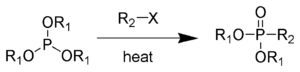
If the alkyl substituents of the trialkylphosphite and the alkyl halide R 1 and R 2 are the same, then we are talking about the rearrangement of Arbuzov . The reaction was discovered in 1898 by Augustus Michaelis [1] and was investigated in detail by Alexander Arbuzov [2] [3] .
Currently, the Arbuzov reaction is used not only for the synthesis of phosphonates from phosphites, but also for the production of phosphoryl compounds with a CP bond by alkylation or arylation of full esters of trivalent phosphorus acids:

Content
Reaction Mechanism
Arbuzov's reaction proceeds through the intermediate formation of phosphonium salts with their further rearrangement. At the first stage, alkylation occurs according to the mechanism of S N 2 with an alkyl halide 2 of trialkylphosphite 1 with the formation of a trialkoxyphosphonium salt 3 .
At the next stage, the nucleophilic attack of the halide ion on the electrophilic carbon atom of the alkoxy group occurs with the removal of the alkyl halide 5 and the formation of dialkylphosphonate 4 , this stage is called Arbuzov rearrangement.
Alkylation of phosphinites (A, B = R) and phosphonites (A = R, B = OR) proceeds by a similar mechanism:
Thioanalogues of trivalent phosphorus acid esters enter the Arbuzov reaction:
however, in this case, the reaction is complicated by competing alkylation of sulfur with further sulfide cleavage:
In the case of phosphite alkylation with α-haloaldehydes and α-halogen ketones, the formation of vinyl phosphates can occur in parallel with the Arbuzov reaction leading to phosphonates (Perkov reaction):
Applicability and Modifications
In the classical synthesis of trialkylphosphonates from trialkylphosphites, the alkyl halide used in the reaction is identical to the formed one, therefore, it is taken in catalytic amounts:
Under similar conditions, trimethylphosphite and other methylphosphites under the influence of Lewis acids undergo a rearrangement of Arbuzov in the absence of methyl halides:
In the case of alkylation with other alkyl halides, they are taken in excess, the reaction is carried out at 100-160 ° C, in the case of lower alkyl phosphites (trimethyl, triethyl, etc.), the low-boiling halides formed in the reaction are distilled from the reaction mixture to prevent the formation of non-target phosphonate [4] .
The use of Lewis acids makes it possible to lower the reaction temperature, for example, in the presence of zinc bromide, benzyl halides and their heterocyclic analogues react with triethyl phosphite at room temperature, forming the corresponding phosphonates in 80–90% yields, ZnBr 2 catalysis also allows to be used as alkylating benzyl halides corresponding benzyl alcohols with phosphonate yields of 75–85% [5] :
Synthetic Application
Phosphonates with mobile hydrogen atoms in the methylene group are used as a substrate in the synthesis of alkenes ("olefination of the carbonyl group") according to Horner-Wadsworth-Emmons
See also
- The reaction of Abramov
- Perkov reaction
Notes
- ↑ Michaelis, A .; R. Kaehne. Ueber das Verhalten der Jodalkyle gegen die sogen. Phosphorigsäureester oder O-Phosphine (German) // Berichte der deutschen chemischen Gesellschaft : magazin. - 1898. - Bd. 31 , Nr. 1 . - S. 1048-1055 . - ISSN 1099-0682 . - DOI : 10.1002 / cber.189803101190 .
- ↑ Arbuzov, AE {{{title}}} (neopr.) // J. Russ. Phys. Chem. Soc .. - 1906. - T. 38 . - S. 687 .
- ↑ Arbuzov, AE {{{title}}} (unopened) // Chem. Zentr .. - 1906. - T. II . - S. 1639 .
- ↑ Nagata, W .; Wakabayashi, T .; Hayase, Y. Diethyl 2- (cyclohexylamino) vinylphosphonate. Organic Syntheses, Coll. Vol. 6, p. 488 (1988); Vol. 53, p. 44 (1973).
- ↑ Rajeshwaran, Ganesan Gobi; Meganathan Nandakumar, Radhakrishnan Sureshbabu, Arasambattu K Mohanakrishnan. Lewis Acid-Mediated Michaelis-Arbuzov Reaction at Room Temperature: A Facile Preparation of Arylmethyl / Heteroarylmethyl Phosphonates (Eng.) // Organic Letters : journal. - 2011 .-- March 18 ( vol. 13 , no. 6 ). - P. 1270-1273 . - ISSN 1523-7052 1523-7060, 1523-7052 . - DOI : 10.1021 / ol1029436 .