The Greek phoenix ( Greek φοίνιξ ) is the first currency of the modern Greek state , which was in circulation from 1828 to 1833. Divided into 100 mites [1] . Named after the mythical phoenix bird [2] , symbolizing the revival of independent Greece .
| Greek phoenix | |||||
|---|---|---|---|---|---|
Φοίνιξ (Greek) | |||||
| |||||
| Territory of circulation | |||||
| Issuing country |  Greece Greece | ||||
| Derivative and parallel units | |||||
| Fractional | Lepta ( 1 ⁄ 100 ) | ||||
| Coins and Banknotes | |||||
| Coins | 1, 5, 10, 20 mites 1 phoenix | ||||
| Banknotes | 5, 10, 50, 100 phoenixes | ||||
| Story | |||||
| Introduced | 1828 year | ||||
| Predecessor currency | Ottoman (Turkish) Kurush Lombardo-Venetian Lyre | ||||
| Start of seizure | 1833 year | ||||
| Successor currency | Greek drachma (GRD) | ||||
| Courses and ratios | |||||
| 1828 year | 1 kurush = 6 phoenixes | ||||
| 1828 year | 1 FRF = 1 phoenix | ||||
| 1831 year | 1 GRD = 1 phoenix | ||||

Content
- 1 History
- 2 Coins and banknotes
- 3 notes
- 4 Literature
History
The Greek phoenix was introduced in 1828 under the first ruler of Greece, John Kapodistrias [3] and replaced the Turkish kurush ( piastre ), common in the Ottoman Empire , with 1 phoenix equal to 1 ⁄ 6 kurush. France became a model for the Greek monetary system with its bimetallic standard , in which 15.5 units of silver were equal to 1 unit of gold . The Greek phoenix was based on the silver standard and equated to 1 French franc , although the silver content in it was lower than in the franc - 3.747 g versus 4.5 g [4] [5] .
However, a small number of coins were minted, and therefore most of the monetary operations continued to be carried out using foreign currencies . Having no precious metals to mint more coins, the Greek government issued an additional 300,000 phoenixes in unsecured banknotes in 1831 . As a result, they were not distributed and were hardly used. .
In 1833, the state’s monetary system was reformed - Greek drachma was introduced into circulation, replacing the phoenix in the ratio 1: 1 [4] [5] .
Coins and Banknotes
In 1828, coins of the following denominations were minted: 1, 5, 10, 20 mites and 1 phoenix [6] .
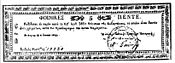
In 1831, banknotes of 5, 10, 50 and 100 phoenixes were issued .
Notes
- ↑ Greece paper money catalog and Greek currency history
- ↑ CH, 1993 , The Phoenix .
- ↑ National Finance Bank (1822-1832 )
- ↑ 1 2 GHC, 2010 , Greece .
- ↑ 1 2 Lazaretou, 2003 , pp. 5-6, 34.
- ↑ Lazaretou, 2003 , p. pp = 5-6, 34.
Literature
- Krause, Chester L. and Clifford Mishler (1991). Standard Catalog of World Coins: 1801-1991 (18th ed. Ed.). Krause Publications. ISBN 0873411501 .
- Pick, Albert (1994). Standard Catalog of World Paper Money: General Issues. Colin R. Bruce II and Neil Shafer (editors) (7th ed.). Krause Publications. ISBN 0-87341-207-9 .
- Global History of Currencies . - Global Financial Data, 2010. Archived April 4, 2014 on the Wayback Machine
- Dictionary of numismatists / [Authors: Fengler H., Girow G., Unger V.] / Per. with him. M. G. Arsenyeva / Resp. ed. V.M. Potin. - 2nd ed., Revised. and add. / Publ. Dictionary of numismatists. Description of coins . - M .: Radio and communications, 1993. - ISBN 5-256-00317-8 .
- Lazaretou S. Greek Monetary Economics in Retrospect: The Adventures of the Drahma . - Official site. - Bank of Greece , 2003.