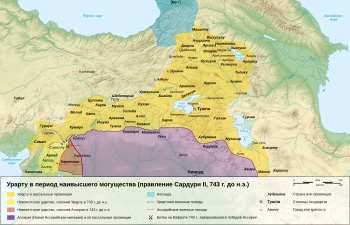
Urartu ( Arm. Ուրարտացիներ ) is an ancient people living on the territory of the Armenian Highlands . Inhabited the state of Urartu , known as the union of tribes with the XIII , and as a state - from the VIII century BC. e. and existed until the VI century BC. e. [1] . During the period of ethnogenesis of Armenians , Urartians switched to the ancient Armenian language and joined the Armenian people, making up the main genetic component of this people [2]
The Armenians are the successors of the physical [3] and cultural [4] component of the entire ancient population of the highlands, primarily the Urartians [5] , Hurrians and Luvians, as well as speakers of the Proto-Armenian language.
Content
- 1 Origin
- 2 Language
- 3 Religion
- 4 notes
Origin
To date, there is no accurate information about the origin of the Urartians. It is known that the Urartians, along with the Akkadians and Hurrites , belonged to the Armenoid group of populations [6] . It is assumed that the possible spread of urartans along the Armenian Highlands occurred from the Revanduz region (in the territory of today's north-western Iran, Western Azerbaijan ), where the ancient city of Musashir was located [7] [8] [9] [10] . It is likely that the ancient Urartian city of Musashir was located on the territory of the original settlement of this tribe [7] [10] . Since the end of the II millennium BC. e. to VI - II centuries BC e. Urarats along with other peoples participated in the process of the formation of the Armenian nationality [11] . Thus, the Armenians are the successors of the physical [3] [12] [13] and cultural [4] component of the entire ancient population of the highlands, primarily the Hurrians, Urartians [12] [14] [15] and Luvians, who made up the main genetic component modern Armenians [15] . It is also believed that the Cimmerians and Scythians took part in the ethnogenesis of Armenians [16] .
Language
Urartian language has no descendants [12] . Today, there is a consensus among scholars on the direct connection between the Urartian language and the Hurrian language [17] [18] [19] . Although several unencrypted inscriptions with the use of Urartian ideograms have come down to us, mainly the Urartians used a significantly simplified form of Assyrian cuneiform writing. For example, when borrowing many ambiguous Assyrian ideograms were used by the Urartians only in one sense, various semantic nuances of the Assyrian signs were lost [20] . Of the currently known about 500 cuneiform tablets, approximately 350-400 root words are distinguished, most of which are Urartian, and some are borrowed from other languages. To date, it has been determined that in the Armenian language there are a large number of root words common with the Uratian language (more than 70 root words) [21] . About 170 root words were found in the languages of the Nakh-Dagestan group, which includes about 60 different languages [22]
Religion
The religion of the Urartians is closely connected with the religions of Mesopotamia : the Urartians had a large pantheon of deities, many of which are clearly borrowed from the religions of the states of Mesopotamia ( Sumer , Akkad and Assyria ) [1] . In Urartu, the practice of sacrifices was widespread, in which mainly bulls and sheep participated. There are also traces of human sacrifices from prisoners of other nations [23] . Various rituals of worshiping deities, as well as sacrificial procedures, usually took place in rooms hollowed out in rocks resembling the tops of ziggurats built in Mesopotamia, used in a similar way. In one of these hollowed-out rooms, a tablet was found listing 79 Urartian deities and the number of animals that needed to be sacrificed to each of them [23] [24] .
Notes
- ↑ 1 2 Piotrovsky B. B. The Van Kingdom (Urartu) / Otv. ed. I.A. Orbeli . - Moscow: Publishing House of Oriental Literature, 1959. - 286 p. - 3500 copies.
- ↑ author = Dyakonov IM: quote: the bulk of the Urarthian-speaking population lived in the territory of the formation of the Armenian people and joined its composition ... Subsequently, when the Urartians themselves switched to the ancient Armenian language and joined the Armenian people, in which they probably made up the majority - the name “Hittites” also became their self-designation. In proto-Armenian, this name could sound * hatyos or * hatiyos (հատ (ի) յոս) later on, according to the laws of Armenian phonetics, it turned out հայ (high)
- ↑ 1 2 Dyakonov I.M. Background of the Armenian people . - Yerevan: Publishing House of the Academy of Sciences of the Armenian SSR, 1968. - S. 236.Original text (Russian)Components of the ancient Armenian people. So, from our point of view, the ancient Armenian people initially formed in the Upper Euphrates valley of three components - Hurrians, Luvians and Proto-Armenians (flies and, possibly, Urumans). At the same time, Hurrians, as more numerous, made up the bulk of the people and determined the main line of physical continuity, and the proto-Armenians, for a number of historical reasons, conveyed their language to the new people.
- ↑ 1 2 Dyakonov I.M. Background of the Armenian people . - Yerevan: Publishing House of the Academy of Sciences of the Armenian SSR, 1968. - S. 210-211. - 264 p. Original text (Russian)As for cultural continuity, the Armenians are undoubtedly the successors of the entire ancient population of the highlands, primarily the Hurrians, Urartians, and Luvians; there is no evidence of a particularly important cultural impact on the later population of the highlands on the part of Hayasa more than Isuwa, Alzi, Uruatra or Kumme. In essence, we know very little about the Hayas culture, except for its marriage customs and the names of deities, from which there are no memories in the Armenian tradition
- ↑ I. M. Dyakonov. On the prehistory of the Armenian language (on facts, evidence and logic) . Number 4. pp. 149-178. ISSN 0135-0536 . Historical and Philological Journal (1983). Date of treatment October 18, 2013. Archived January 9, 2014. Original text (Russian)In other words, the Armenians are primarily the descendants of the Urartians who adopted the Indo-European language, but retained their own pronunciation (articulation base or, in everyday life, “accent”), but also the descendants of the Hurrians, Luvians, and, of course, the original speakers of the Proto-Armenian language itself
- ↑ N. A. Kislyakov, A. I. Pershits // Peoples of Western Asia // Publishing House of the Academy of Sciences of the USSR, 1957 - p. 49 - Total pages: 613 Original text (Russian)the habitats of these peoples (in the mountains of Zagros and further to the north) lie on the border of the area of ancient distribution of the most pronounced Armenoid type (Akkadians, Hurrites, Urartians), partially coinciding with it. Thus, the territory of Kurds, Luris and Bakhtiaries is located, as it were, at the junction of two modern anthropological types: dolichocephalic - Khorasan and brachycephalic - Armenoid
- ↑ 1 2 Urartu // Edwards IES, Gadd CJ, Hammond NGL, Boardman J. Cambridge Ancient history. - London: Cambridge University Press, 1982. - Vol. 3, part 1. - P. 314-371. - ISBN 0-521-22496-9 .
- ↑ Stone EC, Zimansky P. The Urartian Transformation in the Outer Town of Ayanis // Archeology in the Borderlands. Investigations in Caucasia and beyound. - Los Angeles: University of California Press, 2003 .-- ISBN 1931745013 .
- ↑ Salvini Mirjo. Geschichte und Kultur der Urartäer. - Darmstadt, 1995.
- ↑ 1 2 Melikishvili G.A. Musashir and the question of the oldest outbreak of the Urartian tribes // Bulletin of Ancient History. - Moscow, 1948. - No. 2 . - S. 37 - 48 .
- ↑ Dyakonov I.M. History of the Ancient World: The Decline of Ancient Societies. - M .: Head. ed. Eastern Literature, 1989. - T. T. 3. - S. 282. - ISBN 5020169773 , 9785020169777. Original text (Russian)The Armenian people included elements of proto-Armenian, Hurrit-Urartian, Luvian, Aramaic (in cities) and some marginal Proto-Georgian; if the Armenian language, probably, even before the start of the new era was the lingua franca, then by the 1st century AD n e. he became koyne (as can be seen from the instructions of Strabo). Nevertheless, even more important than language was the consciousness of the state, and in the absence of the state, a religious community
- ↑ 1 2 3 M.P. Kim and B. B. Piotrovsky. Soviet culture: 70 years of development; to the 80th anniversary of academician M.P. Kim. - Moscow: Nauka, 1987 .-- S. 328. - 398 p. Original text (Russian)It turns out that although the Urartians cannot be considered as the ancestors of the peoples of Transcaucasia by language (their language did not give descendants), the Urartians (alarods) themselves became part of the later formed Armenian people
- ↑ History of the East. In 6 t. T. 1. East in antiquity / Ch. editorial : I90 R.B. Rybakov (pre ... [Ed. By V.A. Jacobson]. - M: Vost. Lit., 2002. - p. 540 (total 688) Original text (Russian)Although a new, Armenian people had already begun to take shape on the highlands, Armenian society was a direct continuation of the Hurrit-Urartian, and even the terms for the concepts of “slave” and “slave” continued to be used by the Hurrit-Urartian.
- ↑ I. M. Dyakonov. On the prehistory of the Armenian language (on facts, evidence and logic) . Number 4. pp. 149-178. ISSN 0135-0536 . Historical and Philological Journal (1983). Date of treatment October 18, 2013. Archived January 9, 2014. Original text (Russian)In other words, the Armenians are primarily the descendants of the Urartians who adopted the Indo-European language, but retained their own pronunciation (articulation base, or, in everyday terms, “accent”), but also the descendants of the Hurrians, Luvians, and, of course, the original speakers of the Proto-Armenian language itself
- ↑ 1 2 Dyakonov I.M. Background of the Armenian people . - Yerevan: Publishing House of the Academy of Sciences of the Armenian SSR, 1968. - T. Chapter III. Education of the Armenian people - 3. Education of the Armenian people. Components of the Armenian people . - S. 229-243. - 264 p.
- ↑ Yu.V. Bromley / Ethnography / Ch. 8 "Peoples of the Caucasus" 1982 - p. 262 "It is believed that the composition of the Armenians also included Iranian-speaking Cimmerians and Scythians, who penetrated during the | millennium BC from the steppes of the North Caucasus into Transcaucasia and Front Asia "
- ↑ Dyakonov I.M. , Starostin S.A. Hurrit-Urartian and East Caucasian languages // Ancient East: ethnocultural relations. - Moscow: Science, 1988.
- ↑ Johannes Friedrich . Decryption of forgotten scripts and languages. - M .: URSS, 2003. - ISBN 5-354-00045-9 .
- ↑ Dyakonov I.M. The languages of ancient Near East. - M .: Science, 1967.
- ↑ Melikishvili G.A. Urartian wedge-shaped inscriptions . - Moscow: Publishing House of the Academy of Sciences of the USSR, 1960.
- ↑ Encyclopedia Americana, v. 2, USA 1980, pgs. 539, 541; Hovick Nersessian, "Highlands of Armenia," Los Angeles, 2000. Mr. Nersessian is in the New York Academy of Sciences.
- ↑ Igor M. Diakonoff, Sergei A. Starostin. Hurro-Urartian and East Caucasian Languages, Ancient Orient. Ethnocultural Relations. Moscow, 1988, pp. 164—207 http://starling.rinet.ru/Texts/hururt.pdf
- ↑ 1 2 Lehmann-Haupt CF Armenien, einst und jetzt. - Berlin: B. Behr, 1910-1931.
- ↑ König F. W. Handbuch der chaldischen Inschriften. - Graz: E. Weidner, 1955 .-- 275 p.