The Battle of Samugar is a decisive battle in the internecine war in India, which took place on May 29, 1658 between the troops of the Indian claimants to the throne of the Mughals Aurangzeb and Dar Shikokh . Ended in the defeat of the latter.
| Battle of Samugar | |||
|---|---|---|---|
| Main Conflict: Civil War in India 1657-1658 | |||
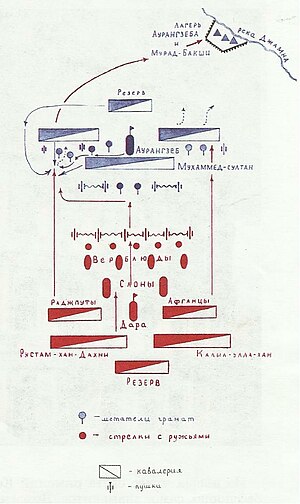 Battle pattern | |||
| date | May 29, 1658 | ||
| A place | Samugar , about 16 km. east of Agra | ||
| Total | Aurangzeb's victory in the internecine war | ||
| Opponents | |||
| |||
| Commanders | |||
| |||
| Forces of the parties | |||
| |||
| Losses | |||
| |||

Content
Background
In September 1657, the paddies of the Mughal Empire Shah Jahan I became seriously ill and his sons Dara Shikokh , Shah Shuja , Murad Bakhsh and Aurangzeb started a civil war for the throne. The younger ones fought against the elder Dar Shikokh. Dara Shikokh managed to defeat Shah Shuja, but two other brothers remained his enemies. [one]
In the battle of Dharmat, Dara Shikokh was defeated by Aurangzeb. On May 2, 1658, Dara hastily gathered new forces for further struggle.
Dara Shikokh
Dara Shikokh decided to continue Akbar's policy, expressed in broad religious tolerance. He relied on the Hindu tribal nobility of the Rajas, on the priesthood, on the Hindu merchants and moneylenders.
Aurangzeb
Decides to express the interests of the Muslim nobility and impersonating a fanatical Muslim and a merciless fighter against the "infidels." In fact, the struggle was for the abolition of the debt of Muslim nobility to Hindu moneylenders, for the seizure by Muslims of the riches of Hindu temples, for the seizure of the fertile lands of Bijapur and Golconda and coastal trade.
The forces of the parties
F. Bernier writes that the army of Dar Shikokh consisted of 100 thousand cavalry and 20 thousand infantry with the support of a large number of elephants and 80 guns. Sarkar's research showed that on the contrary determines the size of the army at 60,000, which is more likely, since these calculations take into account the dispersion of troops in various strategic directions. Tsarevich’s troops were armed from Agra’s arsenal and received a salary from Shah Jahan himself.
A large army created only the appearance of force, since it consisted of various disparate tribes and groups for the most part that did not have combat experience. The only hope of Dara was the Rajputs and Saedis . The most combat-ready troops were marching against Suji in the army of Suleiman Sheku.
Maneuvers before the battle
On May 22, the 60,000th army of Dara crossed the Chambal River near Dholpur, 40 km south of Agra. Here she took a comfortable position, set up artillery against river crossings and proceeded to establish field defenses.
Soon the troops of other brothers went to the river. Chambal and located near the river crossings. From the Dara camp, one could see their tents. Aurangzeb scouts and scouts reported to him about the difficulties of crossing the river. Therefore, it was decided to make a deep detour of the location of the troops of Dara.
One of the rebellious Rajas, who had betrayed Dar, agreed to lead the troops of Aurangzeb and Bakshi through the mountains and forests of their possessions. Leaving several tents at the site of his camp for the purpose of camouflage, the army of two brothers at night, observing silence, set out on a march and forced march during the day and night went to crossings across the river. Chambal, 70 km from Dholpur, where it crossed the river. Then the troops marched on Agra and on the outskirts of the capital, 10 km from it, on the river. Jamne took a good position, where there were conditions for convenient use of water. This item was called Samugar, and then Fateabad, which means "place of victory." The troops began to establish defensive structures.
Only when Aurangzeb was already on the left bank of the river. Chambal, Dara learned about the maneuver of his opponent, who was in his rear. The army of Dara was forced to abandon her fortified position and move to Agra. Soon it reached the river. Jamne camped on the river bank between Agra and the army of Aurangzeb and Bakshi. Opponents stood against each other for three to four days without engaging in battle. Again, friends advised Dara to expect the army of Suleiman-Sheki. But, contrary to advice, he ordered his commanders to be built for the battle 4 km from the camp.
layout
Dara
The battle formation of the Dara army had tactical depth, while the main forces were dismembered along the front. The first line was artillery. 80 cannons were linked together by chains - to protect against cavalry. Behind them settled several thousand shooters with guns. The third line consisted of camels. On each of them sat arrows with small guns. Behind the camels, Dara placed war elephants in shells. The main forces of Dara consisted of cavalry. Rajputs stood on the right flank. On the other wing gathered 4,000 Afghan riders. Between them - 3,000 Dara guards.
The second line of troops was divided into two wings. On the right are the Mughals of Kalil-Ulla Khan, on the left are the Hindu warriors Rustam Khan-Dakhni. Behind the rear is a reserve squad of 10,000 soldiers.
Long before the early dawn, the construction of Dara’s troops began and was completed by 8 o’clock in the morning.
Aurangzeb
The troops of the other two brothers were more disciplined and trained, with high morale before the battle. Aurangzeb's army had European artillerymen and various instructors. Aurangzeb, like Dara, divided the battle formation of his forces along the front and especially in depth.
Aurangzeb put guns ahead. Behind them was the vanguard of 10,000 horsemen of Muhammad Sultan. The second line consisted of two wings. They were supported by small field tools. In the rear was a reserve of 10,000 soldiers. Aurangzeb himself was sitting on a war elephant. Other elephants settled down among the troops as moving tower fortresses. Ahead of battle formations, grenade throwers scattered.
Battle
Phase One
The Allied forces in battle formations marched several kilometers and stood opposite the troops of Dara. He ordered to open fire from guns. However, the army of the brothers was still far away, and the cores did not cause her much damage. Gunpowder was spent in vain for an hour; black powder smoke swept the entire battlefield and deprived the command of the opportunity to clarify the situation. For this reason, Dara overestimated the results of his artillery fire.
Aurangzeb ordered the gunners to mount the guns and chain them, giving only one salvo, preserving the gunpowder for the decisive moment.
Phase 2
In the afternoon, Dara ordered his troops to launch an enemy attack on the entire front. The gunners Aurangzeb let the enemy closer and opened fire. The warriors of Dara paused in confusion. But their commander himself led the attack and at the head of a strong cavalry detachment broke through enemy battle formations. Aurangzeb's camels and infantry were put to flight, and his camp was captured by part of Dara’s troops.
Aurangzeb sent a strong cavalry detachment to intercept the erupted enemy, but his counterattack was repelled.
Third Phase
The warriors of the brothers managed to squeeze the left flank of the enemy. In this battle, the warlord who commanded the left wing of the army of Dara died. The Rajputs, furious with the death of their leader, rushed into a fierce attack and pressed the enemy. The defeat of Aurangzeb and Murad-Bakshi seemed inevitable. However, 30 thousand Mughals were in no hurry to help Dara. Their commander, Kalil-ulla-khan, announced that he could not enter the battle without an order.
Mohamed Sultan orders to open fire from cannons and attack the warriors of Dara. At that time, Aurangzeb's reserve squad attacked the other flank of Dara. The army of Dara could not stand the blow of fresh forces and was defeated.
Summary
The troops of Dara lost 10 thousand people killed. For 20 km, the road was littered with wounded warriors dying from blood loss and exhaustion. Dara himself fled to Afghanistan.