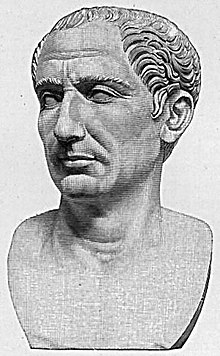
Reforms of Julius Caesar were carried out in Ancient Rome in 49-44 BC. During this time, Julius Caesar was elected several times as a dictator , and also consistently held several important government posts, which allowed him to enforce a number of laws.
In all of Caesar's reform work, two main ideas are clearly marked. One is the need to unite the Roman state into one whole, the need to smooth out the distinction between a citizen- master and a provincial - slave , to smooth out the discord of nationalities; another, closely related to the first, is streamlining the administration, close communication of the state with citizens, elimination of intermediaries , and a strong central authority .
Both of these ideas are reflected in all Caesar's reforms, despite the fact that he carried them out quickly and hastily, trying to use the short intervals of his stay in Rome . In view of this, the sequence of individual measures is random; Each time, Caesar undertook what seemed most necessary to him, and only a comparison of everything he had done, regardless of chronology, allows us to grasp the essence of his reforms and to note the harmonious system in their implementation.
Caesar's unifying tendencies were reflected primarily in his policy towards parties among the leading classes. His policy of mercy in relation to opponents, with the exception of the irreconcilable, his desire to attract everyone to the state life, without distinction of party and mood, his admission on Wednesday of his close former opponents, undoubtedly testify to the desire to merge all disagreements about his personality and his regime . This unifying policy explains the widespread trust in everyone, which was the reason for his death. The unifying tendency also clearly affects Italy.
Unification measures were also two major reforms of J. Caesar - monetary and calendar.
Texts and dating
Details of the events of the dictator are known mainly from the writings of the authors of the era of the Empire, and there is very little evidence of contemporaries on this issue.
As a rule, the sources do not specify how this or that law was adopted, and some reforms that are traditionally attributed to the dictator himself could be formally carried out by his associates.
In addition, it is not always possible to establish an absolute and relative chronology of reforms: firstly, sources usually do not report the date of adoption of the law, and secondly, calendar reform ( see below ) confused the dating of events up to 45 BC. e [1] .
Decision Making
Often, Caesar made the decision without consulting with the Senate, although when the text of the law was publicly announced, it was indicated that the senators supported the dictator [2] . In addition, he personally made all decisions in foreign policy - an area that was previously exclusively reserved for the Senate [2] . However, no one could impede his reforms in the usual way of pointing to non-compliance with formal procedures: old political opponents died in the civil war, and all open opposition to Caesar consisted of several young people's stands. And despite the fact that the latter did not have the authority to veto the decisions of the dictator, any public manifestations of disagreement with Caesar’s actions were suppressed - as a rule, by the wrong hands [3] .
However, the growing dissatisfaction with the actions of the dictator fueled opposition sentiments and actions of the Romans displeased by Caesar. In addition to the fronting of individual stands, the case of a politicized anti-Caesarian mime performance in the theater is also known; probably political pamphlets were issued [4] . In addition, some dissatisfied with the actions of Caesar, including his former supporters, joined the ranks of the conspirators [5] .
Municipal Law
It is known that Caesar published in 45 BC the so-called Julia municipalities law (lex Julia municipalis), which governs some aspects of municipal life in Italy. In 1732 and in 1735, during the excavation of the ancient Roman city of Heraclea Lukanskaya near modern Taranto , two bronze tables were found with the text of the charter of Heraclea municipality, copying the text of the Julius law on municipalities.
The law immediately supplemented for all municipalities the charters of individual Italian communities, and served as an adjustment for all of them. On the other hand, the combination in the law of the rules governing the urban life of Rome and the norms of municipalities, and the significant likelihood that the norms of urban improvement of Rome were also mandatory for municipalities, clearly indicates a tendency to reduce Rome to municipalities, to raise municipalities to Rome, which from now on should It was only the first of the Italian cities, the seat of central authority and a model for all similar centers of life. The general municipal law for the whole of Italy, with local differences, was unthinkable, but some general rules were desirable and useful and clearly indicated that in the end Italy and its cities represent one whole, united with Rome.
The Law of Caesar is published in CIL., I, 206; Dessau, Inscr. selectae ", II, 6085; for lex Julia municipalis he was first considered Savigny, "Vermischte Schriften", III, 279 et seq .; Wed Puchta, “Institutionen”, I, § 90; Nissen, “Rhein. Museum ”, 1890, 100 and ff .; Mommsen, "Rom. Gesch. ”, III, 519 et seq. The incorrect opinion of Savigny, which Mommsen refused at the end of his life, is proved by the discovery of a fragment of the Tarentine municipal charter (see De Petra, “Monumenti dei Lincei”, VI, 435 et al .; Hackel, “Wiener Studien”, 1902; Mommsen, “ Ephemeris epigraphica ", IX, 5 et seq.).
Giving citizenship to provincials
The same unifying pan-Italian tendency also manifests itself in the fact that already in 49 under the law of Caesar all citizens of Transpadanian Gaul were granted citizenship and, therefore, the pan-Italian municipal system was extended to this part of the Roman world. This was the first case of the extension of Roman citizenship to an entire province, and Caesar was not going to stop there.
The oldest Roman province of Sicily and one of the most romanized, Narbonne Gaul, joined him to the Italian system by granting Latin cities to their cities.
Other provinces, especially the western ones (Helvetia, Gaul, Spain, Africa), receive colonies of Roman citizens - cells from which the city system was to spread throughout the province, guides of justice among the provincials and a guarantee of a better future for them.
Caesar was the first of the great leaders of democracy who finally made Roman colonization in the provinces and laid a solid foundation for Romanization, that is, the unification of the West in one culture. More than 80,000 Roman citizens found service in his colonies, both serving in his army and not serving.
Colonization in the East
In the East, his colonial activity was much weaker.
The restoration of Corinth and the deportation of the colony there was not a measure of the Romanization of Greece, which is already proved by the sending of exclusively the absentee, but by the same act of justice and reasonable economic policy as the restoration of Carthage.
The foundation of Sinop proves the already noted desire to unite in one state all the lands between the Danube and Parthia (for the colonies of J. Caesar, see Kromayer, in "Hermes", 31, 1 and ff .; Kornemaun, in Pauly-Wissowa "Realencyclopoedie", IV, 563, where are references to other works).
The foundation of the colonies was accompanied by a wide distribution of the right of Roman citizenship to the provincials, and Caesar was not embarrassed by the recognition of new citizens ins honorum and their enrollment in the Senate. The same omnipotent tendency is also reflected in the fact that in the colonies founded by them, the exiles could be decurions.
Monetary reform
For a long time, an introduction was suggested in Rome, next to the silver, gold currency: the whole East lived for it; gold has long plied near silver; there was not only its official recognition and especially the Roman gold monetary unit.
Yielding to the needs of a world state, Caesar introduces a Roman aureus of a certain weight and establishes once and for all his attitude to silver denarius. This measure for the next time has almost the same meaning as the introduction in 269 of a silver coin in Rome; thanks to her, the entire Roman state received one common coin, reduced the old royal and city coinage to the degree of goods.
It is not hard to imagine how the two named (monetary and calendar) reforms of a purely Hellenic type facilitated (recall the monetary reform of Alexander the Great) the economic life of a huge state and the trade communication of some parts of it with others; this, in turn, was supposed to smooth out the contradictions between the West and the East and contribute to an even stronger influx of Hellenism to the soil of the Romanized West.
Statistical work
The statistical work undertaken by Caesar was also important.
First of all, he carried out a census of the city of Rome in the Hellenistic, Egyptian way. This fact shows once again that Caesar saw only his residence in Rome, and did not merge the city of Rome and the Roman state into one inseparable whole, as it was the basic principle of Roman statehood before him. At the same time, statistical work was regulated throughout Italy; the qualification was made everywhere in all populated centers, and its results were summarized in Rome. By this the population of Italy was merged with Rome; before the general vote in all cities of Italy there was only one step left.
Land Cadastre Plan
Even more important was the unenforced plan of the general state land cadastre. This plan arose clearly under the influence of Egypt, where such an inventory has long existed; he indicates the intention to carry out one common land taxation in all provinces, the beginning of which was already laid by Caesar in the province of Asia, where, undoubtedly, a similar cadastre existed before. Such a general reform, destroying fundamentally the financial power of equestrianism, reducing it to the degree of servants of the new regime, besides its general significance, had an undoubted leveling and unifying character. The plan of one general civil code, also inspired by the East with its general Hellenistic law, was only conceived in the most general forms.
Army Reform
In relation to the army (for this, see Mommsen, in “Hermes”, XIX, 1 et seq .; Domaszewski, in “Neue Heidelberger Jahrbucher”, 1894, 157 et seq.) We do not see any fundamental and fundamental reform.
Under Caesar, the evolution of the military system, which had begun long before him, continued, transforming the army from civilian to hired and from temporary to permanent. Like Sulla, Pompey and Y. Caesar held the army in their hands with personal charm and material benefits - gifts, allotments of land , etc. A major step towards turning into mercenaries was to double the salaries of soldiers, which was a heavy burden on the state budget.
In personal relations with the army, Y. Caesar carried out the same idea as in all his activities. He put forward ordinary soldiers to the detriment of noble officers and did not hesitate to introduce provincial residents (for example, the entire V legion of Alaudae - the lark - consisted of Gauls), who only after the end of their service were granted Roman citizenship. And here, therefore, a tendency manifests itself, which sought to smooth out the differences between the estates and individual constituent parts of the state.
For his permanent army, Caesar outlined a number of permanent parking places that coincided with the places of August time, with the exception of Sicily and Sardinia, Italy and Pontus. The most powerful garrisons were in Spain, Gaul, Illyric, Africa, Egypt, Syria; the army intended for the Parthian campaign was in Macedonia. The total number of Caesar legions exceeded 40; but we know almost nothing about the auxiliary troops, which played such an important role in the army of Pompey and then in the army of Augustus.
Calendar Reform
No less important was the calendar. The Roman calendar, due to its complexity and backwardness compared to the scientifically proven calendars of the Hellenistic East, could not compete with them and lay claim to national significance. In 47, Yu. Caesar, in his rank of chief pontiff, with the help of a commission of specialists, was reforming the calendar according to the most accurate calculations of that time. The new calendar, by virtue of its superiority, could be gradually introduced into all provinces and achieve not only official, but also real unity during the reckoning.
Finally, in 46 BC e. Caesar announced the reform of the Roman calendar . Instead of the former lunar, a solar calendar was introduced, developed by the Alexandrian scientist Sozigen and consisting of 365 days with one additional day every four years. However, to carry out the reform, it was first necessary to bring the current calendar in line with astronomical time. Since in the 50s and 40s BC e. Caesar was a great pontiff, often absent from the capital and unable to bring the traditional calendar in line with astronomical time, the gap grew to almost three months. Using his powers as a great pontiff, in February 46 BC. e. Caesar inserted the usual additional month of mercedonium in such cases, and between November and December he added two more additional months, therefore, only in 46 BC. e. according to the Roman account it turned out 445 days. Starting from the new year 45 BC e. the calendar, now known as the Julian calendar, began to operate. The new calendar was used everywhere in Europe for sixteen centuries, until the development, on behalf of Pope Gregory XIII, of a slightly refined version of the calendar, called the Gregorian [6] .
Administrative Reform
Senate Replenishment
The dictator also replenished the Senate, which was empty as a result of civil strife of the 50s BC. e. and civil war. In all, Caesar reviewed the lists of senators three times and, according to Dion Cassius, eventually brought their number to 900, but this number was hardly accurate and constant. Many people included in the senate did not belong to the old Roman families, but to the provincial aristocracy and the estate of horsemen . Contemporaries, however, spread rumors that the children of freedmen and barbarians were also included in the number of senators [7] [8] .
Reorganization of the tax system
The farmers, published from most of the provinces, were expelled and the collection of taxes passed into the hands of the communities, and the collection of funds from the cities was monitored by Caesar's personal agents - his slaves. The entire provincial administration, introduced into certain legal norms, was thus concentrated in the hands of one leader, Y. Caesar, who also had powerful means of control in the person of his legates and his personal agents.
Finally, there was a special law of Caesar (another 59 g.), Which strengthened the severity of control of the amounts of provincial government and demanded that a report be kept in the province, in addition to presenting it in Rome.
In the direct taxation system of Asia, the Hellenistic principle of a self-governing and self-taxing city, only controlled by the state, was again put forward, instead of the principle that ignored the city as such and saw in the province one large estate of the Roman people, rented out.
Reform of the administrative apparatus
The second main idea of Caesar was, as said, the creation of a strong and regularly functioning administrative machine, under the leadership of a strong central authority.
Provincial Reorganization
To do this, first of all, the number of provinces was increased, that is, the competence of each individual promotion department was reduced [9] .
The stay of proconsuls in the province was limited to two years, propreters - one year.
If we take into account that Y. Caesar was given the right, first, to recommend the magistrates , and secondly, to decide without the help of the Senate which of the former magistrates in which province should function as a promo, then the above measures will have special meaning.
The dictator set a strict maximum for the time of the magistrates in the provinces: the term of the governor-pro-consul in the province was limited to two years, and the deputy governor-prophet — one year [10] .
Judicial Reform
In addition to this measure, the dictator revised the system of staffing judges in permanent criminal courts ( quaestiones perpetuae ), giving half the seats to senators and riders instead of the previous third of seats, which became possible after exclusion from the collegiums of the emperor tribunes [10] [11] .
There is an opinion that he generally disbanded / destroyed this quasi-ancestry .
In the field of public administration, Caesar increased the number of most collegiums of the Kurul (senior) magistrates . The number of praetors chosen annually increased from 8, first to 14, and then to 16 [7] . Accordingly, the number of questors has been increased; this at the same time greatly undermined the significance of these magistrates, since from now on every praetor had in Rome only a very narrow judicial competence.
The penalties for crimes against the provinces were strengthened: persons convicted in these cases were removed from the senatorial estate (this reform is due to the general judicial reform of Caesar, little known to us and not of fundamental importance).
Other reorganizations
The same desire was reflected in the constant support of the urban economy, in the care for beautification in the beauty of cities.
The number of quaestors was increased by 20 people annually, and aediles - by 2 due to aediles ceriales , which controlled the supply of bread.
The number of augurs, pontiffs, and members of the collegium of Quindetsemvir also increased.
The dictator also resorted to the use of consuls- suffixes , because of which their number actually increased from the previous two; the case is known when the suffix was assigned for one day - December 31 .
Among the goals of increasing the number of magistrates are: creating opportunities for a wider involvement of residents of Italy and noble Romans in government, meeting the needs of the growing state apparatus (including in the provinces) and reducing the severity of the struggle between the candidates, which has already led to an increase in electoral corruption [10] [12] [13] .
The dictator has arrogated to himself the right to nominate candidates for key positions: first, this was done informally, and then he officially received this right [8] . He removed unwanted candidates from the election [14] . Often Guy nominated people of noble origin to high posts: it is known that more than half of the consuls elected under the protection of Caesar were “new people” ( homines novi ), among whom there were no consuls [15] .
However, during the years of his sole rule, elected magistrates played a secondary role compared to the people appointed by Caesar. In particular, the magistrates at 45 BC. e. they did not choose for a long time, and while they were gone, the daily management of the republic was carried out by magister equitum Mark Emilius Lepidus and the prefects appointed by Caesar [16] .
Economic measures
Next to these major reforms are a series of economic measures, caused by the constant plagues of the economic life of Rome: the terrible debt of both rich and poor, the growth of large estates to the detriment of small property, the rapid increase in the number of slaves, more and more crowding out free labor.
Nothing could be done here, but there were moments of a particular aggravation of relations when it was impossible not to intervene. Such was the moment after the revolution of Celius Rufus and Dolabella, when Y. Caesar was forced to set off interest on the payment of capital and add part of the rent to the poorest tenants.
The struggle against the latifundia was the same as before, that is, by endowing the poor with land. The agrarian law of J. Caesar of 59 is at the same time a struggle against population decline in Italy, granting special rights to those who had more than 3 children. He gave the veterans land in Italy, along with its political significance, also had a certain economic meaning.
To combat slavery, Y. Caesar again used the old tribune arsenal, demanding a reduction in the number of slaves on large estates, setting the required percentage of free workers.
A newer measure was that certain categories of people were prohibited from leaving Italy. However, this prohibition should be seen more as a military measure that facilitates recruitment (over the period from 49 to 44 more than 200,000 recruits were recruited in Italy) than an economic measure.
In connection with the economic reforms of J. Caesar are his reforms as praefectus morum, namely, the impact on luxury by the so-called leges sumptuariae, which limited, among other things, the luxury of the table. In this regard, there is also the establishment of customs duties on overseas imports, mainly on luxury goods.
Solving City Problems
It remains to say a few words about Caesar's relationship to Rome as a city. It was already noted above that Rome for Yu. Caesar is not a synonym for the Roman state, but the residence of the head of state, the population of Rome is not Roman citizenship, but the capital's mob.
Adjustment of bread distribution
The latter is most clearly manifested in Caesar's adjustment of frustrations - bread distributions. From now on, not all citizens have the right to receive free bread, but only 150,000 elected, replenished by drawing lots from the remaining candidates. What was the right of all citizens is done by grace in relation to the population of the residence. Officially, however, republican magistrates continue to manage the frustrations; Caesar creates special plebeian aediles specifically for this purpose, under the name Ceriales.
Building Life Management
Yu. Caesar seeks to concentrate the whole construction life of Rome in his hands; any major construction should remind the population of a generous builder; a new venue for the vote of the people (saepta Iulia), a new curia for the meetings of the Senate (curia Iulia), a new tribune for a conversation between the magistrate and the people (rostra Iulia), finally, even a new square with the temple of the ancestor of the Julian family - Venus Genetrix (forum Iulium) is marked that Rome turns into the residence of the Julian clan.
Land Management
The colossal work for the benefit of the people of Rome and Italy — the settlement of the Tiber channel, the drainage of the Pontine marshes and Lake Fucina — should have captured the imagination of contemporaries and made their creator something more than an ordinary political figure.
The quest for the monarchy
From all that has been said, it is clear that Y. Caesar consciously strove for a monarchy, and, moreover, the monarchy, not in the Old Roman, long obsolete way, but in the Hellenistic monarchy. In essence, all of him, with his upbringing, tastes, individualism, pronounced fatalism (see Fowler, in the Classical Review, 1903, 153 et seq.), Was a typical Hellenistic monarch like Dimitri Poliorket, Pyrrhus and others: the same grace treatment, the same physical strength, dexterity and indefatigability, the same skill in political intrigue, the same strong passions, restrained only by ambition, the same chivalry towards women, the same concern for their appearance and clothing, the same high culture, love to intellectual studies, to scientific and literature nd work.
Naturally, Caesar was always drawn to the East; he was seduced by the idea of becoming a monarch in the Roman state, as Alexander had once been the monarch of the entire Greek and barbarian world. That Caesar really had such an idea proves a number of facts, and first of all, the attitude that Caesar took on the issue of his enrichment. Not to mention the fact that in the provinces of the East he appears in exactly the same way as the Seleucids, that is, as the son of Areus and Aphrodite, he constantly indicates in Rome his divine origin from Venus and accepts a number of, if not divine, then heroic honors. More than once he points out his connection with the god Romulus, the first king of Rome, takes the clothes of the Roman kings, puts his statue in the temple of Quirin, the other - among the statues of the Albanian kings on the Capitol. In all this, not so much a monarchical tendency is manifested, as a certain claim to the divinity of origin. A purely Hellenistic manner of celebrating religious days with their rituals, as well as their birthday, with the obligation of such a celebration for everyone, to accept agony in their honor, to swear by their own names, to agree to build temples together with deities, to arrange special priestly colleges, named after him (luperci Iulii) - all this clearly indicates that Caesar sought divinity in a Hellenistic manner. In this regard, there are a number of political measures: minting in Rome coins with his image (which was previously tolerated only in the provinces) and indicating his title (moreover, Caesar's personal slaves were in charge of minting this coin), an honorary guard of horsemen and senators in the manner the same guard at the Hellenistic courts, the establishment of the post of seal manager, as at the court of the Ptolemies and the Seleucids (cf. article ab epistulis in the “Realencylopaedie” Pauly-Wissowa, vol. V), an assignment to his departed command of the army in Egypt, the oath of allegiance to the senators and horsewoman Finally, the introduction of the principle of heredity, affects in making for his son, who could he be born pontiff's titles, and in the adoption of his nephew Octavian. Cleopatra, who arrived in Rome, Caesar accepts as king of the king, in his house. When the Senate offered him the highest honors, he did not get up from his gilded chair. Anthony’s quite reliable attempts to crown him with a solemn diadem, a special distinction of the Hellenistic kings, also belong to the same order of phenomena. In Rome at that time, they were firmly convinced that the monarchy had finally arrived, and a number of rumors were inclined to believe that this monarchy would be of the eastern standard: they said that Caesar was going to move the residence to Ilion (see Nissen, “Italische Landeskunde”, II, 2; Mommsen, “Sitzungsberichte der Berl. Akad.”, 1889), since only the king can defeat the Parthians, Caesar will accept this title in the East, etc. All of the above, in connection with the Hellenistic nature of Caesar's reforms and his eastern sympathies, says that these rumors had good reason.
Other Reforms
Caesar legally replenished the ranks of the patrician estate, whose representatives traditionally held some important positions in the religious sphere. Most patrician families had already died out, and by the middle of the 1st century BC. e. there are only a little more than ten of them [12] [17] .
In addition, the dictator dissolved many public colleges ( collegiae ), a considerable part of which in the 50s BC. e. It was used to recruit armed supporters of demagogues and to bribe voters at the polls [11] [17] [18] . emphasizes that the right of citizens to form colleges was further enshrined in the laws of the XII tables , and the beginning of the prohibitive policy reflected the desire of Caesar, and later emperors, to limit personal freedoms of citizens [19] .
Estimates of Caesar's political reforms vary. Ряд исследователей видят в его политических мероприятиях фактическое установление «демократической монархии» ( Теодор Моммзен ), монархии эллинистического или восточного типа ( Роберт Юрьевич Виппер , Эдуард Мейер ) или римского варианта абсолютной монархии (Маттиас Гельцер, Джон Болсдон). В XX веке большее распространение получили осторожные оценки его действий, акцентирующие внимание на римские корни всех реформ ( Рональд Сайм , Алексей Борисович Егоров) и на разрешение Цезарем в основном текущих вопросов (Сергей Львович Утченко) [20] . В современной историографии обращается внимание на косметический характер реформ Цезаря, которые не меняли «конституцию» — систему традиционных политических институтов и отношений между ними [12] .
Стремясь заручиться поддержкой жителей провинций, Цезарь активно даровал им различные льготы и привилегии. Жители нескольких городов (в частности, Гадес и Олисипо ) получили полное римское гражданство, а некоторых других ( Виенна , Толоса , Авеннио и прочие) — латинское право [21] . При этом римское гражданство получали только города западных провинций, в то время как эллинизированные полисы Греции и Малой Азии подобных привилегий не удостоились, а греческие города Сицилии получили лишь латинское право [22] . Полное римское гражданство получили проживавшие в Риме врачи и преподаватели свободных искусств [23] . Кроме того, диктатор снизил налоги с Нарбонской Галлии, а также перевёл провинции Азия и Сицилия на прямую выплату налогов, минуя откупщиков [11] . До наших дней фрагментарно сохранились с текстом муниципального закона Цезаря ( ), регламентировавшего внутреннее устройство и систему управления городов-государств. Впрочем, существует предположение, что закон мог быть принят раньше, в том числе и другим Цезарем — дядей диктатора [24] .
Диктатор внёс корректировки в процесс раздач бесплатного хлеба, отнимавший значительную часть расходов государственного бюджета. Во-первых, списки получателей бесплатного хлеба были сокращены вдвое — с более чем 300 до 150 тысяч (это сокращение порой связывается с падением общей численности населения из-за гражданских войн). Во-вторых, некоторые из прежних получателей смогли переселиться в новые колонии в различных провинциях Римского государства.
Демобилизованные солдаты Цезаря также получали земельные наделы и не создавали дополнительной нагрузки на систему хлебных раздач [10] . Впрочем, демобилизация коснулась в основном легионеров, служивших с диктатором ещё в Галльскую войну, а для амбициозных внешнеполитических планов Гая большая часть войск оставалась в строю [21] . Новые колонии в основном появлялись в провинциях, поскольку в самой Италии свободной земли было крайне мало. Впрочем, известно, что ветераны VII и VIII легионов получили землю в Кампании [25] . В числе прочих мер по колонизации Цезарь заново заселил Карфаген и Коринф , разрушенные римлянами одновременно в 146 году до н. э [26] .
Для решения важной задачи по повышению числа людей, пригодных к военной службе, Цезарь предпринимал различные меры поддержки многодетных отцов [17] . В стремлении ограничить неконтролируемую эмиграцию в провинции, Цезарь запретил полноправным жителям Рима и Италии в возрасте от 20 до 40 лет покидать Апеннины более чем на три года подряд, а дети сенаторов могли выехать в провинцию только как солдаты или участники свиты наместника [17] .
Для пополнения бюджетов городских общин Цезарь постановил вернуть в Италии торговые пошлины на привозные товары [27] .
Наконец, для частичного решения проблемы безработицы диктатор принял указ, чтобы по крайней мере треть пастухов в Италии следовало набирать из свободных людей, а не рабов [17] .
Задачу по снижению безработицы преследовали и обширные строительные проекты Цезаря как в Риме, так и за пределами столицы. К 46 году до н. e. завершилось строительство нового Форума Цезаря , начавшееся ещё во времена Галльской войны (до наших дней дошли лишь руины храма Венеры-Прародительницы , который был заложен по обету, данному перед Фарсальской битвой). Диктатор взял на себя обязательство перестроить здание сената, сгоревшее в 52 году до н. э.: Фауст Сулла , которому сенат ранее поручил эту миссию, был убит во время гражданской войны. Здание храма Юпитера Капитолийского , восстановленное противником Цезаря Квинтом Лутацием Катулом , сенат номинально перепоручил диктатору, в результате чего он смог написать на фронтоне сооружения своё имя. Цезарь задумал ряд других крупных инфраструктурных проектов — расширение порта в Остии , осушение Понтийских болот и Фуцинского озера , — но не успел осуществить их [11] [27] .
Ещё в 49 году до н. e. из-за начала гражданской войны в Риме и Италии сложилась проблематичная ситуация с невыплатой долгов: кредиторы, которые были вынуждены ссужать деньги сначала помпеянцам, а затем и Цезарю, начали требовать скорейшего погашения долгов от обычных заёмщиков, но те не могли погасить кредиты из-за нехватки наличности. Единственной возможностью рассчитаться с кредиторами была распродажа имущества, однако из-за начала войны цены на наиболее дорогие в античную эпоху товары — землю и недвижимость — резко упали. Цезарь, сам в прошлом крупный должник, не решился реализовать популярное требование полной кассации долгов (лозунг tabulae novae — «новые таблицы»), но также он не принял сторону кредиторов. Вместо этого он постановил оценивать всё имущество должников по его довоенной стоимости, а кредиторов обязал принимать это имущество в зачёт уплаты долгов. Позднее он также частично аннулировал долги по аренде жилья [13] [28] . Программу всеобщего аннулирования задолженностей подхватили противники диктатора из магистратов, однако их деятельность блокировалась оставшимися в Риме цезарианцами [29] . После решения долгового кризиса Цезарь предпринял и другие меры, направленные на оздоровление финансов государства. В частности, именно при диктаторе началась регулярная чеканка золотых монет ( ауреусов ), хотя ранее золотые монеты выпускались в Риме лишь эпизодически. Кроме того, впервые на монеты было помещено изображение живущего человека — им стал сам диктатор [30] [11] .
В качестве наказания за ряд преступлений Цезарь закрепил изгнание, а у богатых приказал ещё и конфисковывать половину состояния. Также он издал новые законы против роскоши : запрещалось использование личных носилок, жемчужных украшений, выкрашенных пурпурной краской одежд, в дополнение к чему регламентировалась торговля изысканными продуктами и ограничивалась роскошь надгробных памятников [31] . Впрочем, эти меры не оказали значительного влияния на жизнь современников. Диктатор планировал кодифицировать разрозненные законы и постановления магистратов в единые сборники, но не успел осуществить задуманное [27] . Гай также планировал создать в Риме и крупную библиотеку по образцу Александрийской и Пергамской , поручив организацию энциклопедисту Марку Теренцию Варрону , однако гибель диктатора расстроила и эти планы [27] .
Notes
- ↑ Gardner JF The Dictator // A Companion to Julius Caesar (ed. by M. Griffin). — Malden; Oxford: Wiley-Blackwell, 2009. — P. 58–61.
- ↑ 1 2 Billows R. Julius Caesar: The Colossus of Rome. — London; New York: Routledge, 2009. — P. 245. (существует любительский перевод книги на русский язык )
- ↑ Gardner JF The Dictator // A Companion to Julius Caesar (ed. by M. Griffin). — Malden; Oxford: Wiley-Blackwell, 2009. — P. 57–58.
- ↑ Машкин Н. А. Принципат Августа. - M .; Л. : Изд-во АН СССР, 1949. — С. 108.
- ↑ Утченко С. Л. Юлий Цезарь. — М. : Мысль, 1976. — С. 326.
- ↑ Billows R. Julius Caesar: The Colossus of Rome. — London; New York: Routledge, 2009. — P. 244—245.
- ↑ 1 2 Gardner JF The Dictator // A Companion to Julius Caesar (ed. by M. Griffin). — Malden; Oxford: Wiley-Blackwell, 2009. — P. 62.
- ↑ 1 2 Billows R. Julius Caesar: The Colossus of Rome. — London; New York: Routledge, 2009. — P. 241.
- ↑ Моmmsen, «Hermes», XXVIII, 599 и сл.
- ↑ 1 2 3 4 Billows R. Julius Caesar: The Colossus of Rome. — London; New York: Routledge, 2009. — P. 241—242.
- ↑ 1 2 3 4 5 Scullard HH From the Gracchi to Nero: A History of Rome 133 BC to AD 68. — London; New York: Routledge, 2011. — P. 122.
- ↑ 1 2 3 Gardner JF The Dictator // A Companion to Julius Caesar (ed. by M. Griffin). — Malden; Oxford: Wiley-Blackwell, 2009. — P. 61.
- ↑ 1 2 Утченко С. Л. Юлий Цезарь. — М. : Мысль, 1976. — С. 265.
- ↑ Егоров А. Б. Рим на грани эпох: Проблемы рождения и формирования принципата. — Л. : ЛГУ, 1985. — С. 71.
- ↑ Brunt PA The Fall of the Roman Republic and Related Essays. — Oxford: Clarendon Press, 1988. — P. 494.
- ↑ Cambridge Ancient History. — 2nd ed. — Volume IX: The Last Age of the Roman Republic, 146–43 BC. — Cambridge: Cambridge University Press, 1992. — P. 460.
- ↑ 1 2 3 4 5 Billows R. Julius Caesar: The Colossus of Rome. — London; New York: Routledge, 2009. — P. 243.
- ↑ Gruen E. The Last Generation of the Roman Republic. — Berkeley: University of California Press, 1995. — P. 445.
- ↑ Brunt PA The Fall of the Roman Republic and Related Essays. — Oxford: Clarendon Press, 1988. — P. 306.
- ↑ Егоров А. Б. Рим на грани эпох: Проблемы рождения и формирования принципата. — Л. : ЛГУ, 1985. — С. 70.
- ↑ 1 2 Scullard HH From the Gracchi to Nero: A History of Rome 133 BC to AD 68. — London; New York: Routledge, 2011. — P. 123.
- ↑ Gardner JF The Dictator // A Companion to Julius Caesar (ed. by M. Griffin). — Malden; Oxford: Wiley-Blackwell, 2009. — P. 63.
- ↑ Утченко С. Л. Юлий Цезарь. — М. : Мысль, 1976. — С. 283—284.
- ↑ Утченко С. Л. Юлий Цезарь. — М. : Мысль, 1976. — С. 283.
- ↑ Утченко С. Л. Юлий Цезарь. — М. : Мысль, 1976. — С. 282.
- ↑ Gardner JF The Dictator // A Companion to Julius Caesar (ed. by M. Griffin). — Malden; Oxford: Wiley-Blackwell, 2009. — P. 64.
- ↑ 1 2 3 4 Billows R. Julius Caesar: The Colossus of Rome. — London; New York: Routledge, 2009. — P. 243—244.
- ↑ Andreau J. Banking and Business in the Roman World. — Cambridge: Cambridge University Press, 1999. — P. 103—104.
- ↑ Steel C. The End of the Roman Republic, 146 to 44 BC: Conquest and Crisis. — Edinburgh University Press, 2013. — P. 201—202.
- ↑ Ross Taylor L. The Divinity of the Roman Emperor. — Philadelphia: Porcupine Press, 1975. — P. 65—66.
- ↑ Утченко С. Л. Юлий Цезарь. — М. : Мысль, 1976. — С. 284.
Literature
- Billows R. Julius Caesar: The Colossus of Rome. — London; New York: Routledge, 2009. — P. . (существует любительский перевод книги на русский язык )