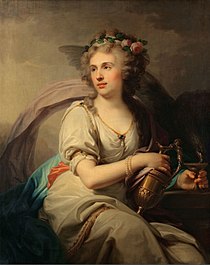
Princess Yekaterina Fedorovna Dolgorukova (nee Baryatinsky ; October 29, 1769 - October 30, 1849) - state lady , cavalier lady; the wife of Lieutenant General Vasily Vasilievich Dolgorukov ; Petersburg acquaintance of Pushkin.
| Ekaterina Fedorovna Dolgorukova | |
|---|---|
 | |
| Birth name | Baryatinsky |
| Date of Birth | October 29, 1769 |
| Date of death | October 30, 1849 (aged 80) |
| Nationality |  Russian empire Russian empire |
| Occupation | stats lady |
| Father | Fedor Sergeevich Baryatinsky (1742-1814) |
| Mother | Maria Vasilievna Khovanskaya (d. 1813) |
| Spouse | |
| Children | 3 sons and 2 daughters |
| Awards and prizes |
|

Content
Biography
The representative of the princely family of the Baryatinsky . The only daughter of Chief Marshal Fyodor Sergeyevich Baryatinsky and his wife Princess Maria Vasilievna Khovanskaya .
At the first publication in 1785, at the masquerade festival hosted by Potemkin in Anichkov Palace for Catherine II, the 16-year-old Catherine Baryatinsky attracted universal attention with her beauty and grace. Major General L. N. Engelhardt recalled [1] :
| ... Two couples were dancing a quadrille: Prince Dashkov with Princess Baryatinsky, who first appeared in public and surprised everyone with her beauty, and especially with her dexterity and flexibility. She was dressed simply in a white dress, and her gentleman was in excess of her uniform in a white domino. The second pair was Countess Matyushkina, her cavalier was Count G.I. Chernyshev , both couples danced so that I had never seen the best dancers in my life. |
The empress honored the young Baryatinsky with her attention and granted her maids of honor , perhaps to please Prince Baryatinsky, one of her main associates during the 1762 palace coup .
Marriage
In January 1786, Ekaterina Baryatinskaya married Lieutenant-General Prince Vasily Vasilievich Dolgorukov. After the wedding, the young couple settled in St. Petersburg in their own house on Bolshaya Morskaya , d.31. With the beginning of the Russian-Turkish war, Prince Vasily Dolgorukov went to the army. He participated in the capture of Ochakov , for which he was awarded the Order of St. George, 2nd degree .
Ekaterina Fedorovna followed her husband into the army, spent the winter of 1790 in Bender , where Prince Potemkin was seriously carried away by her. However, according to contemporaries, all the efforts of the prince to achieve the location of the young beauty were in vain. She loved her husband and was known for "firm rules . " P.V. Zavadovsky informed S. Vorontsov [2] :
| The prince, who has come here, does not otherwise engage as a society of women, seeking them to be liked and to fool and deceive them. He fell in love with the army in Princess Dolgorukova, daughter of Prince. Baryatinsky. A woman surpassed the morals of her gender in our century: she neglected his heart. He rushes about like mad. Wounded ambition makes him laughable. |
True, not everyone thought so, in her memoirs Countess V. N. Golovina wrote [3] :
| ... I immediately noticed Potemkin's passionate attention to Princess Dolgorukova. For some time she held back in my presence, but vanity took up, and she indulged in the most shocking coquetry, which more and more distanced us from each other. Everything around me was unpleasant, and the air itself seemed infected. |
His Highness the Prince gave holidays in her dugout palace, in which she was present in an odalisque costume, fulfilled all her wishes and whims, sent couriers to Paris for ball shoes for her and even expedited the assault of Ishmael for her, wanting to amaze her with the sight of an attack fortresses.
The writer Sollogub , according to Count Golovkin , told such an episode. Once Potemkin, prancing on a horse, asked Ekaterina Fedorovna to give him a sniff of a snowdrop pinned to her mantle. She reluctantly filed a flower. At this time, the horse jerked, and the snowdrop fell into the mud. “You allow me, princess, to return the same flower to you!” Asked Potemkin, and having received consent, he immediately sent the courier to Petersburg. A few days later he presented her with a specially made diamond snowdrop of marvelous work, but this gift was rejected. In a fury, Potemkin threw the precious flower to the ground and trampled it [4] .
After returning to St. Petersburg in 1791, Ekaterina Dolgorukova took first place among the beauties of the imperial court. Combining intelligence, gaiety and charming courtesy with beauty, she was surrounded by a crowd of fans, among whom stood out the Austrian ambassador Count Ludwig Kobenzel , who was notable for his passion for amateur performances. They were played in the house of Princess Dolgorukova, and the main roles were very successfully and with great talent played by the hostess herself, who sang wonderful, and her friend Princess N.I. Kurakina . The portrait of Catherine Fyodorovna in the image of Sibyl was written by Marie Vigee-Lebrun , who noted [5] :
| ... Her beauty struck me: her facial features were strictly classical, mixed with something Jewish, especially in profile; long dark brown hair fell on her shoulders; her waist was amazing, and in all her person there was as much nobility as grace. |
The serene life of the Dolgorukovs ended with the reign of Paul I. The emperor disgraced Prince Fyodor Sergeyevich Baryatinsky as a participant in the sad events of the last days of the reign of Peter III . At the request of Ekaterina Fedorovna to have mercy on his father, Pavel answered with anger: “ I also had a father, madame! [6] "The Baryatinsky were forced to go abroad. In August 1799, disgrace befell Prince V.V. Dolgorukov. He was ordered to leave St. Petersburg at his Znamenskoye estate near Moscow at twenty-four hours with a ban on entry into both capitals. A few months later, the Dolgorukovs received permission to go abroad.
They spent two years in Dresden , traveled to Vienna and Paris . In France, Catherine Fyodorovna occupied a prominent position where regular visitors to her salon were Lagarpe , Abbot Delisle , Count Segur , Vigee-Lebrun ; she was friendly with Madame Recamier , and appeared at the court of the first consul Bonaparte , however, not hiding her contempt. With her piercing remarks, she provoked Bonaparte's discontent. Soon, articles unflattering for the princess appeared in newspapers, and after the proclamation of the empire, the Dolgorukovs moved to Italy . Due to the outbreak of war with Russia, returning to France was impossible, and Princess Dolgorukova and her children spent the winter of 1804-1805 in Naples . A. Ya. Bulgakov , who lived there, wrote to his brother [7] :
| Congratulate us with Dolgorukova, our Petersburg neighbor. She is very kind and good yet. On November 4th, San Carlo was illuminated, but she dazzled more than candles: all eyes were turned on her. You have Catherine III - Pushkina , and we call Dolgorukova so ... I and the princess have infrequent quarrels over her cursed passion for the game, how painful it is for my heart to see a young woman whom I love, upsetting my estate. What a miserable and incurable passion - cards! |
In August 1806, the Dolgorukovs moved to Vienna, where Ekaterina Fedorovna had many friends, and in July 1807 they returned to Russia. In St. Petersburg, the Dolgorukov family was introduced to the court. Ekaterina Fedorovna again took her befitting place in the world. Emperor Alexander I and the royal family attended balls that she gave the city and the diplomatic corps. Her son, Prince Nikolai Vasilievich, later wrote [8] :
| ... Our house has become one of the most beloved. Selective society gathered with us. |
In 1812, Ekaterina Fedorovna was widowed. Prince Dolgorukov died of an apoplexy strike, leaving debts of half a million rubles. In 1816, she was granted the ladies of cavalry , on August 22, 1826, at the coronation of Nicholas I as state ladies , and in 1841 she received the Order of St. Catherine of the Great Cross.
Until a very old age she appeared at court celebrations, where she was respected and respected. However, Pushkin knew her and gave her a sharp description in his diaries [9] :
| ... They grumble at the two ladies chosen for the future ball in the representatives of the Petersburg nobility: Princess KF Dolgoruky and Countess Shuvalova. The first is the concubine of Prince Potemkina and the lover of all the Italian castrates ... |
She died at the age of eighty, was buried next to her husband in a church at the estate of Volynshchino-Poluektovo, Ruzsky district of Moscow province .
Family
The Dolgorukovs had five children:
- Vasily Vasilievich (03/27/1787 - 12/12/1858), received home education, since 1808 lieutenant of the Semenovsky regiment; participated under Alexander I in the Turkish war, distinguished himself in the storming of Brailov and in the battle of Silistria. Having left military service, he served in the court department all his life, since 1812 he was a chamber junker, since 1814 he was a chamberlain, and from 1819 he was the stalmeister of the court, he received the Alexander ribbon in the coronation of Nicholas I. Since 1832, the chief-stalmeister of the court, was in charge of the royal stables; from 1832 to 1841 he was the St. Petersburg provincial leader of the nobility. In 1834 he was awarded the Order of St. Vladimir 1 tbsp. , and in 1839 made a knight of the Order of St. St. Andrew the First-Called . He was married since 1812 to maid of honor Varvara Sergeyevna Gagarina (1793-1833), sister of the director of the Imperial Theaters, Prince S. S. Gagarin.
- Nikolai Vasilievich (10.10.1789 - 02.06.1872) - a marshal, married since 1821 to Princess Ekaterina Dmitrievna Golitsyna (1801-1881), state lady, daughter of General D.V. Golitsyn and granddaughter of the famous "Queen of Spades" N. P. Golitsyna .
- Ekaterina Vasilievna (04.21.1791 - 01.18.1863), received home education, was a good musician and dancer, in 1808 she was granted maids of honor and then married Count Sergei Nikolaevich Saltykov (1777-1828), the youngest son of Field Marshal N. And Saltykov . The marriage was so unsuccessful that Alexander I himself invited her to divorce her and her husband and arrange a new brilliant party. Ekaterina Vasilievna was distinguished by religiosity and piety, therefore, rejected the offer of the emperor. Widowed in 1828, having no children, she served all her life at court, in 1835 she was granted the status of ladies, from 1840 to 1855 she served as clerk at the court of Tsarevich Alexander Nikolayevich, then Empress Maria Alexandrovna and cavalier lady Order of St. Catherine the Great Cross. In her estate on the Okhta River, Saltykova founded a poorhouse for poor women and built a stone church in the name of St. Catherine, for the maintenance of the almshouse she bequeathed capital and was buried in a crypt under the temple.
- Alexander Vasilievich (10.31.1794 - 03.24.17.1795)
- Sofya Vasilievna (07/04/798 - 05/05/1979).
Vasily Vasilievich Dolgorukov Ekaterina Fedorovna with her sons Vasily Vasilievich,
a sonVarvara Sergeevna,
daughter-in-lawEkaterina Vasilievna,
daughter
Notes
- ↑ Engelhardt L.N. Zapiski.-M.: New Literary Review, 1997.-257 p.
- ↑ Archive of Prince Vorontsov. Prince 12. - M., 1877.- P.68.
- ↑ Life story of a noble woman. - M.: New Literary Review, 1996.- P.106.
- ↑ Sollogub V.A. Tales. Memoirs. - L., 1988.S. 485.
- ↑ Memoirs of Mrs. Vigee-Lebrun about her stay in St. Petersburg and Moscow 1795-1801 / Per. from French: Art .- SPB, 2004.- 298s.
- ↑ Life story of a noble woman. Memoirs of Countess Golovina - M .: New Literary Review, 1996.-S. 175.
- ↑ Bulgakov brothers. Correspondence. T. 1. - M .: Zakharov, 2010 .-- 606 p.
- ↑ Russian archive. 1892. No. 11. P.266.
- ↑ Pushkin A.S. Diary of 1834
Literature
- Russian portraits of the XVIII — XIX centuries . Ed. Led. Prince Nikolai Mikhailovich. SPb. 1906. T. I vol. III. Number 85