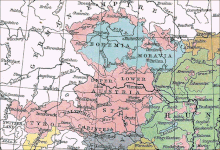
Sudeten Germans ( German: Sudetendeutsche , Czech. Sudetští Němci, Sudetoněmci, Sudeťáci ) - an ethnographic group of Germans, who until 1945 compactly lived in the border regions of the Czech Republic ( Sudeten region ). This term was also used by a number of politicians in the 1920s-1930s as a common label for all Germans within the borders of Bohemia , Moravia and Czech Silesia .
Content
From Austria-Hungary to Czechoslovakia
By the 19th century, Germans made up the majority of the population of the Sudeten region (about 90%). However, during the partition of Austria-Hungary in 1918 , the northwestern border of Czechoslovakia passed along the traditional border of the kingdom of Bohemia (despite the uprisings and attempts to proclaim four German administrations in the disputed region), which immediately posed the “German question” to the young republic (the number of Sudeten Germans reached by 1938 3.3 million people). The respective territories were known as the Sudetenland ( German: Sudetenland ).
“A common designation of all Germans throughout Czechoslovakia never existed” [2] . The very concept of “Sudeten Germans” first appeared in 1902 (introduced by the writer Franz Jesser), but it was sporadically used to refer to the Germans in Bohemia and Moravia in the 1920s , and was only introduced into active political life by Henlein in 1933. [3] The formation of the Czechoslovak Germans as a special ethnic group refers specifically to the interwar period (until 1918 the Germans from Prague or Brno did not identify themselves specifically with the German rural population of the Sudetenland).
In the political system of interwar Czechoslovakia, ethnically “Czechoslovak” public organizations were for the most part formally separated from the “German”, and several political parties of Sudeten Germans operated: social-democratic, agrarian (landbund), Christian socialists (clericals). It was in the Sudetenland that the organization with the name “National Socialist Workers' Party” (DNSAP) first appeared, its leader Rudolf Jung emphasized that it was older than Hitler's NSDAP [4] ; in the fall of 1933 this party was banned. The education system was isolated, the historical division of Charles University into Czech and German branches was preserved. In the Czechoslovak Parliament, Germans, like other national minorities, had the right to speak their native language.
Nazi period
The politically active national-separatist Sudeten German party Konrad Henlein , which arose in 1935 on the basis of the Sudeten German national front and immediately won the national elections (ahead of all the “Czechoslovak" parties), demanded autonomy at first, and then the Sudetenland joined The Third Reich . Soon after the Anschluss of Austria, under the pressure of Germany, without the participation of Czechoslovakia, the four-sided Munich Agreement of 1938 was concluded, as a result of which the territories of the Sudeten Germans - the most industrialized and important areas for the military industry - became part of Germany.
In the Third Reich, part of the Sudetenland formed a special Reichsgau Sudetenland ( German: Reischsgau Sudetenland ), with its capital in Reichenberg (Lieberz). Henlein was the imperial commissar, and then the stalter and Gauleiter of the NSDAP in the Sudetenland. A large number of military equipment was produced on this territory. Some areas were annexed to Bavaria and to Ostmark , the former Austria (Reichsgau Upper Danube and Reichsgau Lower Danube).
Deportation
After World War II, according to Benes decrees, Sudeten Germans (numbering more than 3 million) and Carpathian Germans (about 500 thousand), who lived in Slovakia and Transcarpathian Ukraine, were expelled from Czechoslovakia and settled in various regions of Germany and Austria (this was accompanied by numerous victims among the civilian population, " death marches ", etc.), and the liberated lands were inhabited by Czechs.
After 1945
Currently, there are organizations of people from the Sudetenland in Germany and Austria: the Sudetendeutsche Landsmannschaft, which was created on the basis of 4 associations: the Tillage Society, the Zeliger Society, the Johannes Matesius Society - evangelical Sudeten Germans and the Vitiko Bund.
The three Bavarian ethnic groups were joined by the exiled Sudeten Germans (the “fourth tribe”), who moved to Bavaria mainly after 1945. Free Earth provided them with protection and support. The Decree of November 5, 1962 states: The Government of Bavaria recognizes Sudeten Germans to be an indigenous Bavarian population. Filled with gratitude to their new homeland, the “new Bavarians” put a lot of effort into its restoration after the Second World War. [five]
In the Czech Republic itself lives 40 thousand people who consider themselves Germans. The problem of Sudeten Germans continues to surface from time to time in Czech-German and Czech-Austrian relations.
In Hungary, a group of scientific researchers and teachers created the organization “Scientific meeting of the Sudeten Germans” ( Hungarian. Szudétanémet Tudományos Gyűjtemény , German. Sudetendeutsche Wissenschaftliche Sammlung , English Collections for Research into Sudeten German Minority , Polish which Zbiór Naukow is representing), whose goal is Zbiór Naukow Ničdeck Nichkow Ničdeck Nichkyu Nchkow and the preservation of the culture of the Sudeten Germans [6] .
On November 3, 2009, the President of the Czech Republic, Vaclav Klaus , signed the Lisbon Treaty [7] [8] , and its entry into force formally gives the Sudeten Germans who were deported the right to demand compensation from the Czech government [9] .
Famous Sudeten Germans
- Otto Kittel
- Kurt Knispel
- Gregor Johann Mendel
- Ferdinand Porsche
- Otfried Preusler
- Oscar Schindler
- Adalbert Stift
- Tomasz Enge
- Barbara Bouchet (last name Barbara Bouchet; last name Gocher (Goutscher))
Notes
- ↑ Statistický lexikon obcí v Republice československé I. Země česká. - 1934.
Statistický lexikon obcí v Republice československé II. Země moravskoslezská. - 1935. - ↑ Brugel JW Češi a Němci 1918-1938. Praha, 2006, S. 178.
- ↑ Bobrakov-Timoshkin A. The project "Czechoslovakia": a conflict of ideologies in the First Czechoslovak Republic (1918-1938), M., 2008, p. 199.
- ↑ Ibid., P. 176.
- ↑ Das Land Bayern: Menschen in Bayern - Tradition und Zukunft. (inaccessible link) . Date of treatment September 22, 2013. Archived November 15, 2012.
- ↑ list of publications (Hungarian)
- ↑ BBC Russian - News Feed - The last obstacle to the signing of the Lisbon Treaty has been removed
- ↑ The Czech President signed the Lisbon Treaty . RIA Novosti (November 3, 2009). Date of treatment November 3, 2009. Archived March 2, 2012.
- ↑ The European Union threatened the Czech Republic with the removal of the post of European Commissioner
See also
- Germans resettlement east
- Pan-Germanism
- Sudeten crisis
Literature
- Kretinin S.V. Sudeten Germans: a people without a homeland. 1918-1945. Voronezh, 2000. ISBN 5-7455-1135-4