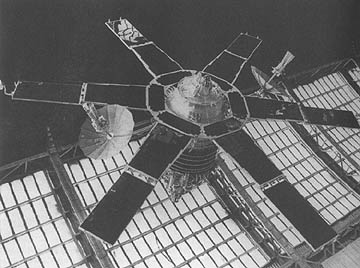
The power supply system of a spacecraft ( power supply system , BOT ) - a spacecraft system that provides power to other systems, is one of the most important systems, in many respects it determines the geometry of spacecraft, design, mass, and the period of active existence. Failure of the power supply system leads to the failure of the entire apparatus.
The power supply system usually includes: a primary and secondary source of electricity, converting, chargers and control automation.
Content
System Settings
The required power of the apparatus’s power plant is constantly growing as new tasks are mastered. So the first artificial Earth satellite ( 1957 ) had a power plant with a power of about 40 W , the Molniya-1 + satellite ( 1967 ) had a power plant of 460 W [1] , and a communication satellite Yakhsat 1B (2011) - 12 kW [2] .
Today, most onboard equipment of foreign-made spacecraft is powered by a constant voltage of 50 or 100 volts. If it is necessary to provide the consumer with alternating voltage or constant of a non-standard value, static semiconductor converters are used.
Primary Energy Sources
As primary sources, various energy generators are used:
- solar panels ;
- chemical current sources , in particular:
- batteries
- galvanic cells
- fuel cells ;
- radioisotope energy sources ;
- nuclear reactors .
The primary source includes not only the power generator itself, but also the systems serving it, for example , the solar cell orientation system .
Often, energy sources combine, for example, a solar panel with a chemical battery.
Solar panels
Today, solar panels are considered one of the most reliable and fairly well-developed options for providing spacecraft with energy.
The radiation power of the Sun in the Earth’s orbit is 1367 W / m² . This allows you to get about 130 watts per 1 m² of solar panel surface (with an efficiency of 8 ... 13%). Solar panels are placed either on the outer surface of the apparatus or on the opening hard panels. To maximize the energy delivered by the batteries, the perpendicular to their surface should be directed to the Sun with an accuracy of 10 ... 15˚. In the case of rigid panels, this is achieved either by orientation of the spacecraft itself or by a specialized autonomous electromechanical orientation system of solar batteries , while the panels are movable relative to the body of the apparatus. Some satellites use non-oriented batteries, placing them on the surface so that at any position of the device the necessary power is provided.
Solar panels degrade over time under the influence of the following factors:
- meteor erosion reducing the optical properties of the surface of photovoltaic converters;
- radiation that lowers the photovoltage , especially during solar flares and when flying in the radiation belt of the Earth ;
- thermal shocks due to deep cooling of the structure in the shaded areas of the orbit, heating in the lit and vice versa. This phenomenon destroys the fastening of individual battery cells, the connection between them.
There are a number of measures to protect batteries from these phenomena. The effective time of solar panels is several years, this is one of the limiting factors that determine the time of active existence of a spacecraft.
When the batteries are shaded as a result of maneuvers or entering the shadow of the planet, the energy production by the photoelectric converters ceases, therefore the energy supply system is supplemented with chemical batteries (chemical buffer batteries).
Batteries
The most common in space technology are nickel-cadmium batteries , as they provide the largest number of charge-discharge cycles and have better resistance to overcharging. These factors come to the fore with the life of the apparatus for more than a year. Another important characteristic of a chemical battery is specific energy, which determines the mass-dimensional characteristics of a battery. Another important characteristic is reliability , since backup of chemical batteries is highly undesirable due to their high mass. The batteries used in space technology are usually sealed; tightness is usually achieved with metal-ceramic seals . The following requirements are also applicable to batteries:
- high specific weight and size characteristics;
- high electrical characteristics;
- wide range of operating temperatures;
- the ability to charge low currents;
- low self-discharge currents.
In addition to the main function, the battery can play the role of a voltage regulator on-board network, since in the operating temperature range its voltage changes little with a change in the load current.
Fuel Cells
This type of energy source was first used on a Gemini spacecraft in 1966. Fuel cells have high performance in terms of mass and size characteristics and specific power compared to a pair of solar panels and a chemical battery, are resistant to overloads, have a stable voltage, and are noiseless. However, they require a supply of fuel, therefore they are used on devices with a period of stay in space from several days to 1-2 months.
Mostly hydrogen-oxygen fuel cells are used, since hydrogen provides the highest calorie content , and, in addition, the water formed as a result of the reaction can be used on manned spacecraft. To ensure the normal operation of fuel cells, it is necessary to ensure the removal of water and heat generated as a result of the reaction. Another limiting factor is the relatively high cost of liquid hydrogen and oxygen , and the complexity of their storage.
Radioisotope Energy Sources
Radioisotope energy sources are used mainly in the following cases:
- high flight duration;
- missions to the outer regions of the solar system , where the flux of solar radiation is small ( Cassini-Huygens , New Horizons , etc.);
- because of low orbits, reconnaissance satellites with side-view radar cannot use solar batteries, but they have a high energy demand [3] ( US-A , Cosmos-1818 , etc.).
Power System Automation
It includes devices for controlling the operation of the power plant, as well as monitoring its parameters. Typical tasks are: maintaining the system parameters in specified ranges: voltage , temperature , pressure , switching operating modes, for example, switching to a backup power source; failure recognition, emergency protection of power supplies, in particular by current ; issuing information about the state of the system for telemetry and to the astronaut’s console.
In some cases, it is possible to switch from automatic to manual control either from the astronaut's remote control or by commands from the ground-based control center.
Notes
- ↑ Lightning 1+ . OJSC Information Satellite Systems named after Academician M.F. Reshetnev. Date of treatment October 2, 2010. Archived June 21, 2012.
- ↑ Satellite information . Tele-satellite. Date of treatment December 22, 2011.
- ↑ I. Afanasyev On the history of the development of marine radio reconnaissance satellites (Inaccessible link) . Cosmonautics News Magazine, No. 01, 2007 (January 2007 ). Date of treatment July 21, 2007. Archived February 25, 2012.
Literature
- Gushchin V.N. Power supply systems // Fundamentals of spacecraft design: Textbook for high schools. - M .: Mechanical Engineering, 2003. - S. 217-241. - 272 p. - 1000 copies. - ISBN 5-217-01301-X .