The Battle of Silar is the last battle between the Roman and rebel forces during the Spartacus uprising , ending in the defeat of the rebels.
| Battle of Silar | |||
|---|---|---|---|
| Main Conflict: Spartacus Rebellion | |||
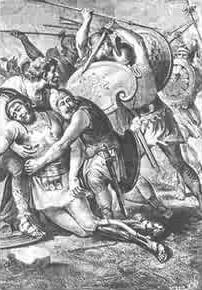 The death of Spartacus at the Battle of Silar | |||
| date of | 71 BC e. | ||
| A place | at the headwaters of the Silar River, Italy | ||
| Total | victory of the Romans | ||
| Opponents | |||
| |||
| Commanders | |||
| |||
| Forces of the parties | |||
| |||
| Losses | |||
| |||
Content
- 1 Background
- 2 Battle
- 3 Summary
- 4 notes
- 5 Literature
Background
Spartak after the battle of Lake Lucanus retreated to the Petelian Mountains (modern Strongoli ) in Bruttius , overtaken by the Roman legions. The persecution of Spartacus Crassus entrusted the legate Quintus Arrius and the quaestor Gnei Skrofe. There, Spartacus stopped the retreat and attacked the Romans. Due to constant clashes, the resources of the rebel army were almost exhausted. In this situation, the leader of the rebellious slaves believed that, being in unfavorable conditions, it was necessary to avoid battle, but his army demanded to go to Crassus. Spartak had to submit - for the decisive battle with the Roman troops all the forces were gathered [3] . Spartak became a camp near the headwaters of the Silar River (now Selje) [4] .
Battle Progress
The slaves understood that this was their last battle, so the battle was fierce. But, despite all the efforts of the leader of the slaves, in this last battle his army was completely and completely defeated, and the vast majority was killed on the battlefield [2] . The further fate of Spartak is unknown.
Roman historians pay tribute to his personal courage in the final battle. Appian reports that Spartak “was wounded in the hip with a dart: having knelt down and putting forward his shield, he fought off the attackers until he fell with a large number of those surrounding him” [2] . Plutarch writes: “... before the start of the battle, a horse was brought to him, but he drew his sword and killed him, saying that in case of victory he would receive many good horses from enemies, and in case of defeat he would not need his own. With these words he rushed at Crassus himself; neither enemy weapons, nor wounds could stop him, and yet he didn’t make his way to Crassus and only killed two centurions that encountered him. Finally, abandoned by his comrades-in-arms, who fled from the battlefield, surrounded by enemies, he fell under their blows, not retreating a step and fighting to the end ” [3] . Flor writes: "Spartacus, bravely fighting in the front row, fell like a commander." Although Spartak’s body was never found, according to historians, he died in battle along with his people.
Summary
According to Appian, the Romans, having destroyed the army of Spartacus, lost only a thousand people, but other historians consider this figure implausible. The body of Spartak was never found on the battlefield. The remnants of the army of Spartak were destroyed by Crassus and the army of Pompey, which gave Pompey the right to challenge the victory over Spartak. Six thousand captured gladiators were crucified by order of Crassus along the Appian Way , from Capua to Rome [5] .
Notes
- ↑ Welley Patculus. II. 30.5
- ↑ 1 2 3 Appian. Civil wars. I. 120
- ↑ 1 2 Plutarch. Crassus. eleven
- ↑ Goroncharovsky, 2011 , p. 135.
- ↑ Joshel, 2005 , p. 80.
Literature
- Appian . Roman history. Civil wars .
- Lucius Anney Flor . Epitomes of Roman history .
- Sextus Julius Frontin . About military tricks
- Titus Livy . The history of Rome from the foundation of the city ( in the electronic library ).
- Pavel Oroziy . The story against the Gentiles.
- Plutarch . Comparative biographies : Crassus , Pompey
- Goroncharovsky V.A. Spartak war: rebellious slaves against the Roman legions. - SPb. : Petersburg Oriental Studies, 2011 .-- 176 p. - (" Militaria Antiqua , XIV").
- Sandra R. Joshel, Margaret Malamud, Donald T. McGuire, Jr. Imperial Projections: Ancient Rome in Modern Popular Culture . - JHU Press, 2005 .-- P. 87. - 299 p. - ISBN 978-0-8018-8268-5 .