
The Astrarium , also called the Planetarium, is an ancient astronomical clock created in the 14th century by Italian Giovanni de Dondi [2] . The appearance of this tool marked the development in Europe of technologies related to the manufacture of mechanical watch instruments . Astrarium simulated the solar system and, in addition to counting time and presenting calendar dates and holidays, showed how planets moved around the celestial sphere [3] . This was his main task, in comparison with the astronomical clock, the main task of which is actually the countdown. It can be said that the Astrarium was a complex medieval mechanism, combining the functions of a modern planetarium , clock and calendar [4] . Devices performing this function were created before, and after Giovanni de Dondi, but relatively little is known about them. Despite this, some sources say that Astrarium was the first mechanical device to show planetary movements [5] [6] .
History
The section provides a description and comparison of tools manufactured at different time periods, but having the same functions as the Giovanni de Dondi Astrarium: each device was simultaneously a planetarium, a clock and a calendar. By date of creation, you can distribute them as follows:
| Antikythera mechanism | 150-100 years BC e. |
| Astrium Giovanni de Dondi | 1364, according to most sources |
| Planetarium Lorenzo della Volpaya | 1510 year |
| Passman Astronomical Clock | 1749 year |
| Ace Aisings Planetarium | 1781 year |
| Jens Olsen Astronomical Clock | 1955 year |
Antique Age
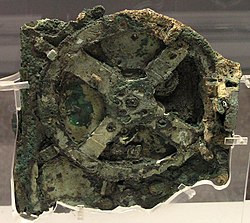
The ancient predecessors of the Astrarium were complex mechanical devices, a kind of attempt to simulate the position and movement of the planets, but any comments on the structure of such devices or guidelines for their manufacture were not preserved. Archimedes is credited with using the planetarium (a primitive version of the Astrarium), or the “celestial sphere,” with which it was possible to observe the movements of the planets, the rising of the Sun and the Moon , the phases and eclipses of the Moon , the disappearance of both celestial bodies beyond the horizon [8] [9] [ 10] .
| External video files | |
|---|---|
| A selection of video files about the Antikythera mechanism (English) | |
| Antikitharian device on YouTube | |
Evidence that complex mechanical devices existed long before the Astririum Giovanni de Dondi was discovered at the beginning of the 20th century. In 1900-1901, the remains of a shipwreck were found by a group of sponge catchers near the Greek island of Antikythera [9] [10] [11] [12] [13] [14] [15] . Under the guidance of archaeologist Valerios Stais [16] and under the control of the Greek government, a block of oxidized material was raised to land, inside of which there was a mechanism with gears [10] . He sank about 70 BC. e. [7] [10] [13] [17] [18] and became known as the Antikythera mechanism - an analogue of Astrarium.
This mechanical tool calculated the positions of celestial bodies and indicated the position of the observer himself on the surface of the Earth [17] [18] . The antikythera mechanism is considered an early analog computer , which was created to calculate the position of the sun and moon on a specific date [11] [13] [14] [19] [20] . In 2002, Michael Wright , a mechanical device specialist at the London Museum of Science , suggested that the mechanism could simulate not only the movements of the Sun and Moon, but also of the five ancient planets known as Mercury , Venus , Mars , Jupiter and Saturn [9] [21] . Later, in 2005, the Greek-British Antikythera Mechanism Research Project [10] [18] was launched, during which detailed studies of the Antikythera mechanism were carried out. Since this device spent almost two thousand years under water, most of its fragments were corroded [10] [13] . Despite this, the researchers were able to study the details of its structure, as well as to understand the inscriptions that cover some surfaces [7] [9] [10] . Having understood the inscriptions, scientists found that the names of the planets were engraved on most of the gears. This fact confirmed Wright's assumption. During the study, fragments of the mechanism were investigated using X-ray radiation [10] [13] [22] , which resulted in the manufacture of copies of an ancient instrument [14] [23] [24] .
The National Archaeological Museum in Athens exhibits 378 fragments of various objects found at the shipwreck, including 82 surviving parts of the Antikythera mechanism itself [9] [10] [13] [18] . To determine its age, two safe (from the point of view of impact on the studied object) methods were used - PTM [15] and computed tomography , as a result of which the approximate date of the creation of the mechanism was determined: 150-100 years BC. e. [7] [14] This case, however, is exceptional: no data has yet been found on any similar device. Before the sunset of the Roman Empire, the technology of its creation was lost. Until the fourteenth century, there were no devices of similar complexity, right up to the advent of mechanical astronomical clocks in Europe [25] .
Middle Ages and Renaissance
The creation of mechanical watches that visualize the movement of celestial bodies was an important activity of medieval scientists and engineers. In the XII century, a Baghdad engineer Ismail al-Jazari built a tower water clock, showing not only time, but also the movement of the zodiac, sun and moon (with changing phases) across the sky [26] . Significant success in this direction was achieved by the English scientist of the 14th century, Richard Wallingford [27] . The astronomical clock he developed around 1330 showed the motion of the sun, planets, the motion and phases of the moon, and the level of tides in the Thames. The watch mechanism contained spiral gears, oval rings, numerous gears. The clock was placed on the inner wall of the cathedral of St. Albany Monastery , of which Richard served as abbot.
Giovanni de Dondi Astrarium
The following documented case of making an astronomical clock is associated with the name of the Italian Giovanni de Dondi (1318–1389 [Comm. 1] ), a resident of Padua , a medieval doctor and scientist involved in astronomy and watchmaking . Giovanni was one of the most significant astronomers of his time. He inherited interest in astronomy and watchmaking from his father, Jacopo de Dondi , which in 1344 was designed [33] [34] [35] with the assistance of Prince Ubertino da Carrara built on Piazza dei Signori in Padua, street chimes, subsequently placed on the palace tower in Piazza Capitagnato [36] . This astronomical clock was one of the first of its kind, but in 1390 it burned down during the storming of the palace by the Milanese [35] . Today, the reconstructed astronomical clock based on the prototype of Jacopo de Dondi is working on the tower of Padua [37] .
Giovanni, his son, designed and built a new astronomical clock, the so-called Astrarium , or Planetarium , a mechanical disk clock with weights and a battle mechanism. According to most sources, Astrarium was created by him between 1348 and 1364 [3] [5] [6] [12] [29] [34] [38] [39] [40] [41] [42] [43 ] [44] [Comm. 2] . Giovanni worked on it for a long time - 16 years. After completing work and demonstrating the invention in the main square of Padua [30], the mechanism was moved to the castle library [3] . The manufacture of Astrarium was an extremely difficult task for that time, since no workshop was adapted for such work. Giovanni was ahead of time: for the manufacture of Astrarium, he used the methods of mechanics, which came into widespread practice several centuries later. This, perhaps, was the reason that in the following centuries after the creation of the Astrarium no one could repair it - there were not enough qualified specialists in this matter [1] [3] [29] [46] . The Astrarium indicated the path of the Sun, the Moon, and the five planets known at that time, orbiting the Earth, based on the then prevailing Ptolemaic worldview [6] [20] [30] [40] [47] (see also Almagest ). Giovanni also measured the duration of each day in hours and minutes and with the help of the Astrarium indicated the exact date and name of the saint revered on a certain day [3] .
The most famous literary work of Giovanni, dedicated to the Astrarium and containing its detailed description, is Tractatus Astrarii ( Russian treatise on the luminaries ) [3] [28] (written by him in medieval Latin [1] [29] ), which was published in 1389 in Padua. This book was reprinted in 1960 by the Vatican Library in Rome [48] and in 2003 by the Geneva publishing house Droz ( Fr. Droz ) [45] .
In 1381, de Dondi presented his Astrarium to the Duke Gianazzo Visconti , who installed it in the library of his castle in Pavia . Astrarium remained there until at least 1485. It is known that in the first half of the XVI century he survived repairs after a breakdown. The master who repaired it was Juanelo Turriano (1501-1585). This Italian-Spanish master is also known for the manufacture of complex astronomical clocks that display the annual movement of the sun, moon and planets (according to the Ptolemaic worldview) [3] . In 1630, the original Astrarium Giovanni de Dondi was lost in Mantua [6] , and its further fate is unknown.
Working hours recreated according to the prototype of Jacopo de Dondi’s clock on the palace tower in padua
Tractatus Astrarii - the main work of Giovanni de Dondi, dedicated to his creation
One of the pages of the Tractatus Astrarii . Depicts the entire steering wheel driven by weights
Edition of Tractatus Astrarii by the Vatican Apostolic Library [48]
One of the publications based on the Tractatus Astrarii de Dondi [49]
Lorenzo della Volpaya Planetarium
Another mention of astronomical clocks showing the movement of the planets dates back to the second half of the Renaissance and is associated with the Italian master Lorenzo della Volpaia ( Italian: Lorenzo della Volpaia ) (1446-1512). He was a famous architect, jeweler, mathematician and watchmaker, who founded the Florentine dynasty of watchmakers ( it ) (his sons Camillo, Benvenuto and Euphrosino , as well as Girolamo's nephew followed [50] [51] .
As a watchmaker, della Volpaya became famous for the construction of planetary watches. They had an exquisitely decorated large dial dial, divided into time sections and displaying zodiac signs . Such a dial, innovative at that time, gave the observer the opportunity to follow, without taking his eyes off the instrument, the movement of all the planets known at that time - Saturn, Jupiter, Venus, Mars and Mercury [52] . The smaller drive, which moved clockwise, had six sections. Five of them were disks of the above planets. They rotated counterclockwise. In the sixth section, there was a mechanism called “ dragon ” [Comm. 3] , which displayed lunar nodes and eclipses. In the center of the planetarium were also disks showing the phases and age of the moon, as well as having a solar pointer. The clock marked (ringing) the hour, day, and month [52] .
Like the Astrarium de Dondi, the main task of the della Volpaya planetarium was not to accurately time the clock, but to display the position of celestial bodies relative to the Earth (geocentrism still prevailed in those days). The manufacturer of such a watch should have had considerable knowledge in the field of astronomy, the exact sciences, and the construction of mechanisms [52] .
It is known that Lorenzo della Volpaya made two models of such watches [52] . One was commissioned by Lorenzo Medici (1449-1492) as a gift to Matthias I (1443-1490), King of Hungary [50] . Another model of Lorenzo watches was made by him in 1510 and handed over to the authorities for placement in the Lily Hall (at that time Sala dell'Orologio - the Watch Hall) in the Palazzo Vecchio [51] . Workshop of Lorenzo on Oriolo street passed to his sons, who worked in it throughout the XVI century [50] .
In 1560, Girolamo, Lorenzo’s nephew, restored his uncle’s watch, but already at the end of the 17th century this watch was lost (possibly disassembled or destroyed) [52] [53] .
New time
Passman Astronomical Clock
In the following centuries, several more similar designs were made. One example is Passman’s astronomical clock, an instrument created in 1749 by engineer Claude-Siméon Passemant ( French Claude-Siméon Passemant ) (1702-1769), Louis Dautier watchmaker ( French Louis Dauthiau ) (1730-1809), sculptors and masters in bronze, Jean-Jacques Caffieri (1725-1792) and Philip Caffieri (1714-1774). The clock showed the current time, date, phase of the moon and planetary motion [54] [55] [56] . However, the Passman clock, in comparison with the Astrarium, showed the movement of the planets, starting from the heliocentric system of the world, and not the geocentric [56] [57] . They were made of gilt bronze, steel, copper and glass, and also partly covered with enamel. The planisphere crowned the two-meter watch design, in the center of which the Sun was located, and planets, including the Earth, revolved around it, the Moon around the Earth. The planisphere was framed by rings with the designation of the signs of the zodiac and the equinox . On a bronze ball denoting the Earth, countries and some cities were shown [57] . The mechanism of this watch was designed to display all the elements up to 9999 [58] .
The watch was demonstrated by the French Academy of Sciences in August 1749 [54] [57] , approved and later presented by the Duke of Sholn King Louis XV in 1753 [54] [56] [59] (1750 [57] ). Kings and representatives of the nobility in those days had a certain passion for science, and Louis XV was interested in astronomy, geography and related inventions, so he bought this watch in the same year. In 1754 (1760 [60] ), he placed the Passman’s watch in the Cabinet with the clock of the King’s Small Apartments in the Palace of Versailles , where they are today [55] [57] [59] .
Ace Acesings Planetarium
Another well-known example is a planetarium built between 1774 and 1781 [61] [62] [63] by the Dutch amateur astronomer [64] Ace Eisinga (1744–1828) from Dronrape , Friesland (Netherlands) . In 1774, panic broke out in Friesland caused by a small pamphlet written by the Rev. Elko Alta ( Dutch Eelco Alta ) [64] [65] [66] Russian resident of Bozum in Friesland. The publisher of the brochure, wanting to increase its popularity, spread a rumor among readers that Elko Alta predicted the end of the world [63] . It was rumored that on May 8, 1774, a parade of planets will take place - Jupiter, Mars, Venus, Mercury, and the Moon, which will lead to devastating consequences not only "for the Earth, but for the entire solar system", and may even be a "prelude or the beginning of its partial or total destruction ” [65] .In the pamphlet itself, Alta was much less eloquent, but on the orders of the Friesland government, dubbing her “rebellious,” she was immediately arrested. It was published only after the terrible date passed without any harm [67] [68] .
Eise Aisinga wanted to show people that there was no reason to panic [62] [63] [69] [70] [Comm. 4] . Свой планетарий он разместил прямо на потолке собственного дома в городе Франекер [63] . По сравнению с Астрариумом Джованни де Донди, в конструкции Эйсинги все планеты следуют вокруг Солнца (а не вокруг Земли ). Планеты движутся пропорционально, с такой скоростью, с какой они делают это на самом деле : Меркурий — за 88 дней, Земля — за один год, а Сатурн — за 29 лет [62] . Вместо запланированных 8 месяцев работы на построение планетария понадобилось не менее 7 лет, в его создании Эйсе Эйсинге помогал отец, который на своём токарном станке изготовил все шестерни для конструкции [67] . Кроме этой модели, Эйсе Эйсинга также соорудил всевозможные специальные часы, отображавшие день, дату, восход и закат Солнца и Луны, видимое движение неба из-за вращения Земли и других явлений [71] . Вся конструкция планетария приводилась в движение внушительным механизмом, который был сделан из деревянных обручей и дисков с 10 тысячами рукодельных гвоздей, похожих на зубы [62] . Движением этого механизма управляли девять гирь и маятник, для размещения которого Эйсинге пришлось сократить супружеское ложе в своей гостиной [67] [71] . Этот планетарий отображал все известные к тому времени планеты (до открытия Урана в 1781 году оставалось всего несколько лет с начала работы Эйсинги, но он узнал об этом уже после завершения своей работы над планетарием, и на размещение новой планеты уже не хватило места на потолке дома [67] ). В планы Эйсинги, однако, входила постройка ещё более грандиозного планетария, чем на потолке его дома, но из-за неспокойной политической обстановки эти планы не были реализованы [67] [69] .
Современность
Часы Йенса Ольсена
В 1955 году по проекту датского мастера-часовщика Йенса Ольсена (1872—1945) были изготовлены астрономические часы , выполняющие множество разных функций, среди которых была также демонстрация передвижения планет Солнечной системы, как и у Астрариума. Датчанин работал над ними в течение всей своей жизни с начала XX века. В молодости Ольсен отправился путешествовать по Европе и в 1897 году был вдохновлён часами Страсбургского собора . После обучения часовому делу в Базеле он вернулся на родину и приступил к работе над своими часами. Все необходимые вычисления удалось закончить лишь к 1932 году, когда Йенсу Ольсену было уже 60 лет. Лишь более чем через 10 лет после этого были выделены деньги и началась постройка часов, проект приобрёл национальное значение. Процесс занял ещё 12 лет, но в 1945 году Йенс Ольсен умер от болезни. Его работу продолжил молодой часовщик Отто Мортенсен ( дат. Otto Mortensen ). Лишь после того, как все детали часов (количеством 15 448 штук) были изготовлены и собраны воедино, король Дании Фредерик IX и внучка Йенса Ольсена — Биргит Ольсен — запустили часы. Это произошло 15 декабря 1955 года в здании копенгагенского муниципалитета. Ко времени их создания эти часы считались самыми сложными механическими часами в мире [3] [72] .
Часы Йенса Ольсена отражают вечный календарь , текущее мировое время , местное солнечное время и разницу между ними . Один из дисков часов показывает время для любого места на Земле, другой — время восхода и заката Солнца. Благодаря сложному устройству можно узнать длительность дня и ночи, а также текущую дату — день недели, месяц и год (по юлианскому календарю ). Часы отображают также фазы Луны и показывают дату Пасхи . Особая верхняя секция часов Йенса Ольсена показывает карту звёздного неба над Данией, подобно Страсбургским часам (которые, соответственно, показывают карту звёздного неба над Страсбургом), а также прецессию Земли . Стрелка такого указателя совершает один полный оборот за 25 753 года. Ещё один диск отображает геоцентрическую орбиту, затмения Солнца и Луны , а также расстояние между Землёй и Луной. Часы Ольсена показывают также движение планет вокруг Солнца. По сравнению с Астрариумом де Донди, планетариумом делла Волпайя и планетарием Эйсинги, эти часы, помимо движений Меркурия, Венеры, Марса, Юпитера и Сатурна, показывают ещё и движение таких планет, как Уран и Нептун , а также самой Земли [3] [72] .
Реконструкции
Благодаря сохранившимся рукописям мастеров, изготовивших перечисленные инструменты, создаются их многочисленные реконструкции.
Несмотря на то, что Астрариум де Донди, состоявший из 297 частей (107 из которых были различными шестернями и рычагами) [3] [30] , был утерян, итальянец оставил в своих рукописях детальные описания, которые сохранились и дали современным мастерам возможность создать реконструкции аппарата [44] . Этой задачей занимались лондонская фирма Thwaites & Reed [6] [29] , а также разные европейские мастера. Некоторые из версий реконструированного Астрариума имеют меньший (по сравнению с оригиналом) размер — 0,25—0,5 от оригинала [1] [73] . Известно о наличии реконструированных моделей Астрариума в следующих местах:
- Музей науки (Лондон) [1] [29] ,
- Международный музей часового дела ( Ла-Шо-де-Фон , Швейцария) [6] [20] [28] [29] ,
- Вашингтонский Национальный музей американской истории Смитсоновского института [29] [30] [40] ,
- Музей науки и технологии «Леонардо да Винчи» в Милане [28] [29] [30] ,
- Парижская обсерватория [5] [29] [31] ,
- Музей часов в Бейере ( Цюрих , Швейцария) [29] ,
- Штаб-квартира IBM в Армонке (штат Нью-Йорк ).
В Музее времени в Иллинойсе среди экспонатов также был реконструированный Астрариум, но в 1999 году музей закрылся, затем коллекция была доступна посетителям в Музее науки и промышленности (Чикаго) , а в 2004 году она была продана [74] .
Итальянец Луиджи Пиппа ( итал. Luigi Pippa ) в 1963 году реконструировал Астрариум Джованни де Донди на основе публикации Tractatus Astrarii 1960 года [28] [75] [76] . Другим итальянским мастером, Карло Кроче ( итал. Carlo G. Croce ), Астрариум также реконструирован, исходя из Tractatus Astrarii Джованни де Донди (публикации 1960 года) [1] . Голландский конструктор Хенк Гипманс ( нидерл. Henk Gipmans ) после многолетнего изучения рукописей Джованни де Донди также реконструировал Астрариум [47] .
О планетариуме Лоренцо делла Волпайя известно меньше, чем об Астрариуме де Донди, но до наших дней тоже дошли манускрипты семьи делла Волпайя, содержащие информацию, необходимую для реконструкции утерянных часов Лоренцо. Используя сохранившуюся информацию, Музей Галилея (до 2010 известный как Институт и музей истории науки) во Флоренции в 1994 году реконструировал планетариум Лоренцо делла Волпайя [52] [53] .
Планетарий Эйсе Эйсинги и сегодня можно увидеть на потолке его дома во Франекере [77] , превращённого в своеобразный музей. Глядя на действующую модель планетария Эйсинги, наблюдатель может проследить за движением планет (см. Ссылки ). Этот планетарий считается самым старым действующим планетарием в мире [62] .
Идея отображения позиций небесных тел относительно Земли или Солнца легла в основу создания планетариев в первой половине XX века [78] . Сегодня в мире существуют тысячи планетариев, некоторые из которых показывают в формате IMAX историю Вселенной и другие астрономические феномены, подобно кинотеатрам, используемым в предпринимательских целях.
Описание Астрариума Джованни де Донди
Origin
| External video files | |
|---|---|
| Изображение работающего Астрариума (итал.) | |
| L'Astrario di Giovanni Dondi на YouTube | |
Джованни де Донди писал, что почерпнул идею для создания Астрариума из Theorica Planetarum Джованни Кампано , который описал конструкцию экваториума [29] [30] . Астрариум был часовым механизмом, за основу которого был взят именно этот вычислительный прибор. В конструкцию Астрариума входили астролябия и циферблат, а также индикаторы Солнца, Луны и планет [4] . Он обеспечивал непрерывный показ основных элементов Солнечной системы и правового, религиозного и гражданского календарей. По замыслу де Донди, Астрариум помог бы людям лучше представить астрономические и астрологические явления и идеи [30] . Во времена Джованни де Донди астрономия и астрология были тесно взаимосвязаны и практически не отделялись друг от друга.
Итальянец дал своему изобретению имя Астрариум , показывая цель данного механизма: определить истинное расположение планет, их орбиты , движения и эволюцию . Он упоминал, что, согласно Аристотелю , всё берёт своё название от цели, для которой оно было сотворено. И книга Tractatus Astrarii , которая описывает сам инструмент, движение его частей и то, как исправить ошибки при работе с ним, — подтверждение этому [28] .
Для расчёта движения планет Джованни де Донди пользовался также альфонсовыми таблицами , составленными приблизительно между 1252 и 1270 годами с целью облегчить расчёт позиций планет и позволявшими вычислять их местонахождение в определённое время и на нужной географической широте. Во времена Джованни де Донди альфонсовы таблицы были чрезвычайно популярны [79] [80] [81] .
Appearance
Астрариум был примерно 1 метр по высоте и опирался на семиугольный бронзовый каркас [29] [82] на 7 декоративных ножках в форме лап. Циферблат часов и диски планет вместе со всеми шестернями были выполнены из латуни [3] . Нижняя секция состояла из механизма с часами на одной из его сторон. Циферблат этих часов был разделён на 24 части (по количеству часов в сутки) и вращался вокруг определённой точки против часовой стрелки [3] . На нём были отмечены церковные переходящие праздники и зодиакальная позиция восходящей Луны. Верхняя секция содержала семь дисков с подвижными частями [73] , каждый из которых был примерно 30 см в диаметре и располагался на одной из сторон семиугольника [12] . На этих дисках были показаны движения Солнца , Луны , Венеры, Меркурия, Сатурна, Юпитера и Марса [4] [12] [20] [29] [30] [50] [73] . Устройство каждого из дисков, кроме диска Луны [1] , было независимым от остальных [29] .
Джованни де Донди своими собственными руками сконструировал эти часы со 107 подвижными частями. Не было использовано ни одного винтика, и каждая частица скреплялась с другой при помощи более трёхсот конических булавок, шпилек, штырьков и клиньев, некоторые из которых были спаяны [1] . У большинства шестерёнок механизма были острые зубья треугольной формы, но некоторые были с тупым концом. Зубья всех шестернёй были вырезаны мастером вручную [3] . В отдельных случаях де Донди использовал эллиптические шестерни [Комм. 5] с целью как можно точнее смоделировать нерегулярные движения планеты . Он пользовался для этого также эпициклами Птолемея (созданными им для подсчёта размеров Вселенной [73] [84] ), основанными на его таблицах [29] [43] , которые могли быть использованы также для расчёта будущего или прошлого положения планет [85] .
Medieval units , due to the lack of international standards , were limited by the needs of everyday life (the length of a piece of fabric or the distance from the abbey to the castle), and de Dondi indicated the sizes in his instructions in Tractatus Astrarii with more accurate objects, in his opinion: the thickness of the blade large or small knife, and for the holes - the width of a goose feather , human thumb , etc. [1]
Purpose
The astrarium was conceived to reflect the world and the celestial processes taking place in it. Since the time of Ptolemy , it was accepted that the daily movement of heaven controls the movements of celestial bodies, just like a calendar wheel Astrarium controls the disks of the planets [29] [81] [86] . His main task was, in our opinion, quite extraordinary: to show in the sky the location of all the planets known at that time [29] . Additional tasks were: measuring the time of day (as well as stellar and average solar time ), indicating the current date and the perpetual calendar of Easter [3] [43] . In Tractatus Astrarii de Dondi also mentioned another purpose of his mechanism - to demonstrate that Aristotle's description of the Avicenna and the motion of celestial bodies were justified [30] [47] .
The Astrarium was one of the first tools in which the Arab traditions to create miniature models of the Universe (and its measurement), that is, astrolabes and equatoriums, were combined with new mechanical watch technologies that have been circulating in Europe since the beginning of the XIV century. This instrument was a time meter, a kind of analog computer , and an instrument showing planetary movements: it allowed people to observe the movements of celestial bodies without preliminary calculations, which were consistent with the mechanical model of the Ptolemaic theory of cosmology [30] [47] [87] .
Clock Movement
The astrium "came to life" from the chain with weights. She set in motion a clock mechanism (which made one revolution per day). This mechanism imparted movement to the calendar wheel (which made one revolution per year), and that, in turn, with the help of many gears simultaneously controlled all the planet disks [29] . This last movement was the whole complexity of the mechanism: Giovanni had to very skillfully and sophisticatedly build a mechanical model so as not to make a mistake with the parameters of each disk [1] [3] .
The movement of the clock was also regulated by a kind of balancer ( en ), which had a stroke frequency of once every two seconds. The clock mechanism had, in addition to 24 main (hourly) divisions, six 10-minute divisions per hour. He turned counterclockwise, starting from a fixed pointer, and indicated the main time, and could also be adjusted if necessary at 10-minute intervals by extending the 12-gear gear, which mesh with its 144 teeth [88] . A special plate ( tabula orientii ) was fixed on each side of the clock mechanism, divided into months and days of the Julian calendar in order to determine the sunrise time and establish the average solar time for the latitude of Padua (approximately 45 ° N ) [88] . At the time the clock was made, the solstice occurred on June 13 and December 13 (old style) [30] .
Calendar Wheel
The annual calendar wheel — the drum in the lower section — had a diameter of about 40 cm (43 cm [3] ). It set in motion a calendar of passing holidays and planet disks. Around the outer side of the wheel was a wide ribbon divided into 365 bands, each of which had a number (indicating the day), a lancelet letter and the name of the saint revered on that day [89] . The months were alternately gilded and silver-plated , and the engraved letters are filled, respectively, with red and blue enamel . De Dondi did not indicate any signs or features of a leap year , he advised stopping the watch for the whole extra day [30] .
Sun Disc
Directly above the 24-hour disk was the disk of the Sun ( Primum Mobile - “first movable”) - the most distant from the center of the Astrarium, so named because it reproduced the daily movement of stars and the annual movement of the Sun against their background . At its core, it was an astrolabe drawn on the projection of the South Pole , with a plate fixed on it and a special network that rotated only once a sidereal day [6] . This net had 365 teeth and was driven by a wheel with 61 teeth. Such a wheel made 6 revolutions in 24 hours ( sunny day or sidereal day). Thus, once a day, the network turned around one full interval + 1/366, which equated to 366 Sun passes through the meridian ( climaxes ) [90] . De Dondi understood that his approximate calculations of the duration of the solar year did not fully correspond to actual reality, and recommended occasionally stopping the watch so that it could be corrected [3] [30] .
Planet Disks
Looking at the working Astrium Giovanni de Dondi, the observer could see on the disks of the planets which path (relative to the Earth in the center of the disk) the planets take. The movement of each of them was irregular and differed from the path of other planets, showing how they move along a loop-shaped trajectories [48] .
Astrarium had five planet disks: Mercury [91] , Venus [92] , Mars [93] , Jupiter [94] and Saturn [95] . For each disk, a functioning system with a complex mechanism was separately developed in order to most accurately model planetary movements. Such models were in good agreement with both the Ptolemaic geocentric theory and observations. For example, on the Mercurian disk, de Dondi used intermediate wheels, which included: a wheel with 146 teeth, two oval gears (having 24 teeth of a non-standard shape, engaged each other), as well as a special gear with internal gearing (it had 63 teeth which mated with 20-tooth gears and made one irregular rotation per year). The implementation of these difficult processes made it possible with the help of the Astrarium to learn more about the planets and their movement through the sky [30] .
Disks of the planets of the reconstructed Astrarium Giovanni de Dondi (works by Carlo Croce [1] )
Venus Disc Mercury Disc Saturn Disk Jupiter Disk Mars disc
Disc of the Moon and the Dragon Head
The disk of the Moon [83] is one of the most complex in construction, since it had two pear-shaped gears and, unlike the disks of planets, was dependent on other disks of Astrarium, and also had a connection with the “Dragon Head” mechanism [96] . This particular mechanism, presumably, reflected the lunar cycles ( nodes of the moon ) [30] . Astrarium went through this closed cycle for exactly 18 years, 7 months and 14 days [1] [97] , which almost completely coincides with the period of the lunar precession ( 18.5996 years ). However, it is unclear how Giovanni de Dondi managed to achieve such accuracy.
Moon disk "Dragon's head"
Astrarium Perception
The Astrarium was believed to be a miracle of its time, no less than the eighth wonder of the world - one of the best examples of human genius [29] [46] . Giovanni Manzini ( Italian: Giovanni Manzini ) from Pavia in 1388 wrote that it was “a thing full of ingenuity, created and perfected by one’s own hands and carved with a skill unattainable for any master. I come to the conclusion that such a magnificent and brilliant invention has never been created ” [30] [98] .
Lewis Mumford called Astrarium “the key mechanism of the new industrial era”, and its appearance is an event “marking the perfection that other mechanisms strive for” [34] [99] .
In July 2006, in Moscow, in the Armory of the Moscow Kremlin , an exhibition was held entitled “History in Time”, dedicated to the 200th anniversary of Kremlin museums and the 160th anniversary of the Swiss watch manufacturer Ulysse Nardin [100] [101] . As part of the exhibition, among other exhibits, the reconstruction of the Astrarium Giovanni de Dondi was shown. On the opening day of the exhibition, it was the Astrarium that was most popular with guests [102] .
Similar Tools
- The armillary sphere is an astronomical tool used to determine the equatorial or ecliptic coordinates of celestial bodies, a model of the celestial sphere.
- The Gottorp Globe is one of the first planetariums in the world in the form of a huge globe, created in the 17th century. Inside it, one could observe the movement of the Sun and stars, the changing times of the day, however, due to the technical complexity, he did not show the movements of the planets and the Moon.
- Orrarius - a device that illustrates the relative position of planets and moons in the solar system and their movement in the heliocentric model.
- A planetarium (device) is a device used to project images of celestial bodies onto the planetarium dome, as well as to simulate their movement.
- Planisphere - an atlas of the starry sky on a plane, an instrument in the form of two adjustable disks that rotate on a common rod; a descendant of astrolabe. It was used to determine the moments of sunrise and sunset of heavenly bodies.
- Tellurium is a device for visual demonstration of the annual motion of the Earth around the Sun and the daily rotation of the Earth around its axis. It also displays the phases of the moon and the perpetual calendar .
- Torquetum is an astronomical tool that combines the functions of the armillary sphere and astrolabe and allows you to set the coordinates of an astronomical object by measuring in various systems of celestial coordinates - horizontal , equatorial and ecliptic .
See also
- Deserent is a concept used along with the epicycle in ancient and medieval theories of planetary motion, including the geocentric model of Ptolemy.
- Celestial mechanics is a branch of astronomy that applies the laws of mechanics to study the motion of celestial bodies.
- Nocturlabium is a navigation device that allows you to determine the time based on the position of the stars in the sky (unlike a sundial, it could function at night).
- The stability of the solar system is an important issue in astronomy and celestial mechanics, revealing the issues of gravity of celestial bodies and their interactions.
- Equant is a mathematical concept developed by Claudius Ptolemy in the II century BC. e. in order to take into account the movements of celestial bodies.
- Ephemeris is a table that contains the positions of moving astronomical objects in equal time intervals.
Notes
- Comments
- ↑ The exact birth and death dates of Giovanni de Dondi are unknown. Sources indicate 1318 [3] [6] [28] [29] or 1330 [30] [31] the year of his birth and 1387 [3] , 1388 [28] [31] [32] or 1389 [6] [29] [30] year of death.
- ↑ However, according to other sources, Giovanni only began his work in 1365, and finished it in 1381 [29] [30] [44] [45] (1384 [28] ).
- ↑ The Giovanni de Dondi also had a mechanism called the Dragon Head . The name of this mechanism “dragon” is due to the fact that he was responsible for the demonstration of lunar cycles ( nodes of the moon ), which during the Middle Ages were called “Dragon's Head” and “Dragon's Tail”.
- ↑ According to the latest data, this assumption is doubtful, since Ace Aisinga, apparently, began the construction of the planetarium before the publication of the brochure of Elko Alt [67] [70] .
- ↑ On such gears, the teeth also varied in size and the spacing between them [83] .
- ↑ In the original work of Giovanni de Dondi, Tractatus Astrarii, numbers do not indicate pages, but sheets. Each sheet has two sides - the front ( recto ) and the back ( verso ).
- Used literature and sources
- ↑ 1 2 3 4 5 6 7 8 9 10 11 12 13 14 15 Giovanni de Dondi ASTRARIUM (# 37 ) . Carlo G. Croce. - The site of the Italian master, who recreated the Astrium Giovanni de Dondi. Date of treatment January 9, 2013. Archived September 26, 2012.
- ↑ Museo Galileo - Multimedia - Mechanical clocks (English) . Galileo Museum . - About mechanical watches and Astrarium. Date of treatment December 30, 2012. Archived October 3, 2012.
- ↑ 1 2 3 4 5 6 7 8 9 10 11 12 13 14 15 16 17 18 19 Hours with an Easter calendar . St. Petersburg Clock Restoration Center (May 1, 2006). - The Antique Review magazine about astronomical clocks depicting church holidays and the Giovanni de Dondi Astrarium (No. 2, May 2006). Date of treatment December 30, 2012. Archived September 26, 2012.
- ↑ 1 2 3 Tourisme au pays d'Aurillac - Manifestations - Expositions (French) . Office du Tourisme du pays d'Aurillac. - Exhibition of the Astrarium Giovanni de Dondi in the Château de Pesteils . Date of treatment September 5, 2012. Archived on October 4, 2012.
- ↑ 1 2 3 Harris, Judith. Celebrating Galileo in Florence - California Literary Review . California Literary Review (March 22, 2009). - Information about Galileo Galilei and the Giovanni de Dondi Asterium, dedicated to the Year of Astronomy 2009 in Rome . Date of treatment August 30, 2012. Archived September 26, 2012.
- ↑ 1 2 3 4 5 6 7 8 9 Image of de dondi's 'astrarium', the world's first astronomical clock, 1364 . Inventory No .: 1974-0386 . Science & Society Picture Library. - Reconstruction of the Astrarium Giovanni de Dondi by Thwaites & Reed . Date of treatment August 15, 2012. Archived on September 26, 2012.
- ↑ 1 2 3 4 The Cosmos in the Antikythera Mechanism, 2012 .
- ↑ Zhytomyr, 2001 .
- ↑ 1 2 3 4 5 World Mysteries - Strange Artifacts - Antikythera Mechanism (English) . - Secrets of the world - Antikythera mechanism. Date of treatment August 31, 2012. Archived October 4, 2012.
- ↑ 1 2 3 4 5 6 7 8 9 Kuznetsov Pavel. Athens. National Archaeological Museum - Reconstruction . Antikythera mechanism . New Herodotus. - The history of the discovery and description of the Antikythera mechanism. Date of treatment September 5, 2012. Archived on October 4, 2012.
- ↑ 1 2 Antikythera mechanism is no longer a mystery . Pravda.Ru (July 10, 2009). Date of treatment September 7, 2012. Archived October 4, 2012.
- ↑ 1 2 3 4 Planetarium on the verge of centuries . "Nature" No. 12, 2000 . Surdin V.G. - An article on planetariums and the history of their invention. Date of treatment September 3, 2012. Archived October 4, 2012.
- ↑ 1 2 3 4 5 6 Greek Archaeoastronomy - Antikythera Mechanism . Ayiomamitis, Anthony. - Photos of the Antikythera mechanism and facts about it. Date of treatment September 7, 2012. Archived October 4, 2012.
- ↑ 1 2 3 4 Naeye, Robert. A Millennium Ahead of Its Time . Sky & Telescope (November 29, 2006). - The history of the discovery and study of the Antikythera mechanism. Date of treatment September 7, 2012. Archived October 4, 2012.
- ↑ 1 2 Antikythera Mechanism Relighting Demonstration . Hewlett-Packard . - HP Antikythera Research Information. Date of treatment September 7, 2012. Archived October 4, 2012.
- ↑ Η εν Αθήναις Αρχαιολογική Εταιρεία (Greek) . - Site of the Athenian archaeological community. Date of treatment August 15, 2012. Archived on September 26, 2012.
- ↑ 1 2 The Antikythera Mechanism I (English) . American Mathematical Society . - The history of the Antikythera mechanism, images and principles of its work. Date of treatment August 31, 2012. Archived October 4, 2012.
- ↑ 1 2 3 4 The Antikythera Mechanism Research Project . - A site dedicated to the research aspects of the Antikythera mechanism. Date of treatment August 15, 2012. Archived on September 26, 2012.
- ↑ Price, 1959 , pp. 60-67.
- ↑ 1 2 3 4 Jaquet-Droz Automates & Merveilles Exhibition . Watchonista Blog. - An exhibition of various clockworks. Date of treatment September 5, 2012. Archived on October 4, 2012.
- ↑ Wright, 2002 , pp. 169-173.
- ↑ The Antikythera mechanism: The clockwork computer . The Economist (September 19, 2002). - Overview on the topic of the Antikythera mechanism. Date of treatment August 31, 2012. Archived October 4, 2012.
- ↑ Webpages of St. G. Frangopoulos (Jpg). teiath.gr. - Copies of the Antikythera mechanism. Date of treatment August 15, 2012. Archived on September 26, 2012.
- ↑ Michael Wright's reconstruction of the Antikythera Mechanism . Imperial College London . - Reconstruction of the Antikythera mechanism of work of Michael Wright. Date of treatment August 17, 2012. Archived October 3, 2012.
- ↑ Marchant, Jo. In search of lost time (англ.) // Nature. — 2006. — Vol. 444 , no. 7119 . — P. 534—538 . — DOI : 10.1038/444534a . — . — PMID 17136067 .
- ↑ Salim TS Al-Hassani. Al-Jazari's Castle Water Clock: Analysis of its Components and Functioning
- ↑ North J. God's Clockmaker: Richard of Wallingford and the Invention of Time. Oxbow Books, 2004, pages 171—218.
- ↑ 1 2 3 4 5 6 7 8 L'Astrario di Giovanni Dondi (Italian) . National Museum of Science and Technology Leonardo da Vinci . - About the Giovanni de Dondi Astrarium with comments by Luigi Pippa. Date of treatment December 30, 2012. Archived September 26, 2012.
- ↑ 1 2 3 4 5 6 7 8 9 10 11 12 13 14 15 16 17 18 19 20 21 22 Dondi's astrarium, the eighth wonder of the world . IN HISTORY . HH Magazine de la Haute Horlogerie (October 24, 2008). - The history of the Astrarium Giovanni de Dondi, the details of its structure and the comments of the masters who reconstructed it. Date of treatment September 3, 2012. Archived September 26, 2012.
- ↑ 1 2 3 4 5 6 7 8 9 10 11 12 13 14 15 16 17 18 19 Tiziana Pesenti. Giovanni Dondi Dall Orologio in Dizionario Biografico - Treccani (Italian) . Dizionario Biografico degli Italiani, Volume 41, 1992. - Biography of Giovanni de Dondi. Date of treatment September 3, 2012. Archived September 26, 2012.
- ↑ 1 2 3 Giovanni de 'Dondi's astrarium - Working Model (English) . Evangelisation of the cosmos . Galileo Museum. - Image of a copy of the Astrarium de Dondi with description Date of treatment August 30, 2012. Archived September 26, 2012.
- ↑ Belloni, 1982 .
- ↑ Watches, a device for measuring time // Encyclopedic Dictionary of Brockhaus and Efron : 86 volumes (82 volumes and 4 additional). - SPb. , 1890-1907.
- ↑ 1 2 3 John H. Lienhard. Engines of Our Ingenuity, No. 1535: INVENTING THE CLOCK . University of Houston . - The history of mechanical watches and Astrarium. Date of treatment August 30, 2012. Archived September 26, 2012.
- ↑ 1 2 Padua Astrarium - Early Town Clock . About.com . - About the Jacopo de Dondi watch. Date of treatment September 5, 2012. Archived on October 4, 2012.
- ↑ Piazza dei Signori - Comune di Padova (Italian) . Comune di Padova (13 ottobre 2008). - The history of Piazza dei Signori (of. Padua website). Date of treatment August 15, 2012. Archived on September 26, 2012.
- ↑ Borsella, 2009 .
- ↑ Usher, 1929, 1954, 1970 , Chapter 7.
- ↑ Storage time line . Museum of American Heritage (April 20, 2010). - A chronology of the development of information storage methods from prehistoric times until 1999. Date of treatment August 15, 2012. Archived on September 26, 2012.
- ↑ 1 2 3 Breaking through: The Creative Engineer . National Engineers Week Foundation. - Information about the Astrarium at the bottom of the page. Date of treatment September 3, 2012. Archived September 26, 2012.
- ↑ Knox, Dilwyn. La biblioteca del Cardinal Pietro Bembo (review ) // Renaissance Quarterly. - 2007. - Vol. 60, no. 4 . - P. 1304-1307. (Retrieved September 5, 2012)
- ↑ Emery, Yannick. Did you hear about the famous Astrarium? (eng.) . Fondation de la Haute Horlogerie (August 29, 2011). - Image of the Astrarium and its creation date. Date of treatment August 29, 2012. Archived September 26, 2012.
- ↑ 1 2 3 Science Timeline . - Chronology of the development of science. See Between 127 and 141 about Ptolemy and In 1364 about Giovanni de Dondi. Date of treatment August 30, 2012. Archived September 26, 2012.
- ↑ 1 2 3 Making the Modern World - Machinery in motion . Clockmaking The Science Museum. Date of treatment September 5, 2012. Archived on October 4, 2012.
- ↑ 1 2 Tractatus Astrarii, 2003 .
- ↑ 1 2 Dohrn-van Rossum, 1996 .
- ↑ 1 2 3 4 Nieuw Astrarium “De Dondi” gepresenteerd in Museum Asten (nid.) . Klok & Peel Museum Asten. - Reconstruction of the Astrarium Giovanni de Dondi. Date of treatment September 5, 2012.
- ↑ 1 2 3 Tractatus Astrarii, 1960 .
- ↑ The planetarium of Giovanni de Dondi, citizen of Padua, 1974 .
- ↑ 1 2 3 4 Multimedia Catalog - Biographies - Lorenzo della Volpaia (English) . Museum of Galilee (Institute and Museum of the History of Science). - Biography of Lorenzo della Volpaya. Date of treatment December 30, 2012. Archived September 26, 2012.
- ↑ 1 2 Chianti Castello di Volpaia (Italian) . - About the Volpaya family, which got its name from the name of the village - the place where they lived. Date of treatment December 30, 2012. Archived October 4, 2012.
- ↑ 1 2 3 4 5 6 Museo Galileo - Multimedia - Lorenzo della Volpaia's planetary clock . Museum of Galilee. - The Galileo Museum about the planetary clock of Lorenzo della Volpaya. Date of treatment September 3, 2012. Archived October 3, 2012.
- ↑ 1 2 Multimedia Catalog - Instrument - XII.38 Lorenzo della Volpaia's planetary clock (model ) . Museum of Galilee (Institute and Museum of the History of Science). - Planetary clock Lorenzo della Volpaya. Date of treatment December 30, 2012. Archived September 26, 2012.
- ↑ 1 2 3 Mauricheau-Beaupré, 1949 , p. 50.
- ↑ 1 2 Lemoine, 1990 , p. 82.
- ↑ 1 2 3 D'Hoste, 1988 , p. 62.
- ↑ 1 2 3 4 5 The Palace of Versailles: Sciences and Curiosities at the Court of Versailles, exhibition from Oct. 26, 2010 to 3 april 2011 . Versailles . - An exhibition in 2010-2011, which showed various items from the collection of kings from the Bourbon dynasty . Date of treatment January 13, 2013. Archived January 22, 2013.
- ↑ Kergoat; Carpio, 2010 , pp. 78-87.
- ↑ 1 2 de Montebello, 1986 , p. 27.
- ↑ The architectural and artistic composition of the Palace of Versailles: a journey through the halls . Date of treatment January 13, 2013. Archived January 22, 2013.
- ↑ Eise Eisinga Planetarium - UNESCO World Heritage Center . Ministry of Education, Culture and Science (17 August 2011). - About the Ace Aisinga planetarium from the UNESCO website. Date of treatment August 15, 2012. Archived on September 26, 2012.
- ↑ 1 2 3 4 5 Acing Planetarium - Attractions . Interesting places of the planet (November 10, 2010). - A site telling about various interesting places on our planet - about the Acesing planetarium. Date of treatment September 21, 2012. Archived October 4, 2012.
- ↑ 1 2 3 4 Das bewegte Leben von Eise Eisinga (German) . - Biography of Ace Aces. Date of treatment September 21, 2012. Archived October 4, 2012.
- ↑ 1 2 Abbot, Alison. Hidden treasures: Eise Eisinga Planetarium (English) // Nature. - 2008 .-- February 28 ( vol. 451 , no. 7182 ). - P. 1057 . - DOI : 10.1038 / 4511057a .
- ↑ 1 2 Wumkes.nl: Digitale historische bibliotheek (nid.) . Digitale Historische Bibliotheek Friesland. - Friesland's electronic library about Elko Alta. Date of treatment August 15, 2012. Archived on September 26, 2012.
- ↑ Speculatie, Wetenschap en Vernuft (nid.) . Friesian Academy . - Site of the Frisian Academy - on the publication of Zuidervaart. Date of treatment September 6, 2012. Archived October 4, 2012.
- ↑ 1 2 3 4 5 6 Botje, Harm. Eise Eisinga and his Godchild: The Planetarium Zuylenburgh . Bulletin of the Scientific Instrument Society No. 108 (2011). - Biography of Ace Aces. Date of treatment September 6, 2012. Archived on September 26, 2012.
- ↑ Eelco Alta, 1774 .
- ↑ 1 2 Sixma, H. The Franeker Planetarium . Popular Astronomy. - A 1934 article on the Francker planetarium from Popular Astronomy magazine. Date of treatment August 15, 2012. Archived on September 26, 2012.
- ↑ 1 2 Zuidervaart, 1995 .
- ↑ 1 2 The end of time? Year 1774 Koninklijk Eise Eisinga Planetarium. - The official website of the Ace Aisingi planetarium is in English (about the planetarium’s structure and its creation history). Date of treatment August 15, 2012. Archived on September 26, 2012.
- ↑ 1 2 Jens Olsen's Astronomical Clock - Restoration . Atelier ANDERSEN. - The Danish clock remodeling bureau is the main project: Jens Olsen's watch. Date of treatment September 5, 2012. Archived on October 4, 2012.
- ↑ 1 2 3 4 Foyer Martin Brunold. - The site of the Swiss master who reconstructs astrolabes and clockworks. Date of treatment September 5, 2012. Archived on October 4, 2012.
- ↑ The Time Museum Collection . - The history of the watch collection in Illinois. See also the main page of the site. Date of treatment September 5, 2012. Archived on October 4, 2012.
- ↑ Pippa, Luigi, 1963 , pp. 19-21.
- ↑ Pippa, Luigi, 1964 , pp. 22-29.
- ↑ Geschiedenis - het verhaal van Eise Eisinga (nid.) . Eise Eisinga Planetarium. - The official website of the Ace Aisings planetarium is in Dutch (Ace Aisings biography and planetarium history). Date of treatment September 21, 2012. Archived September 26, 2012.
- ↑ King, 1978 .
- ↑ Starry Messenger: Astronomical Tables . Cambridge University . - On the astronomical tables of different eras. Date of treatment September 10, 2012. Archived October 4, 2012.
- ↑ Chabás; Goldstein, 2003 .
- ↑ 1 2 Poulle, 1998 .
- ↑ Braunstein, 2004 .
- ↑ 1 2 Tractatus Astrarii, 1960 , p. 24, verso.
- ↑ Goldstein, 1967 , pp. 9-12.
- ↑ Goldstein, 1997 , pp. 1-12.
- ↑ Poulle, 1980 .
- ↑ Dennis Duke. Ptolemy (англ.) . The Florida State University . — Космология Птолемея, изображение действующей модели геоцентрической системы мира. Дата обращения 15 августа 2012. Архивировано 26 сентября 2012 года.
- ↑ 1 2 Tractatus Astrarii, 1960 , p. 3, recto [Комм. 6] .
- ↑ Tractatus Astrarii, 1960 , p. 4, recto.
- ↑ Tractatus Astrarii, 1960 , p. 10, verso.
- ↑ Tractatus Astrarii, 1960 , p. 17, verso.
- ↑ Tractatus Astrarii, 1960 , p. 13, recto.
- ↑ Tractatus Astrarii, 1960 , p. 29, verso.
- ↑ Tractatus Astrarii, 1960 , p. 29, recto.
- ↑ Tractatus Astrarii, 1960 , p. 28, recto.
- ↑ Tractatus Astrarii, 1960 , p. 30, verso.
- ↑ Tractatus Astrarii, 1960 , p. 33, verso.
- ↑ Belloni, 1982 , p. 39.
- ↑ Gimpel, 1977 .
- ↑ Музеи Московского Кремля — Выставки в Московском Кремле — История во времени . Московский Кремль. — О выставке Ulysse Nardin в Кремле. Дата обращения 3 сентября 2012. Архивировано 4 октября 2012 года.
- ↑ Ulysse Nardin. История во Времени. Кремлевская Коллекция . — О выставке Ulysse Nardin в Кремле и об Астрариуме. Дата обращения 3 сентября 2012. Архивировано 4 октября 2012 года.
- ↑ Ulysse Nardin в Кремле . TimeWay. — Портал о швейцарских часах — о выставке «История во времени», где был показан реконструированный Астрариум. Дата обращения 30 августа 2012. Архивировано 3 октября 2012 года.
- ↑ A Philosopher Lecturing on the Orrery (1764—1766) Архивировано 20 марта 2012 года. , Revolutionary Players, изображение из Музея и художественной галереи Дерби , Дерби , доступно на март 2011.

Literature
- Используемая
- Житомирский С. В. Античная астрономия и орфизм. — М. : Янус-К, 2001. — ISBN 5-8037-0072-X .
- Alta, Eelco; Dongjuma, Wytze Foppes. Philosophische Bedenkingen over de Conjunctie van de Planeten Jupiter, Mars, Venus, Mercurius en de Maan. Op den Agtsten May 1774. staande te gebeuren, en wel over de Mogelijke en Waarschijnlijke Sterre en Natuurkundige Gevolgen deezer Conjunctie. — Boazum, 1774.
- Belloni, Annalisa. Giovanni Dondi, Albertino da Salso e le origini dello Studio pavese. — «Bollettino della società pavese di storia patria» ns XXXIV, 1982. — P. 17—47.
- Borsella, Serenella. Piazza dei Signori, la torre dell'orologio astronomico di Jacopo Dondi tra il XIV e il XXI secolo. — Padova: Padova tra Arte e Scienza, 2009.
- Braunstein, Philippe. Travail et Entreprise au Moyen Âge . — De Boeck, 2004. — 527 p. — ISBN 978-2-8041-4377-0 , 2-8041-4377-5.
- Chabás, José; Goldstein, Bernard R. The Alfonsine Tables of Toledo. Archimedes. New Studies in the History and Philosophy of Science and Technology. — Dordrecht: Kluwer Academic Publishers (с 2003 года — Springer Science+Business Media ), 2003. — ISBN 9781402015724 , 1-4020-1572-0.
- de Dondi, Giovanni. The planetarium of Giovanni de Dondi, citizen of Padua / Baillie, Granville Hugh; Lloyd, Herbert Alan; Ward, FAB — L. : The Antiquarian Horological Society, 1974. — ISBN 0-901180-10-6 .
- de Montebello, Philippe. Recent acquisitions: A selection, 1985—1986 . — New York: The Metropolitan Museum of Art , 1986. — 88 p. — ISBN 9780870994784 , 0870994786.
- D'Hoste J. Georges. Tutta Versailles. Ediz. Inglese . — Florence : Bonechi , 1988. — 128 p. — ISBN 9788847622944 , 8847622948.
- Dohrn-van Rossum, Gerhard. History of the Hour: Clocks and Modern Temporal Orders. — Chicago: University of Chicago Press, 1996. — 455 p. — ISBN 9780226155104 .
- Dondi dall'Orologio, Giovanni. Tractatus astrarii: biblioteca capitolare di Padova, Cod. D. 39 / Introd., trascrizione e glossario a cura di Barzon, Antonio; Morpurgo, Enrico; Petrucci, Armando; Francescato, Giuseppe. — Roma: Città del Vaticano: Bibl. apostol. Vaticana , 1960.
- Dondi dall'Orologio, Giovanni. Tractatus Astrarii / Publ. crit. and tradit. vers. Poulle, Emmanuel. — Genève: Droz, 2003. — ISBN 2-600-00810-1 .
- Freeth, Tony; Jones, Alexander. The Cosmos in the Antikythera Mechanism (англ.) // Institute for the Study of the Ancient World at New York University (ISAW). — 2012. — No. Papers 4 .
- Gimpel, Jean. The Medieval Machine: The Industrial Revolution of the Middle Ages. — L. : Penguin (Non-Classics), 1977. — ISBN 978-0-14-004514-7 .
- Goldstein, Bernard R. Saving the Phenomena: The Background to Ptolemy's Planetary Theory (English) // Journal for the History of Astronomy : magazine. - 1997. - No. 28 . - ISSN 0021-8286 .
- Goldstein, Bernard R. The Arabic Version of Ptolemy's Planetary Hypotheses (Eng.) // Transactions of the American Philosophical Society : Journal. - 1967. - Vol. 4, no. 57 .
- Kergoat, Morgane; Carpio, Marie-Amélie. La science portée au pinacle. Les plus beaux instruments de science invités d'honneur (French) // Excelsior Publications . - Science & Vie , 2010. - N o 119 . - P. 78–87.
- King, Henry C. Geared to the stars: the evolution of planetariums, orreries, and astronomical clocks. - Toronto: University of Toronto Press, 1978. - ISBN 0-8020-2312-6 .
- Lemoine, Pierre. Versailles and Trianon: guide to the museum and national domain of Versailles and Trianon . - Réunion des musées nationaux , 1990. - 269 p.
- Mauricheau-Beaupré, Charles. Versailles, history and art: official guide. The palace, the gardens, the park, the Trianons, the carriage museum, the Royal Tennis Court . - Réunion des musées nationaux , 1949. - 171 p.
- Pippa, Luigi. Ricostruito l'Orologio astronomico di Giovanni de 'Dondi. - La Clessidra, 1963.
- Pippa, Luigi. La Ricostruzione dell'Astrario del Dondi. - La Clessidra, 1964.
- Poulle, Emmanuel . Horologium amicorum Emmanuel Poulle; l'astrarium de Giovanni Dondi, Padoue, Bibliothèque Capitulaire, ms D. 39. - P .: Ecole des Chartes , 1998 .-- ISBN 2-900791-16-2 .
- Poulle, Emmanuel. Les instruments de la théorie des planètes selon Ptolémée: équatoires et horlogerie planétaire du XIIIe au XVIe siècle. - Genève: Droz, 1980 .-- ISBN 2-600-03421-8 .
- Price, Derek John de Solla . An Ancient Greek Computer (Eng.) // Scientific American : Journal. - Springer Nature 1959. - Vol. 200.
- Usher, Abbott Payson. A History of Mechanical Inventions. - London: Oxford University Press , 1929, 1954, 1970.
- Wright, Michael T. A Planetarium Display for the Antikythera mechanism (Eng.) // Horological Journal: Journal. - 2002. - No. 144, No. 5 .
- Zuidervaart, Huib J. Speculatie, wetenschap en vernuft. Fysica en astronomie volgens Wytze Foppes Dongjuma (1707-1778), instrumentmaker te Leeuwarden. - Ljouwert / Leeuwarden: Fryske Akademy , 1995. - 206 p. - (Fryske histoaryske rige, nr. 12). - ISBN 9789061718147 .
- Recommended
- Bach, Henri. Das Astrarium des Giovanni de Dondi. - Furtwangen: Dt. Ges. für Chronometrie, 1985. - ISBN 3-923422-02-4 .
- Barcaro, Francesco Aldo. Pietro d'Abano, Jacopo e Giovanni de 'Dondi dall'Orologio; Tre grandi europei del Trecento. - Padova: Panda, 1991.
- Bedini, Silvio A .; Maddison, Francis Romeril. Mechanical universe: the astrarium of Giovanni de 'Dondi. - Philadelphia: American Philosophical Society, 1966.
- Giovanni Dondi dall'Orologio; (particip. Bullo, Aldo). Tractatus astrarii / Giovanni Dondi dall'Orologio. - Conselve (Padova): Ed. Think ADV; Chioggia (Venezia): Nuova Scintilla.
- Lazzarini, Vittorio. I libri, gli argenti, le vesti di Giovanni Dondi dall'Orologio 7 Vittorio Lazzarini. - Padova: Società Cooperativa tipografica, 1925.
- Lloyd, Alan Herbert. Giovanni de 'Dondi's horological masterpiece; 1364. - Limpsfield.
- Marchant, Jo. Decoding the heavens: solving the mystery of the world's first computer. - London: Windmill Books, 2009 .-- ISBN 978-0-09-951976-8 .
- Morpurgo, Enrico. Giovanni Dondi dall'Orologio. Lo scienziato e l'uomo. - Padova: Società cooperativa tipografica, 1967. - ASIN B0014RHWQS.
- Rose, Paul Lawrence. Petrarch, Giovanni de 'Dondi and the humanist myth of Archimedes - Petrarca, Venezia e il Veneto, 1976.
- Sprague De Camp, L. The Ancient Engineers - Barnes & Noble, 1990 .-- ISBN 978-0-88029-456-0 .
- Thorndike, Lynn. The Clocks of Jacopo and Giovanni de 'Dondi, - Isis, Vol. 10, No. 2, University of Chicago Press, Chicago, 1928.
Links
- Planetarium . Encyclopedia Round the world . Date of treatment September 3, 2012. Archived September 26, 2012.
- Introducing the Annosphere . - Shows the time of day and year, tracks changing seasons, simulates sunrise and sunset for each day anywhere on the Earth. Date of treatment September 3, 2012. Archived September 26, 2012.
- Het planetarium van Eise Eisinga (nid.) . - On the site you can observe the movement of the planets around the Sun with their real (proportionally increased) speed. Date of treatment September 3, 2012. Archived September 26, 2012.
- Solar Tempometer: calculate Your Solar Time . The Order of Time . - A clock showing solar time. Date of treatment September 3, 2012.
- Video Entre terre et ciel, l'astrarium de Giovanni Dondi (Fr.) - A short story about the appointment of Astrarium.