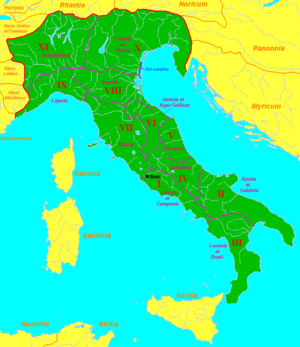

Region X , Venetia and Istria ( lat. Regio X, Venetia et Histria ) - 1) A kind of administrative-territorial unit of the Roman Empire of the Principate era - the “region”, as part of Roman Italy . 2) The province of the Roman Empire, the era of dominance , the Western Roman Empire , as well as, probably, the province of the state of Odoacra , the Kingdom of the Ostrogoths , the Ravenna Exarchate (part of Byzantium ). The main city is Aquileia .
After the invasion of the Lombards in the VI century, most of the province entered the Duchy of Friuli (as part of the Kingdom of the Lombards ), only Byzantium remained the coastal region. During the Middle Ages, almost the entire region came under the control of the Republic of Venice ( see Terraferma ).
Content
History
The administrative-territorial unit “region” was created by the emperor Octavian Augustus [1] for about 7 years with the unification of the ancient regions in Northern Italy - Venetia , Istria , Carnia , as well as the annexation of the land of price zones located in the east of Transpadanian Gaul [2] . Like other regions of Italy, the Xth had a special status, different from the extra-Italian provinces of the Roman Empire , but after the administrative reforms of the emperor Diocletian they were equalized in rights, and "Venetia and Istria", which actually became an ordinary province, became part of the new formation - diocese of Italy. After the reforms of Constantine I , the province was part of the diocese of Rural Italy , which, in turn, was part of the prefecture of Italy, Africa and Illyria (later Illyria became a separate prefecture).
In the era of the Great Migration of Peoples, the province was subjected to invasions of the Visigoths - in 401-406 (ruining the province, unsuccessful attempt for the barbarians to seize Aquileia ), from 408 (ruining the province), Huns - 452 years (ruining the province, plundering Aquileia and other cities) Ostrogoths - from 489 years (ruining a province, creating a kingdom ), Franks - 539 years (ruining a province), from 541 years (ruining a province, in 551 they tried to block the passage of troops of the Byzantine commander Narses here ) and Lombards - from 568 years (looting Aquil ei and other cities, the creation of the kingdom ). Entering various state entities of some of these peoples, the provinces of Venetia and Istria probably retained their approximate borders, and civil administration was built on an administrative system organized by the Romans.
Population and cities
The largest part of the X region was occupied by settlements of Venetian tribes, Roman cities in their territory - Aquileia (the main city of the province), Altin , Atria , Vicenza , Concordia , Opitergy , Patavius , Tarvizy , Feltria [3] [4] . In the northeast there were lands of the Karn tribe [1] , related either to Venets or Celts (Roman cities of Julius Karnikum , Forum Julius ) [5] , to the east, on the Istrian peninsula, there were Istria , a tribe, possibly of Illyrian origin (Rome. the city of Tergest , Pieta Julia / formerly Paula, Parentiy ) [6] . In the northern part of the province lived Eugeneans , Kamuns , Triumpilins , possibly belonging to the Retian tribes. In the western part of the X region there lived a Celtic tribe belonging to the group of авlerks - coenomans [1] (Roman cities of Brixia , Cremona , Bedriac , Mantova , Verona ) [7] . The lands of the tsomanovs were attributed to the region called Transpadanian Gaul among the Romans, which later became part of the province of Cisalpine Gaul , and only after the administrative reforms of Octavian Augustus did they become part of the X region.
Over the centuries, some mutual assimilation of tribes took place in the province, and Roman settlers also played a significant role in local ethnogenesis, the colonies of which were withdrawn both to the local cities and independently. During the period of barbarian invasions, the looting of Aquileia and other large Roman cities, in the more protected zone of the swampy coast, the growth of coastal settlements began - Heracles , Grado , Chioggia , Malamocco [8] , and part of the refugees who moved to the islands of one of the lagoons of the Adriatic Sea laid the foundation the city of Venice [3] .
Management
Archaeological evidence for the existence of latifundia in Istria allows modern scholars to suggest the spread of typically Roman methods of management throughout this region [9] . There is also evidence of active trade in the province - since ancient times, the local cities have been significant points of transshipment between Italy and the northern countries, Baltic amber was an important subject [3] - the territory of Venetia and Istria was the southern end of the Amber Trade Route . Another region with extensive trade ties is Illyria, adjacent to the east and southeast. It is known that trading houses in Aquileia belong to the families of Ceserniev, Statsiev, Kaniev, Barbiev. The interests of these families went beyond the region - often representatives of trading houses (usually freedmen ) acted as attorneys in their commercial affairs in other provinces, for example, in Illyria [10] . In the provinces of Venetia and Istria itself, trading operations were mainly concentrated in Aquileia and the surrounding areas - export and re-export goods were slaves and timber, agricultural products: olive oil, honey, livestock and leather, various local products were also exported: from ceramics, bronzes (for example vessels and padlocks), amber, glass [11] . According to Pliny the Elder , local wine was widely known [12] . The significance of the provincial capital as a center of intermediary trade shows the presence of a special service that served as customs in favor of the Roman treasury [13] . Mining operations probably existed in the province - some ancient authors report the existence of gold mines [14] . In the era of the Roman Empire , infrastructure was also developed on the territory of Venetia and Istria - the river port of Aquileia and the construction of roads provided reliable trade and other ties of the region with Italy and the eastern provinces [15] .
See also
- Roman province
- Venetia
- Istria
- Karnia
Notes
- ↑ 1 2 3 Irmsher J., Jone R. Venetia // Dictionary of Antiquity . - M .: "Progress" , 1989.
- ↑ William R. Shepherd . Historical Atlas. - New York: Henry Holt and Company, 1911.
- ↑ 1 2 3 Venetia // The Real Dictionary of Classical Antiquities / ed. F. Lubker ; Edited by members of the Society of Classical Philology and Pedagogy F. Gelbke , L. Georgievsky , F. Zelinsky , V. Kansky , M. Kutorgi and P. Nikitin . - SPb. , 1885.
- ↑ Some cities are listed in accordance with William R. Shepherd . Historical Atlas. - New York: Henry Holt and Company, 1911.
- ↑ Carni // The Real Dictionary of Classical Antiquities / ed. F. Lubker ; Edited by members of the Society of Classical Philology and Pedagogy F. Gelbke , L. Georgievsky , F. Zelinsky , V. Kansky , M. Kutorgi and P. Nikitin . - SPb. , 1885.
- ↑ Istria // The Real Dictionary of Classical Antiquities / ed. F. Lubker ; Edited by members of the Society of Classical Philology and Pedagogy F. Gelbke , L. Georgievsky , F. Zelinsky , V. Kansky , M. Kutorgi and P. Nikitin . - SPb. , 1885.
- ↑ Cenomani // The Real Dictionary of Classical Antiquities / ed. F. Lubker ; Edited by members of the Society of Classical Philology and Pedagogy F. Gelbke , L. Georgievsky , F. Zelinsky , V. Kansky , M. Kutorgi and P. Nikitin . - SPb. , 1885.
- ↑ Venice (republic) // Brockhaus and Efron Encyclopedic Dictionary : in 86 volumes (82 volumes and 4 additional). - SPb. , 1890-1907.
- ↑ Rostovtsev M.I. Society and economy in the Roman Empire. T. 1. - St. Petersburg: "Science" , 2000. - S. 214; Kuzishchin V.I. Roman slaveholding estate: II c. BC e. - I century n e. - M., 1973. - S. 216-217.
- ↑ Panciera S. La vita economica di Aquileia in età Romana. - Roma, 1957. - P. 76.
- ↑ Rostovtsev M.I. Decree. Op. - S. 76, 79; Kolosovskaya Yu. K. Pannonia in the I — III centuries. - M., 1973. - S. 36; Malevanyi A. M. Roman colonization and socio-economic relations in the province of Illyric by the beginning of the 1st century n e. // Ancient world and archeology. Issue 8. - Saratov, 1990 .-- S. 79-80.
- ↑ Pliny the Elder . Natural history . Prince III. 126.
- ↑ Panciera S. Decree. Op. - S. 61.
- ↑ Aquileia // The Real Dictionary of Classical Antiquities / ed. F. Lubker ; Edited by members of the Society of Classical Philology and Pedagogy F. Gelbke , L. Georgievsky , F. Zelinsky , V. Kansky , M. Kutorgi and P. Nikitin . - SPb. , 1885.
- ↑ Demina CC Concerning the Romanization of Northeast Italy in the 2nd Century BC e. - I century n e. Archived on May 15, 2007. (International scientific and practical (electronic) journal "INTER-CULTUR @ L-NET", issue No. 5, 2006).