Digital rank is one of the systems of counting Old Russian cryptography .
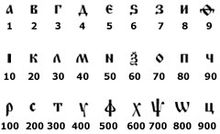
In the period of the Russian Middle Ages, Arabic numerals were not used. Some letters of the Cyrillic alphabet had a numerical value, such a system was called " digital ". The essence of digital discharge is to add the digital meaning of the letters. Usually the letters-digits were bifurcated, i.e., one letter was written in two digits. Even letters were divided in half, odd letters were made up of approximate halves.
Example
The letter K (kako) meant the number 20. The mark of KK , according to the digital system, meant 20 + 20, that is 40. The number 40 was indicated by the letter M (think), that is, the combination of KK meant the letter M.
The letter E was written as HS (3 + 2).
The oldest known example of such cryptography is in the Pskov Apostle 1307 (Collection of the Great Patriarchal Library, No. 722).
See also
- Old Russian cryptography
Literature
- Soboleva T. A. History of encryption in Russia. - M .: OLMA-PRESS Education, 2002. - 512 p. - (Dossier). - 5,000 copies. - ISBN 5-224-03634-8 .