Jan Karol Khodkevich ( Belorussian Jan Karol Hadkevich ; 1560 - September 24, 1621 , Khotin ) [1] - military and political figure of the Grand Duchy of Lithuania , representative of the magnate clan of the Khodkevichs . The great subordinate Lithuanian (1596), the general elder Zhmudsky (1599–1616), the full Lithuanian hetman (1600–1605), the governor of Vilna (1616–1621), the great Lithuanian hetman (1605–1621), the count on Shklov, New Mouse and Bykhov , pan at Mielec and Krasnik.
| Jan Karol Khodkevich | |
|---|---|
| polish Jan Karol Chodkiewicz | |
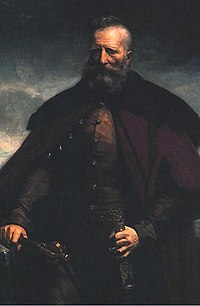 | |
| Date of Birth | 1560 |
| Place of Birth | |
| Date of death | September 24, 1621 |
| Place of death | Hotin |
| A country | |
| Occupation | , , |
| Father | Yan Jeronimovich Khodkevich |
| Mother | Kristina Zborovskaya |
| Spouse | 1) Sofia Meletskaya 2) Anna-Aloysia Ostrog |
| Children | from first marriage: Jerome Hodkevich, Anna Scholastica |
Content
Biography
Start of Service
The son of Jan Jerome Hodkevich , Vilnius coughtan , and Kristina Zborovskaya [2] . He studied at Vilnius University (Academy) , then went abroad. In 1586-1589, together with his brother Alexander, he studied philosophy and law at the Jesuit Academy in the city of Ingolstadt ( Bavaria ) [1] . After studying, he visited Italy and Malta to study the art of war [3] .
He began his service in the forces of the Commonwealth under the command of the hetman Zholkevsky while suppressing the Nalivaiko uprising. He participated in campaigns in Moldova under the command of Jan Zamoysky . In 1601 he became a full hetman of the Grand Duchy of Lithuania .
War with Sweden
He actively participated in the war with Sweden [4] . Despite difficulties, (for example, the lack of help from King Sigismund III and the Sejm ), he won. In 1604 he took Dorpat (now Tartu , Estonia ); twice defeated the Swedish troops. For his victories in March 1605 he was rewarded with the title of Great Hetman of the Grand Duchy of Lithuania.
However, Khodkevich’s biggest victory was still ahead of him. In mid-September 1605, Swedish troops were concentrated near Riga . Another Swedish army was sent here, led by King Charles IX ; thus, the Swedes had a clear advantage over the troops of the Commonwealth.
On September 27, 1605, the Battle of Kirchholm (now Salaspils , Latvia ) took place. Khodkevich had about 3000-4000 soldiers, the bulk of which was the heavy cavalry of the winged hussars [5] . The Swedish army numbered about 11,000, of which the majority (8,500) were infantry.
However, despite such an unfavorable advantage of forces, Khodkevich managed to defeat the Swedish army within three hours. The competent cavalry played a key role in this: having lured the enemy from his fortified positions by feigning retreat, Khodkevich’s troops crushed the advancing Swedish infantry and defeated the main enemy forces with the support of artillery. King Charles IX was forced to flee the battlefield, and the Swedish army, ending the siege of Riga, returned back to Sweden. Khodkevich received congratulatory letters from Pope Paul V , the Catholic sovereigns of Europe ( Rudolph II of Austria and James I of England ), and even from the Turkish Sultan Ahmed I and the Persian Shah Abbas I.
However, even such a significant victory did not improve Khodkevich’s troops financially. There was still no money in the treasury, and the army began to simply scatter. Internal troubles led to the fact that the results of the victory of the Commonwealth did not take advantage.
Rokosh Zebrzydowski
The next five years, Jan Khodkevich actively participated in the internal struggle that broke out inside the Commonwealth. Attempts by King Sigismund III to somewhat centralize state administration provoked an uprising (the so-called " Rokosh ") led by Mikołaj Zebrzydowski ( Polish Mikołaj Zebrzydowski ). Among the Lithuanian nobility, Rokoshan was supported by one of the leaders of the Calvinists, Jan Radziwill. In 1606, the opposition switched to hostilities.
Initially, Khodkevich remained neutral in the conflict, however, after joining the Confederates, Jan Radziwill (the enemy of the Khodkevichs), condemned the Rokosh, and supported the king. On July 6, 1607, in the battle of Guzov in a decisive battle, the royal army defeated the opposition; Khodkevich commanded troops on the right flank.
The victory over the opposition and the suppression of its actions, however, did not allow the king to continue the initiated reforms of public administration. A compromise triumphed, which in fact meant the end of the centralizing policies of King Sigismund.
Return to the Inflants
Meanwhile, the Swedish troops again revived. The internal turmoil of the Polish-Lithuanian Commonwealth allowed them in the spring of 1607 to take the White Stone, and on August 1, 1608 - Dynamunde (now Daugavgriva , since 1924 - part of Riga ).
In October 1608, Khodkevich returned to the Inflants , and immediately went on the counterattack. On March 1, 1609, the two thousandth army under his command by night assault took Pernov (now Pärnu ), and then returned to Riga. Success again accompanied Khodkevich: his cavalry detachments defeated the advanced troops of the Swedes, which forced the Swedish commander in chief Count Mansfeld to retreat from Riga. The capture of the Dynamo fortress and the victory of the small Polish-Lithuanian fleet over the superior Swedish fleet provided the Polish-Lithuanian Commonwealth an advantage in this region. Khodkevich did not receive reinforcements again - King Sigismund was preparing for war with Russia. The death of the Swedish king Charles IX on October 30, 1611 allowed the start of peace negotiations, and until 1617 hostilities in the Baltic were stopped.
Campaigning in Russia: Background
The reason for the outbreak of war with the Moscow state was the introduction of the Swedish corps under the command of J. Delagardi to the territory of Russia at the request of Tsar Vasily Shuisky . Since the Polish-Lithuanian Commonwealth fought with Sweden, this was regarded as a hostile act.
King Sigismund personally led the troops invading the territory of Russia. In September 1609, he launched a siege of Smolensk , ending in June 1611 with the fall of the city. After the defeat of the Moscow army under the command of D. I. Shuisky (brother of the king) from the troops of the hetman S. Zholkevsky near Klushin (near Gzhatsk ; July 24, 1610 ), Tsar Vasily Shuisky was overthrown. The new government, Semiboyarschina , invited Prince Vladislav to the Moscow throne, but Sigismund did not release his 15-year-old son to Russia; Moscow was occupied by the Polish-Lithuanian garrison with Stanislav Zholkevsky at the head.
Jan Karol Khodkevich as a great Lithuanian hetman opposed the help of False Dmitry II and the war with Russia. The experience of confrontation with Sweden, when the lack of money and reinforcements did not allow Khodkevich to inflict a decisive defeat on the enemy, did not give reason to hope for a quick victory. Nevertheless, in April 1611, Khodkevich came to Pskov , and besieged the Pskov-Pechersky monastery for five weeks, but could not take it, and retreated.
First trip to Moscow ( 1611 - 1612 )
In early autumn 1611, Jan Karol Khodkevich, on the orders of the king, led troops to help the Polish-Lithuanian garrison in the Moscow Kremlin . In Shklov , stockpiles of supplies and ammunition were collected, as well as about 2,500 soldiers who approached Moscow on October 6, 1611. Khodkevich’s troops had to endure a series of skirmishes with detachments of the 1st militia under the command of Dmitry Trubetskoy ; their arrival saved the Polish-Lithuanian garrison of the Kremlin from surrender, but the besieged were unable to deliver supplies. In Khodkevich’s detachment, the contradictions between the Poles and soldiers from the Grand Duchy of Lithuania escalated, and in early November 1611, the army reduced to 2,000 men retreated to Rogachevo . Here Khodkevich again gathered supplies, and on December 18 brought them to the Kremlin garrison.
The Battle of Moscow
In 1612, such campaigns to supply the Polish-Lithuanian garrison with food were successfully repeated twice more; the next campaign took place in late August - early September 1612. Simultaneously with Khodkevich, King Sigismund and Prince Vladislav went to Moscow to occupy the throne; Chancellor Lev Sapega accompanied them. However, the troops of the 2nd and the remnants of the 1st militia , who together had more forces, met Moscow Khodkevich; he failed to get to the Kremlin. On August 31, 1612, Khodkevich’s troops were 5 kilometers from the walls of Moscow, on Poklonnaya Gora . September 1, they occupied the Novodevichy Convent and tried to enter Moscow through the Chertol Gate, but were recaptured. The next day, Khodkevich tried to break into Moscow from the south, through the Donskoy Monastery and Kaluga Gate. His troops managed to break through in Zamoskvorechye to Bolshaya Ordynka and Pyatnitskaya streets, but again failed to break through to the Kremlin and Kitay- Gorod. September 2, Khodkevich resumed attacks. His soldiers came close to the banks of the Moskva River , but even now the militias didn’t allow them to the shore. Meanwhile, Kuzma Minin crossed the Moscow River with selected forces and struck in the area of the Crimean court (now the area of the Crimean bridge ). Khodkevich was finally defeated; having lost about 500 people and a convoy with food, he was forced to retreat. The victory of the militias decided the fate of the Polish-Lithuanian troops in the Kremlin: Kitay Gorod was surrendered on November 1, and on December 6, having exhausted all food supplies, the Kremlin garrison capitulated.
Retreating, Khodkevich met in Vyazma with an army in which, together with his father ( King Sigismund ), there was Prince Vladislav IV , who was on his way to Moscow to occupy the Russian throne. However, this army lingered near Volokolamsk and did not manage to prevent the surrender of the Polish-Lithuanian Kremlin garrison.
In February 1613, the Zemsky Sobor elected Mikhail Romanov to the Russian throne of Russia, and the hopes of the Polish-Lithuanian Commonwealth and King Sigismund for the Russian crown became even more illusory.
Second trip to Moscow ( 1617 - 1618 )
In 1613 - 1615, Khodkevich commanded the Polish-Lithuanian forces in the newly formed Smolensk Voivodeship. At this time, the royal court returned to the plan to put Prince Vladislav on the Moscow throne. Khodkevich led the Polish-Lithuanian troops.
By order of the hetman, Jan Khodkevich, in the second half of February 1615, Colonel Lisovsky went on a campaign in Bryansk . At the same time, a detachment of Janusz Kishki advanced towards Starodub [6] .
October 11, 1617 detachments of Khodkevich took the fortress Dorogobuzh ; October 18 - Vyazma . From here, Vladislav began to send letters to various segments of the population of Russia. However, these letters had little success; most of the boyars , nobles and Cossacks remained indifferent to them. After the occupation, Vyazma was hit by frosts, and hostilities stopped. Korolevich and the hetman remained in Vyazma, preparing for a further campaign. The fighting was reduced to raids on the surrounding, and so devastated by the war, areas of the light cavalry units of Alexander Lisovsky (" foxes "). In the spring of 1618, forces were gathered for an attack on Moscow. Khodkevich had under the command of 14,000 people, including about 5,500 infantry. However, discipline in the army was weak. In high command, disputes over command posts began. Prince Vladislav and his favorites often interfered in the decisions of the command. The news that the Diet authorized the financing of the campaign against Russia only for 1618 worsened the situation.
In June 1618, Khodkevich’s troops began a campaign against Moscow. The hetman himself wanted to advance through Kaluga , but Vladislav managed to insist on a direct strike to the Russian capital. In early October 1618, Polish-Lithuanian troops occupied the village of Tushino (north of Moscow), and began preparations for the assault. At the same time, the 20,000th Cossack army of the hetman P. Sagaidachny approached Moscow from the south. On the night of October 11, Polish-Lithuanian troops launched an assault on Moscow, trying to break through the Tver and Arbat gates, but the attack was repelled. With the impending winter and lack of funding, Prince Vladislav agreed to negotiations. On December 11, 1618, a truce was signed in the village of Deulino (near the Trinity-Sergius Monastery) for a period of 14 and a half years. According to its conditions, Russia ceded Smolensk land, which became part of the Grand Duchy of Lithuania , as well as Chernihiv and Seversky lands, which became part of the Polish crown .
Jan Karol Khodkevich returned from this campaign disappointed. Years of constant wars seriously affected his health, he was increasingly sick. Not everything was alright in the family. Khodkevich for some time moved away from state affairs and took up the management of his estates.
War with Turkey ( 1620 - 1621 )
In 1620, the Commonwealth was drawn into a war with the Ottoman Empire. In August 1620, the Polish army suffered a crushing defeat at Tsetsora (near Iasi ). Great Crown Hetman Stanislav Zholkevsky was killed, and full Crown Hetman Stanislav Konetspolsky was captured. In December 1620, Jan Karol Khodkevich received command of all the forces of the Commonwealth.
In September 1621 , having gathered troops, Khodkevich crossed the Dniester and occupied the Khotin fortress. Despite the difficult food situation, Khodkevich’s troops repulsed all attacks of significantly superior troops of Turkey and its vassal - the Crimean Khanate . On September 23, the seriously ill Khodkevich transferred command of the army to the crown subordinate Stanislav Lubomirsky . The great Lithuanian hetman Jan Karol Khodkevich died on September 24. Upon learning about this, the Turks tried again to seize the camp of the Polish-Lithuanian troops, but again failed twice. Having suffered heavy losses, the Ottoman Empire was forced to make peace with the Commonwealth; The contract was signed on October 9, 1621. Hetman Khodkevich won his last battle; the war with the Turks was completed [7] .
Personal life
Jan Karol Khodkevich married in 1593 the daughter of the governor of Podolsk and the hetman of the great crown Crown Nikolai Meletsky , the widow of Slutsky Prince Jan Simeon Olelkovich Sofya Meletskaya ( 1567 - 1619 ). From this marriage, he had a son Jerome (1598-1613) and daughter Anna Scholastika ( 1604 - 1625 ), who was married to Jan Stanislav Sapieha ( 1589 - 1635 ), the eldest son of Leo Sapieha , chancellor of the great Lithuanian.
After the death of his wife, Jan Karol Khodkevich married for the second time to Anna-Aloysiya Ostrog ( 1600 - 1654 ). Political motives played a key role in this marriage: the 60-year-old hetman was persuaded by his brother, Alexander Khodkevich, to marry the 20-year-old princess, who did not want the brother’s richest possessions to be transferred to the Sapeg clan. The marriage took place on November 28, 1620 in Yaroslav . Immediately after the marriage, the hetman went to the Sejm in Warsaw , and after that - on his last trip.
After Jan Karol Khodkevich left large possessions. The main ones were: Bykhov and Gory in the Orsha district, Lyakhovichi in Novogrudok , Svisloch in Volkovysk , Shkudy and Kretinga in Zemaitiya . Together with his brother Alexander, he was the owner of Shklov and Shklov County. It is worth noting that due to the lack of state funding, Jan Karol Khodkevich spent his personal funds on the troops, and therefore his debts before his death reached 100 thousand zlotys (more than the annual income from all his possessions). Nevertheless, feuds began between Khodkevich’s property between the magnate clans who were related to him. Claims were made by: daughter, Anna-Scholastica, and her husband, Stanislav Sapega; Jan Karol’s brother Alexander Khodkevich; and finally, the young widow Anna-Aloysia Khodkevich (nee Ostrozhskaya), along with her guardians.
The struggle for property ended only two years later, in May 1623 , when all relatives finally shared the hetman’s inheritance. The widow of the hetman did not want his body to be buried in the city of Kretinga owned by the Khodkevichs (where his first wife was buried) as he himself wanted, but in the residence of the princes of Ostrog in the city of Ostrog in Volyn .
Notes
- ↑ 1 2 Anatoly Gritskevich . Jan Karol Khodkevich Archived March 1, 2012 to Wayback Machine . History of Belarus, personality.
- ↑ Wanda Dobrowolska (1937). Jan Karol Chodkiewicz. Polski Słownik Biograficzny, T. 3: Brożek Jan - Chwalczewski Franciszek. Kraków: Polska Akademia Umiejętności - Skład Główny w Księgarniach Gebethnera i Wolffa. p. 363-367. (polish)
- ↑ Wanda Dobrowolska (1937). Jan Karol Chodkiewicz. Polski Słownik Biograficzny, T. 3: Brożek Jan - Chwalczewski Franciszek. Kraków: Polska Akademia Umiejętności - Skład Główny w Księgarniach Gebethnera i Wolffa. p. 363-367.
- ↑ War of the Commonwealth with Sweden 1600-29 // Grand Duchy of Lithuania : Encyclopedia. In 3 t. / Ed. G.P. Pashkov et al. T. 1: Obolensky - cadence. - Minsk: Belorussian Encyclopedia, 2005.S. 378.
- ↑ Podhorodecki, L. Slawni hetmani Rzeczy Pospolitej / L. Podhorodecki. - Warszawa: Moda, 1994 .-- 560 s. (polish)
- ↑ Zorin A.V. The great raid of Alexander Lisovsky (March - December 1615). - Kursk, 2008.
- ↑ Plokhy, Serhii , The Cossacks and Religion in Early Modern Ukraine, (Oxford University Press, 2001), 93. (English)
Literature
- Grand Duchy of Lithuania : Encyclopedia. In 3 t. / Ed. G.P. Pashkov et al. T. 2: Cadet Corps - Yatskevich. - Minsk: Belorussian Encyclopedia, 2005 .-- 788 p.: Ill. ISBN 985-11-0378-0 .
- Encyclopedia of the history of Belarus . In 6 vol. T. 6. Book. 2: Assimilation - Yashin; Appendix / Belarus. encyclopedia.; Editorial: G.P. Pashkov (chief ed.) And others; Hood. E.E. Zhakevich. - M.: BelEn, 2003 .-- 616 p.: Ill. ISBN 985-11-0276-8 .
Links
- Article "Jan Karol Khodkevich" (unavailable link) . Date of treatment May 18, 2016. Archived March 1, 2012.