Vladimir Konstantinovich Neisel (1873 - after 1937) - Russian officer, major general (1919).
| Vladimir Konstantinovich Neisel | ||||||||
|---|---|---|---|---|---|---|---|---|
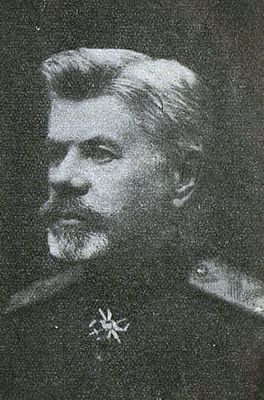 | ||||||||
| Date of Birth | June 2 (14), 1873 | |||||||
| Place of Birth | Yaransk , Vyatka province | |||||||
| Date of death | (after 1937) | |||||||
| Place of death | Belgrade (?) | |||||||
| Affiliation |  Russian empire White movement Russian empire White movement | |||||||
| Type of army | infantry | |||||||
| Years of service | 1892-1922 | |||||||
| Rank | major general | |||||||
| Commanded | Largo-Kagulsky 191st Infantry Regiment , Rymnik 192nd Infantry Regiment , Orsk 331st Infantry Regiment | |||||||
| Battles / wars | Russian-Japanese war World War I Civil War | |||||||
| Awards and prizes |
| |||||||


Content
Biography
Birth and Formation
Vladimir Konstantinovich Neisel, a nobleman by birth, was born on June 2, 1873 in the city of Yaransk , Vyatka province, in the family of an outlandish adviser , Orthodox. At the end of the Simbirsk Cadet Corps , in 1892 he entered the 3rd Alexander Military School , which he graduated in 1894 with production as second lieutenant ( art. 07.08.1893) and was appointed to the Orsky Reserve Battalion. Promoted to lieutenant (Art. 07.08.1897). In 1899, the battalion was renamed the 241st Orsk Reserve Battalion. Vladimir Konstantinovich served as adjutant and treasurer .
Russo-Japanese War
With the outbreak of the Russo-Japanese War as part of the 241st battalion, deployed in the regiment in 1904, Neisel was sent to the army and commanded the 16th company. For the differences in the battles, he was promoted to headquarters captain (Art. 07.08.1904) and awarded two military orders. At the end of the war he was promoted to captain (art. 07.08.1905), after which he acted as the farm manager of the battalion into which the regiment was collapsed. In 1906 he was appointed head of the training team, and in 1908 he took submission to the 1st company. In 1910 he entered the formation of the 191st infantry Largo-Kagulsky regiment and was appointed commander of the 13th company, and in 1911 - the head of the training team of the regiment.
World War I
With the outbreak of World War I, Neusel V.K. was appointed commander of the 10th company and was wounded in one of the first battles, and upon recovery he took command of the 4th and then 1st regiment battalion. He was awarded the Order of St. George , 4th degree
| For the fact that on the night of November 1, 1914, on his own initiative, he captured a heavily fortified height near the village. Novoselki, which made the enemy retreat on the front of the right combat area. |
and St. George’s weapons
| Because on December 10, 1914, commanding a battalion, he went under heavy fire of the river. Yaselka, knocked out the enemy from the trenches, captured 4 officers, 80 lower ranks and 1 machine gun. |
From June 8 to July 14, 1915, Captain Neisel temporarily commanded his regiment, and for military distinctions he was promoted to lieutenant colonel (Article 8/07/1915) and appointed to oversee training teams. In 1916 he was awarded three military orders and promoted to colonel (Art. 18.04.1916). From July 19 to August 16 and from August 19 to 21, 1916 he temporarily commanded a regiment, and in battle on August 8–9, when the enemy used toxic substances, he was poisoned with suffocating gases , but, despite his grave condition, remained in service, continuing to command the regiment . On December 4, 1916, Vladimir Konstantinovich was appointed commander of the 192nd Rymnik Infantry Regiment , and he held this position until June 19, 1917. From June 20 to September 2, 1917, Colonel Neisel commanded the 331rd Orsk Infantry Regiment; On October 7, he was appointed brigade commander of the 188th Infantry Division, but he did not take up this position, since the division was disbanded. On November 15, 1917, Vladimir Konstantinovich went to the headquarters of the 4th Army for a meeting of the St. Petersburg Duma and did not appear again in the regiment.
White movement in Russia
After the revolution , with the outbreak of the civil war , Vladimir Neisel was in Orenburg. With the "transition of the army to an elective beginning" on December 6, 1917, he was forced to leave the army. In December 1917 - January 1918, as the commander of the Orenburg combined detachment, he participated in the defense of Orenburg, where he was seriously wounded and shell-shocked. He went to Samara, joined the COMUCH People’s Army . From August 3 to December 11, 1918 and from January 4 to June 14, 1919, he was the acting head of the 5th Orenburg Rifle Division. Since August 7, 1918, he was Chairman of the 1st Commission for the development of provisional rules on the organization of service in the People’s Army. Since September 17, 1918, Vladimir Neisel was the assistant to the chieftain A. I. Dutov as the head of the Orenburg garrison. Since the summer of 1919 he was appointed acting chief of supply of the Southern Army. The Neisel Rifle Division in the army of Ataman Dutov until mid-April 1919 successfully conducted military operations against the Red Army units in the interfluve of the Salmysh and Yangiz rivers. Neisel’s division at that time consisted of the 18th, 19th, 20th, 21st rifle regiments, 21 machine guns and 8 artillery pieces. In contrast to Neisel’s division, the Red Army command dispatched superior military formations. On April 26, 1919, a battle occurred that turned out to be a turning point in the entire campaign near Orenburg and the first, most serious defeat in the career of V.K. Neisel. After the artillery preparation, the Red Army troops under the command of Guy ( Hayk Bzhishkyan ) went on a decisive attack, dropping the Neisel’s division to the crossing. Having captured the crossing, Guy's troops destroyed up to 200 whites (officers and Cossacks were not taken prisoner), 1,500 division soldiers were captured. Later, in his report, Colonel Neisel, with regard to the circumstances of the battle on April 26, 1919, noted that there was no intention of returning the 5th Orenburg Rifle Division, and that there could be nothing other than a catastrophe under the onslaught of the enemy, and therefore the order to attack the Colonel was understood as a decisive bet - or a breakthrough of the Red front and the capture of Orenburg, or the death of a division. Neisel during the battle during the retreat miraculously escaped death and captivity.
In August - September 1919, with the remnants of his Orenburg division, he participated in military campaigns against the forces of the Red Army in the Upper Ural, Trinity and Orsk counties of the Orenburg province and Aktyubinsk. On September 7, 1919, Neisel was promoted to major general with seniority on June 14, 1916. During the retreat from the war zone as part of the Orenburg separate army of Ataman Dutov and General Bakich , from November 22 to December 31, 1919, General Neisel, with the remnants of parts of his division, takes part in the most severe Hunger campaign in the Semirechensk and Semipalatinsk regions and then with battles to the city Sergiopol . In January 1920, the remnants of parts of his division (90% of the military were sick with various forms of typhus ) became part of a separate Semirechensk army. General Neisel was appointed to the post of supply chief of a separate Orenburg army. As part of the Orenburg (already Southern) army, he is sent to the steppes of the Amur Region and further to the Far East. From October 16, 1920, he was appointed to the post of general in the troops of the Far Eastern Army for orders under the commander-in-chief of the troops of the Russian Eastern Outskirts, Lieutenant General G. M. Semenov. Later, Vladimir Konstantinovich was appointed a non-staff general for assignments under the Commander of the troops of the Provisional Amur Government, and from July 4, 1921 he was enlisted in the state. On July 27, 1921 he was a temporary acting officer on duty of the General Staff of the Provisional Amur Government.
In 1922 he emigrated to China and was seconded to the Siberian Cadet Corps in the city of Shanghai [1] . In 1925 he went to the Kingdom of Serbs of Croats and Slovenes. From 1929 to 1937 he was in the city of Belgrade (at that time the capital of Yugoslavia).
Family
- Sibling - Neisel Vasily Konstantinovich, was born in 1877 in the city of Elabuga (Tatarstan, Russian Federation). The officer of the Russian army . In 1905, lieutenant of the Sterlitamak 310 Infantry Regiment, in 1909, lieutenant in the Orsk 241st Reserve Battalion. In 1914, the headquarters captain of the Largo-Kagulsky 191st Infantry Regiment, in 1915 he served in the Orsk 331st Infantry Regiment. In 1918, he was captain at the headquarters of the Southwestern Army. Adjutant of the stage department of the Orenburg military district. Expelled from allowance from November 1, 1918. Rewards: Order of St. Anne 3 degrees with swords and bow. Wife Maria Evmenievna, daughter Nina. In Soviet times, he lived in the city of Saratov , worked as a budget technician. On October 28, 1937, the UNKVD was arrested in the Saratov region. On November 25, 1937, he was sentenced to death by a trio of the UNKVD in the Saratov region for anti-Soviet agitation. Shot on November 29, 1937. The burial place is the city of Saratov. Rehabilitated on April 22, 1963 by the Saratov Regional Court.
- The wife of Vladimir Konstantinovich is the daughter of the court adviser Anna Ilyinichna Kambulina, a native of the Orenburg province.
- Children: Maria (born on August 22, 1899), Konstantin (born on December 22, 1900), George (born on May 21, 1902), Anna (born on September 22, 1903) Lydia (March 7, 1905) D.O.) Igor (06/02/1908).
According to close relatives, Neusel V.K., being in Yugoslavia, created a new family. He did not maintain contact with his close relatives, with the exception of two letters in 1937, in which he made it clear that he would not return to Russia and would not correspond with people in order to prevent reprisals . The further fate of Vladimir Konstantinovich Neisel after 1937 is unknown. Thus, the wife of Vladimir Konstantinovich and children, with the exception of his son George (left with his father), survived the events of the civil war and repression of the 1930s and 40s. Currently, his descendants live in the cities of Orenburg and Saratov (Russia), Temirtau (Kazakhstan), Kartaly (Kyrgyzstan).
The history of the appearance in Russia of the surname Neisel
It is assumed that the ancestors of General Neisel arrived in Russia from the Netherlands under Tsar Peter I. The surname Van Newsoul is translated from Dutch as a new soul. The founder of the dynasty was a skipper in the service of Tsar Peter I. For loyal service in the Navy for the benefit of the Russian Empire, Peter I granted the skipper nobility . Van Neisel converted to Orthodoxy and moved permanently to Russia. Over time, the prefix of the name Wang was lost. Almost all of his descendants in Russia became military or sailors.
Rewards
- Order of St. Stanislav 3 degrees - May 17, 1904,
- Order of St. Anne 3 degrees with swords - October 5, 1904,
- Order of St. Stanislav 2 degrees with swords - October 26, 1904,
- Order of St. Anne 2 degrees - March 9, 1912,
- Order of St. George 4 degrees - (Highest Order April 4, 1915),
- St. George's Arms - (Highest Order April 22, 1915),
- Order of St. Vladimir 4 degrees with swords and bow - June 15, 1915,
- light bronze medal "In memory of the Russo-Japanese War" at - January 21, 1906.
Memory
- In the memorial hall of Russian military glory on a marble plank between the twisted columns of the St. George Hall of the Moscow Kremlin, the name of the 4th degree St. George cavalier Vladimir Konstantinovich Neisel is immortalized.
- In 1935, a photo album dedicated to the St George Knights and a clarification of the St. George Awards (formulations of the Highest Orders) based on the book “The Album of the Knights of the Order of the Holy Great Martyr and Victorious George and the St. George Arms”, in which a portrait of General V. K. Neisel was recorded, was released in Belgrade.
Notes
Links
- Ganin A.V. , Semenov V.G. Neisel Vladimir Konstantinovich // Officer corps of the Orenburg Cossack army. 1891-1945: Biographical reference book. - M .: Russian way ; Library Fund “Russian Abroad” , 2007. - P. 397—398. - 676 p. - ISBN 978-5-85887-259-7 .
- The Russian army in the Great War: Valentin Yushko 48th Infantry Division.
- White movement in Russia: organizational structure. (inaccessible link)
- Neisel, Vladimir Konstantinovich . // Project "Russian Army in the Great War".
- Neisel Vasily Konstantinovich. Book of Memory of the Victims of the Communist Terror.
- Neisel V.I.
- The Epic of General Neisel