Hypecoum ( lat. Hypécoum [3] ) - a genus of flowering plants . The type genus of the tribe is Hypecoeaceae, or Hypecoeae ( Hypecoeae ), which is part of the subfamily Dymyankovye ( Fumarioideae ) of the poppy family ( Papaveraceae ).
| Hypecoome | |||||||||||||||||||||||
|---|---|---|---|---|---|---|---|---|---|---|---|---|---|---|---|---|---|---|---|---|---|---|---|
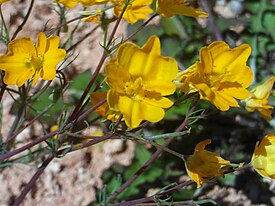 Hypecoem flowers lying. Campo de Calatrava , Spain | |||||||||||||||||||||||
| Scientific classification | |||||||||||||||||||||||
| |||||||||||||||||||||||
| International scientific name | |||||||||||||||||||||||
Hypecoum L. , 1753 | |||||||||||||||||||||||
| Type view | |||||||||||||||||||||||
Hypecoum procumbens L., 1753 [2] - Hypecoome lying | |||||||||||||||||||||||
The genus combines annual or biennial herbs with leaves collected in a rosette . A distinctive feature of the genus, of all poppies characteristic only for it, is flowers with two axes of symmetry. The flowers of other poppies have either one axis of symmetry (as in dicenters ), or many (like in poppies ).
Hypecoome includes about 20 species , combined into two subgenera. In the wild, they are common in the Mediterranean region and in many parts of Asia. Several species are sometimes grown in gardens as ornamental plants. Hypecoums contain various alkaloids , they are used as medicinal plants in the medicine of some peoples of Asia.
Content
- 1 Botanical Description
- 2 Area
- 3 Cultivation
- 4 Chemical composition, application in medicine
- 5 Taxonomy
- 5.1 Genus name
- 5.1.1 Synonyms
- 5.2 Position in the classification
- 5.3 Intrageneric taxa
- 5.1 Genus name
- 6 notes
- 7 Literature
- 8 References
Botanical Description
The genus Hypecoome is represented by low annual , rarely biennial herbaceous plants with a pronounced stem root .
The aerial parts of the plant are smooth, usually covered with a gray-green bloom. Leaves are numerous, collected in a basal rosette. The leaf blade is on a short petiole , lanceolate in shape, sometimes expanded to obovate, deeply and many times unpaired, dissected into narrow filiform or lanceolate pointed lobes [4] . Plant juice is reddish or yellowish, but not milky white, like many other poppy seeds [5] . Some species of the genus (included in the Pendulae section) emit a strong curry smell when dried [6] .
The flowers are asymmetric (that is, they have two axes of symmetry), collected in cimic inflorescences on a long rising or almost upright stalk, with small bracts that look like leaves. The calyx is inconspicuous and early falling, with almost membranous small lobes, in shape ovate-triangular or ovoid [7] . Corolla consists of 4 petals - two external and two internal. The color of the corolla, depending on the type, can be yellow or white, sometimes it contains an orange, pinkish or bluish tint. External petals are whole or shallowly divided into three lobes, flattened. The two inner petals, on the contrary, are divided into three lobes very deeply. The lateral lobes of the inner petals are pressed to the outer petals, flat, and the middle part is narrow, protruding parallel to the stamens, with a fringed or even serrated-serrated edge, on which pollen accumulates when it is pressed against the anthers in newly opened flowers [4] . Four stamens , they are with membranous, translucent threads, at the base on the sides with nectaries . Anthers are dicotyledonous, oblong, in two median stamens with two pointed elevations at the apex, and in two lateral stamens with one [5] . Two pistils , each with a filiform column and stigma, divided into two filiform fractions, often fused into one linear [7] . The ovary is lower, cylindrical, consists of two carpels, single-celled, with several ovules [8] . The embryo sac in the ovule is of a normal type, that is, there are three antipode cells and two synergids (auxiliary cells that form the egg apparatus together with the ovum). Antipodes are greatly enlarged, polyploid . Flower formula : [9] .
The role of insect pollinators of the hypecome is performed by bees and small baby beetles. There are also species in which self-pollination is possible - these are plants with smaller flowers, in which the external petals are whole. This is the hypecoeum lying and Hypecoum torulosum [10] .
Pollen grains with two deep and wide pits ( lat. Colpi ), with a surface covered with spikes and small holes [5] .
There are various numbers of chromosomes among the types of hypecome: 2n = 16, 32 or 42 (in the three-lobed hypecome ) [5] .
The fruit is a bivalve pod of linear shape. The seeds in it are arranged in one row, small, flat, gray or almost black. Their surface is covered with a protective membrane of the epidermis , preventing them from germinating. During wintering, this shell disappears, and under it opens a layer of crystals of calcium oxalate ( oxalic acid salt), making the surface of the seeds rough [5] . During maturation, the leaves of the pod open, or it breaks down into many parts, one seed in each [4] .
Hypecouma serve as the initial link in food chains . Hypecoum littorale lays eggs in the fruits of the Hypecooma bearded and Hypecoum littorale , forming galls , Aylax hypecoi is the hymenoptera from the family Cynipidae . The larvae of this insect feed on the fruits of plants [11] . Small-flowered hypecoome feeds on horsefly Omocoris unicolor [12] .
Entyloma hypecoi , a fungus from the Entiloma order, grows on a three-bladed hypocome [13] . The hypecome is a host of the oomycete Peronospora hypecoi [14] .
Range
Hypecooms are common only in the Old World . The range of the genus extends from the Mediterranean ( Western and Southern Europe , North Africa ) in the west to Siberia , Mongolia and central China in the east. Species from the subgenus Hypecoum are common in Europe and Near East , while representatives of the subgenus Chiazospermum gravitate toward the Himalayas and China [5] .
In Russia , three species of this genus are known - one from the subgenus Chiazospermum and two from Hypecoum . Gipekoum direct grows on the slopes in the forests and steppes of the southern part of Western and Eastern Siberia. Small-flowered hypecoum in Russia is found in the foothills of Altai . The hypecome is aerated, growing on clay and rocky slopes and in semi-deserts, is the only species known in European Russia . It is often found in Dagestan , but is also common in the Black Sea region and in the lower Volga region [7] .
Cultivation
Some hypecoums are very decorative, sometimes grown in gardens in Europe. Hypecoums are well grown along with other low annuals [15] . The typical species, Hypecoome lying, was introduced into the culture before 1594, however, it was only occasionally grown in botanical gardens. The hypecome is autoclaved since 1640 [16] .
- Agricultural technology
Gypecoumums are unpretentious, grow well in both fertile and poor, dry soils. They are easily propagated by seeds [8] , which can be sown both in spring (March – April) and, for earlier flowering, in autumn. When planting in spring, the protective membrane of the epidermis should be removed from the seeds, otherwise the seeds will not be able to germinate. In dry spring, seeds do not always germinate, however, they winter well enough in the ground and germinate the next year or even after a few years [16] .
Chemical composition, use in medicine
The chemical composition of plants is close to that of other poppies. All species of the genus contain fatty oils and psychoactive alkaloids. One of the differences between the hypecooma and other representatives of the Dymyankovye subfamily is the absence of delta-acetylornithine amino acids in its composition [5] .
Of the leaves and roots of hypecoomes, mupinamide and koptizin are distinguished . Prokumbin was isolated from the lying hypecooma . Gipekoum direct is used as an antipyretic and analgesic, for the treatment of cough and detoxification. Alkaloids gipecorin , gipecorinin , hyperectin and N-methylcanadine were isolated from its roots. Protopin , cryptopin , allocryptopin , hypecorinine, oxyhydrastinin , N-methylcanadine and N-methylcoridalin were isolated from the aerial parts of the plant. All of them have antibacterial action [17] . The composition of the hypecooma of thin-bred includes chelerythrin , Hypecorin, Hypecumin , Leptocarpinin , Leptopidin , Leptopidinin , Leptopin , Leptopinin , Oxyhydrastinin , Procumbin , Isocoridine, Coridine , and Sanguinarine [18] . The Mongolian species Hypecoum lactiflorum , in addition to the aforementioned protopin, allocryptopin, and N-methylcanadine, also contains N-methylcoridalizole and N-methylstilopine [19] .
Several species are used in Chinese medicine. Thin-fruited Hypecoum is used for intoxication and fever - a large amount of sweat is released when its leaves are taken. Also, this and related species are used in Indian medicine for abdominal pain [20] . Direct and thin-skinned hypercouples are used in Mongolian and Tibetan medicine [21] .
Taxonomy
| subfamilies Poppy ( Papaveroideae ) and Pteridophyllum ( Pteridophylloideae ) | |||||||||||||||
| about 20 species, typical - Hypecoum lying ( Hypecoum procumbens ) | |||||||||||||||
| Poppy family ( Papaveraceae ) | Hypecoeae tribe | genus Hypecoome ( Hypecoum ) | |||||||||||||
| Ranunculales order | subfamily Dymyankovye ( Fumarioideae ) | ||||||||||||||
| 6 more families (according to APG III System ) | Smoky tribe ( Fumarieae ) | ||||||||||||||
Genus name
The name Hypecoum was indeed published in the work of Karl Linnaeus in 1753, Species plantarum , the conditional publication date of which is taken as the starting point of the botanical nomenclature. Earlier, in 1737, Linnaeus used this name in the book Genera plantarum [22] . There he refers to the second edition of the work of Joseph Tournefort Institutiones rei herbariae (1719), where this plant is called Hypecoon . Tournefort, in turn, indicates that a plant called ὑπήκοον is described in the Vienna Dioscorides [23] . Caspar Baugin in Pinax Theatri botanici (1623) also writes about a plant with that name in the Natural History of Pliny [24] . In the opinion of J. Parkinson (1629), it is precisely the hypoCome that is recumbent that is described in Dioscorides [16] . The origin of this name is not exactly established [7] . According to the main version, ὑπήκοον comes from ὑπηχέω - “I give an echo, I respond, I echo”, which probably refers to the sound that comes from the shaking of mature bolls of plants described by Dioscorides under this name. Catalan botanist Juan Cadeval and Diars however, indicates that from a linguistic point of view such an etymology is unlikely. In addition, the seeds in ripe fruits of the hypecome do not rattle at all, since the walls of the fruits are covered with pubescence from the inside. Kadeval considers the origin of the name from ὑπήκοος - “subject” to be a more plausible version. Hypoecum lying could be called so, since in places of growth it displaces all other herbs, making them its "subjects" [25] .
In the work of 1596 by the botanist John Gerard , the English name horned wild cumin - “horned wild cumin” [16] - is used for the hypecooma. An ordinary wild fireplace ( English common wild cumin ) in England is called an umbrella plant, a lacidium ciriform , which the hypecoome resembles in the form of leaves.
Until the beginning of the 20th century, specifying a type species for a name was considered optional, and they were not defined in Linnaeus' works. In 1929, A. S. Hitchcock chose the name Hypecoum procumbens L. as the type species of the genus [26]
Synonyms
synonyms of the genus Hypecoum [27] :
- Chiazospermum Bernh. , 1833
- type Chiazospermum erectum ( L. ) Bernh. , 1839 - a synonym for Hypecoum erectum L., 1753
- Mnemosilla Forssk. , 1775
- type Mnemosilla aegyptiaca Forssk. , 1775 - a synonym for Hypecoum aegyptiacum (Forssk.) Asch. & Schweinf. , 1887
Synonyms of the tribe Hypecoeeae [28] :
- Hypecoaceae Willk. & Lange , 1880 , Hypecoëae
- Hypecooideae Prantl , 1889 , Hypecoideae
Classification clause
Carl Linney in the Species plantarum attributed the hypecoum to the Digynia order, combining plants with two pistils, in the Tetrandria class, in which he placed all species with four stamens in a flower [29] . Linnaeus's classification was artificial and was soon completely revised. Gipekoum then for a long time was ranked among poppies and smokies, its intermediate position between these families was emphasized - its flowers are more regular than most smokies, but not completely zygomorphic, like typical poppies. There was also a similarity in the structure of the flower with some barberry , namely, epimedium and bongardia [30] .
Currently, the genus is included in the monotypic tribe Hypecoeae in the subfamily Dymyankovye ( Fumarioideae ) of the vast family Poppy ( Papaveraceae ). This position is based on data from morphological and phylogenetic studies of Joachim Walter Kaderite and co-authors of 1994 [31] . The hypecoome is a sister taxon in relation to the Dymyankovye tribe ( Fumarieae ). These two taxa, united in the Dymyankovye subfamily, form a sister group in relation to the Papaveroideae subfamily. The hypecoome and the Dymyankovy tribe are united by a number of signs: asymmetric or zygomorphic flowers, collenchyma tissue under the epidermis , campylyotropic ovules (that is, located parallel to the placenta) and the presence of nectaries on the sides of the stamens. The subfamilies Poppy and Dymyankovye together form an unnamed sister group for the genus Pteridophyllum . A common feature of this large group is the presence of idioblasts and crystals of calcium oxalate on the inner epidermis of seeds. Pteridophyllum was sometimes included by the second genus in the tribe Hypecoeeae , since both genera have 4 stamens and sepals are poorly developed. However, there are many significant differences between this plant and hypecoome. According to Kaderaith, as well as S. Hoot and P. Crane , pteridophyllum is a basal representative of the poppy family. This monotypic genus was isolated in the subfamily Pteridophylloideae [32] [33] .
Intrageneric taxa
One of the first intrageneric classifications of the hypecoome is the system of Mikhail Grigorievich Popov , published in the book Flora of the USSR in 1937. However, the names of the taxa proposed by him are not valid, since Popov did not give them the necessary description in Latin. According to Osleg Dahl's classification of 1990, which is an altered Popov system, the Hypecoome genus is divided into two subgenera - Chiazospermum and Hypecoum proper ( Euhypecoum at Popov) [6] . Species from the first subgenus grow in the Far East, they have a central share of the internal flower petals with a serrated edge. The second subgenus is widespread in the Near East and the Mediterranean; the margin of the central lobe of the petal of its representatives is fringed. Popov, on the other hand, distinguished subgenuses not by the structure of the flower, but by the method of releasing seeds — in the first subgenus, the pods open with leaves, and in the second, they break [7] . Chiazospermum is divided into two sections - Leptocarpae (in Popov included in another subgenus) and Chiazospermum . The typical type of this subgenus is the direct Hypecome. The subgenus Hypecoum is divided into sections Hypecoum (Popov has the Procumbentia series), Mnemosilla and Pendulae (the Pendula series) [6] .
The genus Hypecoome was only once monographically processed by Frederick Fedde in 1909; Fedde described 15 species of the genus. In the future, the genus was only included in regional monographs; only in 1989 did O. Dahl carry out a complete monographic processing of the Hypecoum section [6] .
- The species composition of the genus [4] [6] [34]
- Hypecoum aegyptiacum ( Forssk. ) Asch. & Schweinf. - A typical view of the Mnemosilla section, described from the environs of Alexandria in Egypt .
- Hypecoum aequilobum Viv. also included in the Mnemosilla section. Described from Cyrenaica .
- Hypecoum alpinum ZXAn from China is part of the Leptocarpae section, very close to H. leptocarpum , from which it is smaller. Typical instances are lost.
- Hypecoum angustilobum Å.E.Dahl is described from Armenia , view of the Hypecoum section.
- Hypecoum chinense Franch. - first discovered in the vicinity of Beijing, a section view of Leptocarpae .
- Hypecoum dimidiatum Delile described from Egypt, grows in North Africa and the Middle East . Included in the Hypecoum section.
- Hypecoum duriaei Pomel from the Hypecoum section is close to H. procumbens . Described from Algeria . There are several syntypes.
- Hypecoum erectum L. - Direct hypecome - a type of subgenus and section of Chiazospermum . Brought to Linnaeus from Siberia , where it is very widespread.
- Hypecoum ferrugineomaculatum ZXAn is included in the Pendulae section. Perhaps a synonym for H. pendulum , from which it should differ by brownish spots on the corolla, which, however, is also present in typical H. pendulum . Type specimens are probably lost.
- Hypecoum imberbe Sm. - Gipekoum beardless first discovered in Greece . Distributed in the Mediterranean region, in particular, in Italy , Spain and France . Included in the subgenus Hypecoum , sometimes combined with H. procumbens .
- Hypecoum lactiflorum ( Kar. & Kir. ) Pazii represents the Chiazospermum section. It differs from H. erectum only in white and not yellow color of the corolla. Known from Kazakhstan and Mongolia .
- Hypecoum leptocarpum Hook.f. & Thomson - Hypecome thin - bred - type of section Leptocarpae . Described from the Himalayas, grows in the mountainous regions of Southern Siberia, Mongolia and Tibet. Plants of this species are sometimes not annuals, but biennials.
- Hypecoum littorale Wulfen is described from North Africa. In the system, O. Dahl is included in the Mnemosilla section.
- Hypecoum parviflorum Kar. & Kir. - Small-flowered hypecoome from the Pendulae section. Described from Kazakhstan , widely distributed throughout Central Asia . Sometimes combined with H. pendulum .
- Hypecoum pendulum L. - Hypecome aechnoid - a typical species of the Pendulae section. First described from France. It is close to H. parviflorum , from which it differs by solid external petals.
- Hypecoum procumbens L. typus [2] - Hypecoum lying - a type species of the genus and section Hypecoum . Widely distributed in the Mediterranean and the Caucasus .
- Hypecoum pseudograndiflorum Petrovič presents the Hypecoum section. Described, presumably, from the vicinity of the city of Niš in Serbia .
- Hypecoum torulosum Å.E.Dahl is also part of Hypecoum . Described from the Greek island of Mykonos .
- Hypecoum trilobum Trautv. - Three-bladed hypecoome is included in the Pendulae section. First discovered in the mountains of Turkmenistan . It also grows in Iran and other parts of Central Asia.
- Hypecoum trullatum Å.E.Dahl so far found only in Turkey . View section Hypecoum homonymous subgenus.
- Hypecoum zhukanum Lidén is a poorly studied species of the Leptocarpae section. Alpine plant, endemic of eastern Tibet .
Notes
- ↑ For the conventionality of specifying the class of dicotyledons as a superior taxon for the plant group described in this article, see the APG Systems section of the Dicotyledonous article .
- ↑ 1 2 Information on the Hypecoum genus in the Index Nominum Genericorum database of the International Association for Plant Taxonomy (IAPT) .
- ↑ The Garden Club of America. Pronunciation of Plant Names. - 1922. - P. 44. - 94 p.
- ↑ 1 2 3 4 ML Zhang, M. Lidén. Flora of China . - 2008 .-- Vol. 7. - P. 288-290.
- ↑ 1 2 3 4 5 6 7 M. Lidén. The Families and Genera of Vascular Plants. - Springer, 2004 .-- Vol. II. - P. 317-318. - 489 p. - ISBN 3-540-55509-9 .
- ↑ 1 2 3 4 5 Å. E. Dahl. Infrageneric division of Hypecoum (Papaveraceae) (English) // Nordic Journal of Botany . - Wiley-Blackwell 1990. - Vol. 10 . - P. 129-140 . - DOI : 10.1111 / j.1756-1051.1990.tb01760.x .
- ↑ 1 2 3 4 5 M.G. Popov. Subfamily 1. Hypecoideae // Flora of the USSR : in 30 tons / hl. ed. V.L. Komarov . - M .; L .: Publishing House of the Academy of Sciences of the USSR , 1937. - T. 7 / ed. volumes B.K. Shishkin . - S. 576-581. - 792, XXVI p. - 5200 copies.
- ↑ 1 2 J. Cullen. The European Garden Flora. - II. - Cambridge, 2011 .-- Vol. II. - P. 535. - 642 p. - ISBN 978-0-521-76151-2 .
- ↑ DJ Mabberley. The Plant-Book. - II. - Cambridge, 1997. - Vol. II. - P. 290. - ISBN 0-521-41421-0 .
- ↑ Å. E. Dahl. Taxonomic and morphological studies in Hypecoum sect. Hypecoum (Eng.) // Plant Systematics and Evolution : journal. - Springer , 1989 .-- Vol. 163 . - P. 227—279 .
- ↑ AM Stojanova, MM Draganov. Life cycle of Aylax hypecoi (Insecta: Hymenoptera: Cynipidae), a gall inducer on Hypecoum ssp. (Papaveraceae) (Eng.) // Central European Journal of Biology: journal. - 2008 .-- Vol. 3 , no. 2 . - P. 199-204 . - DOI : 10.2478 / s11535-008-0009-6 .
- ↑ FV Konstantinov. Review of Omocoris Lindberg, 1930 and a description of a new genus to accommodate Eurycolpus dimorphus Wagner 1961 (Heteroptera: Miridae: Phylinae) (English) // Advances in Heteroptera Research: journal. - 2008 .-- P. 215-230 .
- ↑ SA Annalijev. De speciebus fungorum novis in Turcomania inventis (neopr.) // Novosti Sistematiki Nizshikh Rastenii. - 1975 .-- T. 12 . - S. 170-177 .
- ↑ A.A. Yachevsky, P.A. Yachevsky. Key to mushrooms. Perfect mushrooms (diploid stages). - 3. - M. - L. , 1931. - T. 1. Ficomycetes. - S. 149.
- ↑ P. Miller. The Gardeners Dictionary. - 1759.
- ↑ 1 2 3 4 J. Loudon. The ladies' flower-garden of ornamental annuals. - 1840. - P. 39–41. - 272 p.
- ↑ YF Su, SK Li, N. Li, LL Chen, JW Zhang, JR Wang. Seven alkaloids and their antibacterial activity from Hypecoum erectum L. (English) // Journal of Medicinal Plants Research: journal. - 2011. - Vol. 5 , no. 22 . - P. 5428-5432 .
- ↑ JJ Zhou, GR Xie, XJ Yan. Encyclopedia of Traditional Chinese Medicines. - Heidelberg: Springer, 2011 .-- Vol. 5. - P. 468. - ISBN 978-3-642-16740-9 .
- ↑ S. Philipov, R. Istatkova, P. Denkova, S. Dangaa, J. Samdan, M. Krosnova, C. Munkh-Amgalan. Alkaloids from Mongolian species Hypecoum lactiflorum Kar. et Kir. Pazij. (English) // Natural Product Research: journal. - 2009. - Vol. 23 , no. 11 . - P. 982-987 .
- ↑ CP Khare. Indian Medicinal Plants. - Springer, 2007 .-- P. 319. - ISBN 978-0-387-70637-5 .
- ↑ DS Bae, YH Kim, CH Pan, CW Nho, J. Samdan, J. Yansan, JK Lee. Protopine reduces the inflammatory activity of lipopolysaccharide-stimulated murine macrophages (English) // BMB Reports: journal. - 2012. - Vol. 45 , no. 2 . - P. 108-113 . - DOI : 10.5483 / BMBRep.2012.45.2.108 .
- ↑ C. Linnaeus. Genera Plantarum. - 1737. - P. 32. - 384 p.
- ↑ JP Tournefort. Institutiones rei herbariae. - Parisiis, 1719.
- ↑ C. Bauhin. Pinax theatri botanici. - 1623. - P. 172.
- ↑ J. Cadevall y Diars. Flora de Catalunya . - Barcelona, 1915. - Vol. I. - P. 71-72. - 431 p.
- ↑ AS Hitchcock, ML Greene. Nomenclature: Proposals by British Botanists. - London, 1929 .-- P. 126.
- ↑ O. Kuntze. Lexicon generum phanerogamarum inde ab anno MDCCXXXVII . - Upsaliae: Typis Weitmanianus, 1904. - P. 292. - 714 p.
- ↑ Index nominum familiarum plantarum vascularium. // The Botanical Review. - T. 71 . - S. 348-361 . - DOI : 10.1663% 2F0006-8101% 282005% 29071% 5B0001% 3AINFPV% 5D2.0.CO% 3B2 .
- ↑ C. Linnaeus. Species Plantarum. - Holmiae: Laurentius Salvius, 1753. - Vol. 1. - P. 124. - 560 p.
- ↑ JD Hooker, T. Thomson. Flora Indica. - London, 1855. - Vol. I. - P. 274-276. - 285 p.
- ↑ JW Kadereit, FR Blattner, K. Jork, A. Schwarzbach. Phylogenetic analysis of the Papaveraceae sl (incl. Fumariaceae, Hypecoaceae, and Pteridophyllum) based on morphological characters (Eng.) // Botanische Jahrbücher für Systematik: journal. - 1994. - Vol. 116 . - P. 361-390 .
- ↑ S. Hoot, P. Crane. Inter-familial relationships in the Ranunculidae based on molecular systematics (English) // Plant Systematics and Evolution : journal. - Springer , 1995 .-- Vol. 9 . - P. 119-131 .
- ↑ JW Kadereit, FR Blattner, KB Jork, A. Schwarzbach. The phylogeny of Papaveraceae sensu lato: morphological, geographical and ecological implications (Eng.) // Plant Systematics and Evolution : journal. - Springer , 1995 .-- Vol. 9 . - P. 133-145 .
- ↑ Hypecoum : Taxon information on The Plant List . (Retrieved June 15, 2012)
Literature
- M. G. Popov. Subfamily 1. Hypecoideae // Flora of the USSR : in 30 tons / hl. ed. V.L. Komarov . - M .; L .: Publishing House of the Academy of Sciences of the USSR , 1937. - T. 7 / ed. volumes B.K. Shishkin . - S. 576-581. - 792, XXVI p. - 5200 copies.
- Å. E. Dahl. Taxonomic and morphological studies in Hypecoum sect. Hypecoum (Eng.) // Plant Systematics and Evolution : journal. - Springer , 1989 .-- Vol. 163 . - P. 227—279 .
- Å. E. Dahl. Infrageneric division of Hypecoum (Papaveraceae) (English) // Nordic Journal of Botany . - Wiley-Blackwell 1990. - Vol. 10 . - P. 129-140 . - DOI : 10.1111 / j.1756-1051.1990.tb01760.x .
- M. Lidén. The Families and Genera of Vascular Plants. - Springer, 2004 .-- Vol. II. - P. 317-318. - 489 p. - ISBN 3-540-55509-9 .
- J. Cullen. The European Garden Flora. - II. - Cambridge, 2011 .-- Vol. II. - P. 535. - 642 p. - ISBN 978-0-521-76151-2 .
- JW Kadereit, FR Blattner, K. Jork, A. Schwarzbach. Phylogenetic analysis of the Papaveraceae sl (incl. Fumariaceae, Hypecoaceae, and Pteridophyllum) based on morphological characters (Eng.) // Botanische Jahrbücher für Systematik: journal. - 1994. - Vol. 116 . - P. 361-390 .