John Stevens Bowen ( October 30, 1830 - July 13, 1863 ) - American officer, Army General of the Confederation in the West during the Civil War . He fought under Shiloh, Corinth and participated in the Vicksburg campaign . He was considered one of the most capable generals of the Western Theater of War.
| John Stevens Bowen | |
|---|---|
| English John stevens bowen | |
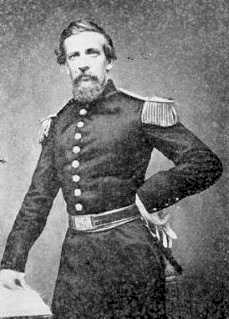 John Bowen in the form of a lieutenant colonel | |
| Date of Birth | October 30, 1830 |
| Place of Birth | Bowens Creek, ( Georgia ), USA |
| Date of death | July 13, 1863 (32 years old) |
| Place of death | Edwards, Mississippi |
| Affiliation |  (USA) (USA) KSA (KSA) KSA (KSA) |
| Type of army | infantry |
| Years of service | 1853-1856 (USA) 1857-1861 (Missouri) 1861-1863 (KSA) |
| Rank | Major General (KSA) |
| Battles / wars | U.S. Civil War
|
The early years
Bowen was born in Bowens Creek, Georgia . In the 40s, he entered the University of Georgia in the city of Athens , and was a member of the literary society Fi Kappa there. However, he left the university before graduation. In 1848, he entered the West Point Academy. His studies were suspended for a year in March 1851, so he graduated from the Academy in 1853, the 13th out of 52 cadets [1] . Among his classmates were John Bell Hood (44th) and John Chambliss.
He was temporarily identified as second lieutenant in the cavalry regiment (Regiment of Mounted Rifles). Bowen was sent to the cavalry school in Carlisle (PA), and in 1855 he was transferred to the Jefferson Barracks in St. Louis, Missouri. In St. Louis, he met Mary Kennerly and married her. He soon became an adjutant in the 2nd Cavalry Regiment, and at the beginning of 1855 he was sent to Fort Macintosh in Texas. There he decided to resign from the army and returned to Georgia, where he began to work as an architect. he soon became a lieutenant colonel in the Missouri Volunteer Miltia. In 1861, he commanded a battalion that defended the western border of Missouri from raids by the Kansas known as the Jayhawkers.
Civil War
In early May 1861, Bowen was sent to St. Louis, where he took command of the 2nd Regiment of the Missouri Militia, consisting mainly of members of the Minutemen secessionist organization. He became regiment commander and chief of staff of brigadier general Daniel Frost, and was captured by Camp Jackson when the secessionists were defeated by the army of federal general Nathaniel Lyon . On June 11, 1861, even before the release of the exchange, he received the rank of colonel of the Confederate army. Returning to Memphis, he set about recruiting and forming the 1st Missouri Infantry Regiment. In the fall, he became a brigade commander and served in Kentucky under General Leonidas Polk [2] .
On March 14, 1862, Bowen was promoted to Brigadier General and sent to the General Breckinridge Reserve Corps as part of the Mississippi Army . He showed himself well in the battle of Shiloh , where he was badly wounded by a shell fragment. After recovering, he began to command a brigade in the Mansfield Lovell division in the West Tennessee army, and participated in the second battle of Corinth. On the first day of the battle, his brigade successfully attacked the positions of the federal army, but Lovell refused to repeat the attacks. On the second day, his attack was less successful, and Lovell ordered not to repeat the attacks. During the retreat from Corinth, his brigade walked in the rearguard and kept the federal army at the turn of the Tuscumbia River all day. When the army retreated to Ripley, Bowen accused the army commander Earl van Dorn of poorly organized march, lack of reconnaissance before the battle, and neglect of the wounded. However, the tribunal withdrew all charges from Van Dorn [3] .
In December, Van Dorn was removed from command and John Pemberton was appointed commander at Vicksburg. Bowen was instructed to defend the Grand Gulf forces of the infantry brigade. After ascertaining that Grant would soon be landing at Grand Gulf, he requested reinforcements from Pemberton, but was refused. When the federal army appeared, Bowen managed to detain her in the battle at Port Gibson for the whole day, while personally led two counterattacks. For this battle, he received the title of Major General on May 25, 1863, although Congress never approved this title. Emberton and Johnston were unable to help Bowen, so Grant soon resumed his march to Mississippi. Bowen’s detachment joined forces with Pemberton’s army and was instructed to command the division, which consisted of the teams of Francis Cockrell and Martin Green.
In this role, he took part in the battle of Champion Hill. He managed to counterattack literally cut the army of the grant in two, but his attack was not supported and he had to retreat. Pemberton retreated to Vicksburg and instructed Bowen to cover the retreat. Bowen took up a position on the Black River, but suffered a heavy defeat at the Battle of the Black River Bridge . He took the remainder of his forces to Vicksburg and took part in the defense of Vicksberg, but soon became ill with dysentery. He participated in negotiations with Grant (with whom he was friends in the pre-war period) which led to surrender on July 4. In captivity, dysentery worsened and he died in Edwards 9 days after surrender (July 13).
Notes
- ↑ Register of Officers and Graduates of the United States Military Academy Class of 1853
- ↑ Tucker, pp. 66–72, 80–91
- ↑ Cozzens, S. 142, 174, 271–272, 295, 308–309
Literature
- Ballard, Michael B., Vicksburg, The Campaign that Opened the Mississippi. Chapel Hill, North Carolina: University of North Carolina Press, 2004. ISBN 0-8078-2893-9 .
- Daniel, Larry, Shiloh: The Battle that Changed the Civil War. Simon and Schuster, 1997. ISBN 0-684-83857-5 .
- Eicher, John H., and Eicher, David J., Civil War High Commands. Stanford University Press, 2001. ISBN 0-8047-3641-3 .
- Patterson, Gerard A., Rebels from West Point, Stackpole Books, 2002, ISBN 0-8117-2063-2 .
- Sifakis, Stewart. Who Was Who in the Confederacy. New York: FactsOnFile, 1988. ISBN 0-8160-2204-6 .
- Sword, Wiley, Shiloh: Bloody April. Morningside Books, 1974. ISBN 0-89029-770-3 .
- Tucker, Phillip Thomas. The Forgotten "Stonewall of the West": Major General John Stevens Bowen. Macon, Georgia: Mercer University Press, 1997. ISBN 0-86554-530-8 .
- Warner, Ezra J., Generals in Gray: Lives of the Confederate Commanders. Louisiana State University Press, 1959. ISBN 0-8071-0823-5 .