Short-clawed kangaroo [1] , or bridle kangaroo [1] , or dwarf kangaroo [1] ( lat. Onychogalea fraenata ) is a marsupial mammal of the kangaroo family. Endemic to Australia . It is found in small isolated populations in Queensland .
| Short-Clawed Kangaroo |
 |
| Scientific classification |
|---|
| No rank : | Bilateral symmetrical |
| Squad: | Two-tailed marsupials |
| Suborder : | Macropodiformes |
| Gender: | Talon-tailed Kangaroo |
| View: | Short-Clawed Kangaroo |
|
| International scientific name |
|---|
Onychogalea fraenata ( Gould , 1841) |
| Area |
|---|
|
| Security status |
|---|
Endangered speciesIUCN 3.1 Endangered : 15330 |
|
Content
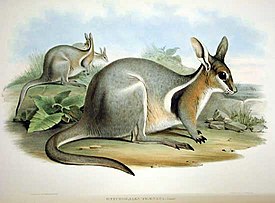
Short-clawed kangaroo from 43 to 70 cm long, tail from 36 to 73 cm long. Weight is from 4 to 9 kg, while males are much larger and heavier than females. The hind limbs are large and strong, the forelimbs are much shorter. The tail is long and muscular, on the top of the tail is small, like a nail spur. The coat on the upper side is predominantly gray, the underside is whitish. White streaks in the form of reins are characteristic, extending from the center of the neck behind the ears on the shoulders down to the belly. The hips also have white, but often invisible stripes.
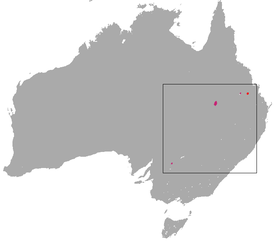
The species used to be widespread in eastern Australia. Today its population is limited to three small areas in Queensland. Lives on the edge of the eucalyptus forest and thickets of acacias.
These kangaroos are active at dawn or at night. During the day, they rest in tall grass or in low nests, at night they go in search of food. They live more often alone, sometimes in a period of great drought form groups. Their food consists mainly of herbs, as all kangaroos have a multi-chamber stomach, which helps to better absorb difficult to digest plant food.
There is no specific breeding season and, under good conditions, females can grow up to three cubs per year. Pregnancy lasts 21-26 days. Usually one cub is born, less often two. Feeding with milk lasts 190-245 days. Puberty in females occurs in 4.5–9 months, in males in 9–14 months.
- ↑ 1 2 3 Sokolov V. E. The Bilingual Dictionary of Animal Names. Mammals Latin, Russian, English, German, French. / edited by Acad. V. E. Sokolova. - M .: Rus. Yaz., 1984. - S. 24. - 10,000 copies.
- Ronald M. Nowak: Mammals of the World . Johns Hopkins University Press, Baltimore 1999. ISBN 0-8018-5789-9