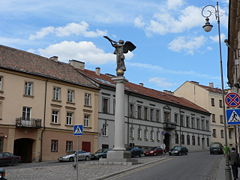
Uzhupis ( lit. Užupis , Rus. Zarechye ) - Vilnius district , partially located in the Old Town . It is considered a district of artists and artists, often compared with the Montmartre district in Paris . Today in the area there are art galleries and workshops, numerous cafes.
Content
- 1 Location and general description
- 2 Republic of Uzupis
- 3 See also
- 4 References
- 5 notes
Location and General
Uzupis is a small and isolated area. On the one hand, it is separated from the Old Town by the river Vilenka ( Vilnale ), on the other hand there are steep hills, and on the third - an industrial zone built in Soviet times . In the 16th century , the first bridges over the river were built. The quarter was inhabited mainly by artisans . Since the end of the 19th century, military and small-scale employees began to settle in Zarechye, but the majority of the inhabitants were the urban poor .
From one of the bridges over Vilenka ( Bernardinųtiltas Bernardine ), begins Malunu street ( Malūnų g. , Ul. Młynowa ), which was named after the royal mills that once stood on it. The entire left side of the short street is occupied by the building (132 meters long [1] ) of the former “riverine” Bernardine monastery (founded in 1495 by Barbara Radziwill and Anna Olehnovich ; the current building was erected after the fire of 1794 caused by the bombing). Upon the abolition of the monastery in 1864, the tsarist authorities made barracks in it, from 1876 until the First World War the building belonged to the Orthodox Holy Spirit Brotherhood . In the period between the world wars, the apartments of the former monastery housed residential apartments for civil servants; in 1934-1936 Here lived the Polish poet Constant Galchinsky . Now in the building of the former monastery private apartments.
In the summer, an exhibition of famous Lithuanian photographers [2] organized by Alexandra Divova [3] takes place on the street wall of the monastery. The exhibition is updated every two weeks, among the participants in 2015 are Marius Abramavichus , Max Fry , national prize winner Algirdas Sheskus [4] and others.
Malunu street goes to Užupё street (Zarechnaya, Užupio g. , Ul. Zarzeczna ) at its widest point and to the intersection with Paupio street ( Paupio g. , Ul. Popławska ). Užupё Street is expanding significantly in this place, the explanation for this is that there used to be a small church of Peter and Paul, which burned down in 1610 and was not restored; in the middle of the XVII century a cross was erected in its place, in the middle of the XIX century a pseudo-Gothic chapel was built , destroyed after the Second World War . For some time a water pump stood on the remaining low elevation, now in the same place stands a column with the Uzhupsky angel. The intersection leads to Užupё street, starting after another, second bridge at Vilenka ( Zarechny bridge , Užupio tiltas ), opposite the monument to Mieczyslaw Dordzik .
A significant area on the corner of Zarechnaya and Poplavskaya streets is occupied by an impressive palace of strict classicist forms. The palace was built at the end of the 18th century according to the design of the architect Augustin Kossakovsky and was rebuilt at the beginning of the 19th century . Since 1840, it belonged to various institutions and owners, it housed a hotel, inn, bakery. In 1863, the palace passed to the Gonest family, which was owned by it until 1940 , due to which its name ( pałac Honestich ) was fixed , in 1877 it was reconstructed. Today, a part of the first floor of the palace is occupied by a grocery store.
From it, the winding Poplavskaya street (Paupё) leads to another, third Poplavsky bridge on Vilenka. On the wall along Paupo Street, tables with the Constitution of the Republic of Uzupis are installed.
Along Zarechnaya Street, east of the gate, on the right side, is the church of St. Bartholomew . Behind it, at a small park that once had a market, the street bifurcates into Polocko ( Polocko g. ) And Krivuų ( Krivių g. ) On the Polotsk street was located the Research Institute of Oncology. A well-known oncologist, professor at the University of Stefan Batory Casimir Pelchar (shot by German occupiers in Ponar ) worked here.
The old Batory path to Polotsk began from Polotsk Street, and now it goes to Belmontas and Stepono Batoro g. Leading to New Vilna . The first right turn on Polotsk by a short street вvirgždino ( Žvirgždyno g. ) Leads to the Bernardine cemetery .
Until 1915, Krivu Street was called Popovsky Lane and past the mountain of the Gediminas grave , where, according to legend, the Grand Duke of Lithuania was burnt, led to Golenderskaya Street (now Olandų ) and Antakalnis . Ponomarsky Lane (now Filaretu , Filaretų ) branched off to the right from Popovsky Lane.
Since Soviet times, many famous people have lived or had their own workshops in Uzhupis. The long-term mayor of Vilnius Arturas Zuokas lives in Užupis and takes part in some events taking place there [5] .
The symbol of Užupis is an angel , since a monument depicting a trumpeting angel was erected in the main square. The bronze sculpture is mounted on a column 8.5 meters high. The column was installed in 2001 . Initially, a huge egg rested on it, sold in March 2002 at an auction organized by the Užupis Angel Club. On April 1, 2002, the sculpture installed there was inaugurated on the column (silver-plated and gilded bronze, total height 12.50 m <); the authors of the monument are sculptor Romas Vilčiauskas and architect Algirdas Umbrasas [5] . Funds for the construction of the monument (about half a million litas ) were donated by individuals and companies. The angel symbolizes the revival and artistic freedom of the quarter.
Uzupis Republic
In 1996 , a group of artists founded the "Center for Alternative Art" here, in the same year the first art exhibitions and public events were organized and held there. Later, the quarter became the home of many artists and artists, the area became known as the “Vilnius Montmartre”. Having heard about a similar phenomenon, representatives of the French Montmartre visited the city (now a symbolic tablet indicates the friendship and cooperation of both). In 1998, residents of the quarter proclaimed the Republic of Uzupis with their own flag, president, constitution, and even an army of 12. They celebrate the semi-joke Independence Day, April 1 .
Now Uzupis has its own currency , anthem , customs , honorary citizens , ambassadors and consuls in 320 cities of the world, elections and carnivals .
The President of the Republic of Uzupis is a poet, musician and film director Romas Lileikis [6] .
Prime Minister - Sakalas Gorodetskis.
Minister of Finance - financier Alyus Lekevicius.
The Minister of Information is entrepreneur Vytautas Ratkevičius.
Foreign Minister - essay writer, screenwriter Thomas Chepaitis [5] .
The minister without a portfolio is entrepreneur Vitas Machiulis [7] .
- A person has the right to live near the Vilnius , and the Vilnial flow next to the man.
- A person has the right to hot water, heating in winter and a tiled roof.
- Everyone has the right to die, but is not obliged.
- Everyone has the right to make mistakes.
- Everyone has the right to be one and only.
- Everyone has the right to love.
- Everyone has the right to be unloved, but this is not necessary.
- Everyone has the right to be unknown and not famous.
- Everyone has the right to be lazy and do nothing.
- Everyone has the right to love and patronize a cat.
- Everyone has the right to take care of a dog until the end of the days of one of them.
- A dog has the right to be a dog.
- A cat is not obliged to love its owner, but in difficult times it is obliged to come to his aid.
- Everyone has the right to forget whether they have responsibilities.
- Everyone has the right to doubt, but this is not an obligation.
- Everyone has the right to be happy.
- Everyone has the right to be unhappy.
- Everyone has the right to remain silent.
- Everyone has the right to believe.
- Everyone has the right to realize their worthlessness or their greatness.
- No one has the right to commit violence.
- No one has the right to encroach on the eternal.
- Everyone has the right to understand.
- Everyone has the right to understand nothing.
- Everyone has the right to any nationality.
- Everyone has the right to celebrate or not to celebrate his birthday.
- Everyone must remember their name.
- Everyone can share what he has.
- No one can share what he does not have.
- Everyone has the right to brothers, sisters and parents.
- Everyone can be free.
- Everyone is responsible for their freedom.
- Everyone has the right to cry.
- Everyone has the right to be misunderstood.
- No one has the right to blame others.
- Everyone has the right to be a person.
- Everyone has the right to have no rights.
- Everyone has the right not to be afraid.
The commandments
DO NOT WIN
DO NOT PROTECT
DO NOT GIVE UP- Wall of translations of the Constitution of Uzupis on Paupio Lane street [8]
- Honorary Citizens of the Republic of Uzupis
- Jonas Mekas [5]
See also
- Independent Republic of Greenwich Village
Links
- Official website of the Uzhupis Republic
- The Republic of Užupis // vilnius-tourism.lt (English)
- About Uzupis on Privet-Litva.ru
- How they do it in Uzupis // strana.lenta.ru
- The patrimony of free artists: Uzupis celebrated Independence Day // Sputnik , 2.04.2019
Notes
- ↑ Audronė Kasperavičienė, Jerzy Surwiłło. Przechadzki po Wilnie. Zarzecze. Cmentarz Bernardyński. Wilno: Efekt, 1997. S. 7. (lit.)
- ↑ Malunu Street Photo Exhibition on Facebook
- ↑ Rasa PAKALKIENĖ . Nuotraukos ant sienų paryškina Užupio veidą , Lietuvos žinios (May 25, 2015).
- ↑ Adomaitis and Kanovich - laureates of the National Culture Award , DELFI (December 11, 2014).
- ↑ 1 2 3 4 Own correspondent Interview with Thomas Chepaitis for the magazine "Tatlin" - 2012. - No. 5. // solo-e.livejournal.com
- ↑ Pavuk O. Under the canopy of an angel // baltic-course.com, 2 Apr 2003
- ↑ see Vilnius Cardiac Surgery Clinic (interview with V. Machiulis) in the journal "Hospital" No. 11 1998, p. fourteen.
- ↑ Text of the Constitution of the Republic of Uzupis