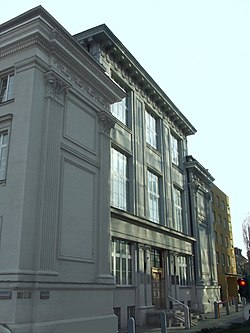
The Central Committee of Polish Jews ( Polish Centralny Komitet Żydów Polskich (CKŻP) , Yiddish צענטראל קאמיטעט פון די יידו אין פוילו) is a cultural, charitable, educational and representative organization of Polish Jews who survived after the Holocaust . The Central Committee of Polish Jews operated in Poland from 1944-1950.
Content
History
The Central Committee of Polish Jews was established on November 12, 1944 as a continuation of the created one month earlier “ Provisional Central Committee of Polish Jews ” ( Polish Tymczasowy Centralny Komitet Żydów Polskich (TCKŻP) ). The aim of the creation of the Central Committee of Polish Jews was to restore the Jewish community in Poland, to provide various assistance to Polish Jews who survived in the Holocaust and to represent their interests in the Polish government.
The “Historical Commission”, created earlier by the Provisional Central Committee of Polish Jews, was transformed by the Central Jewish Historical Commission , whose task was to collect information about surviving Jews and to assist in the search for Nazi criminals who participated in the Holocaust. In May 1947, the “Central Jewish Historical Commission” was transformed into the Jewish Historical Institute .
Since 1946, most of the organization’s funding (80%) was funded by grants from the American Jewish Joint Distribution Committee .
In June 1946, the governing council of the Central Committee of Polish Jews was established. Based on the compromise, six seats were provided for the Communists (from the so-called Jewish faction of the Polish Workers' Party ), four seats for members of the Bund and members of the United Zionist Democrats from the Ihud party, three seats for members of the left Poalei Zion and members right Poalei Zion and one place - for a member of the Hashomer hazair . Emil Sommerstein , a member of Ihud, was chosen as the first chairman of the Central Committee. At the end of 1946, Adolf Berman from the left Poale Zion replaced him.
In 1948, after the influence of the Polish communist government, the majority of the seats on the governing council went to the communists. In the same year, 22 out of 32 Jewish schools were nationalized and a program containing Jewish subjects was canceled. In 1949, the representative of the Polish United Workers Party, Hersh Smolyar , was appointed chairman.
In 1950, the Central Committee of Polish Jews ceased to exist after the issuance of a special decree of the Polish government, which combined the Central Committee of Polish Jews and the communist Society of Jewish Culture into a single Jewish public organization, the Socio-Cultural Society of Jews in Poland , which has been operating in Poland to date. .
Publishing
In 1945-1950 The Central Committee published the Yiddish daily newspaper Dos Naje Lebn (New Life) and, since 1947, the monthly youth magazine Ojfgang . In 1946-1947 the book publisher Dos Naje Lebn , later renamed Undzer Lebn , also worked.
Educational Activities
Since May 1946, the “School Department” began to work under the Central Committee of Polish Jews, which was able to organize the academic year 1946/47. for 28 school educational institutions and in the next academic year - for 33 educational institutions. The educational program in these years was attended by about three thousand children. The program of the "School Department" roughly corresponded to the Polish state program. Hebrew and Yiddish subjects on Jewish history and literature were also added. There was no religious subject in the program; Saturday was a day off for schoolchildren. The school department also supported 11 orphanages and 60 nursing homes.
In 1945, the School Department organized the Central Jewish Library. Since August 1946, the "Community Department" began to work under the "School Department".
Cultural Activities
Under the Central Committee of Polish Jews, the “Department of Culture and Art” operated, uniting the few Jewish cultural figures who survived the Holocaust. The "Department of Culture and Art" provided financial and organizational assistance to the Jewish Society for the Promotion of Art . Since November 1947, the "Jewish Society of Culture and Art", founded by members of the Polish Workers' Party, functioned at the "Department of Culture and Art" (later it was renamed the "Society of Jewish Culture"). The department of culture and art also supported the activities of the film studio Kinor .
Literature
- Rafał Żebrowski. Zofia Borzymińska, Po-lin. Kultura Żydów polskich w XX wieku, rozdział Po II wojnie światowej. - Amarant, 1993 .-- P. 304-318.
- JadFF Schatz. Komuniści w "sektorze żydowskim": tożsamość, etos i struktura instytucjonalna. - Austeria, 2008 .-- S. 27-49.
- Nusech Pojln. Studia z dziejów kultury jidysz w powojennej Polsce. - Austeria, 2008 .-- S. 27-49.