Jeffrey Lee Pierce ( born Jeffrey Lee Pierce ; June 25, 1958 , Montebello - March 31, 1996 , Salt Lake City ) is an American musician, composer, singer, guitarist. Founder and permanent member of The Gun Club , author of several solo records. Born in the city of Montebello , in the east of Los Angeles , spent his childhood in El Monte , California . He began to get involved in music and playing the guitar from the age of ten [1] .
| Jeffrey Lee Pierce Jeffrey lee pierce | |
|---|---|
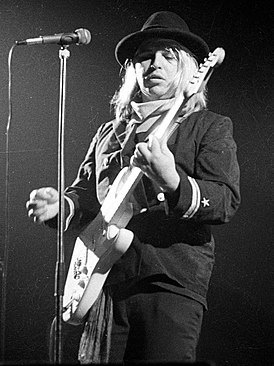 At a concert in Antwerp , 1985 | |
| basic information | |
| Date of Birth | June 27, 1958 |
| Place of Birth | Montebello , California , USA |
| Date of death | March 31, 1996 (age 37) |
| A place of death | Salt Lake City , Utah , USA |
| A country |  USA USA |
| Professions | musician , composer |
| Genres | rock , country , blues , country punk , punk blues , sycobilly |
| Aliases | JLP, Ramblin 'Jeffrey Lee (Tramp Jeffrey Lee) |
| Collectives | The gun club |
| jeffreyleepierce.com | |
Content
- 1 Biography
- 2 Posthumous memory
- 3 notes
- 4 References
Biography
In 1973, Pierce left El Monte and moved to the working town of Granada Hills in the San Fernando Valley . He earned a living by hard work in a music store and help in the manufacture of fanzines [2] . The first hobbies of Jeffrey Lee were cinema and theater, the young man took part in dramatic productions, wrote several short plays. In the mid-70s, he lost interest in the theater and devoted all his time to music. He studied delta blues under the guidance of Los Angeles musician Fast Freddy Patterson [3] , was fond of glam and progressive rock in the person of Sparks , Genesis and Roxy Music . After attending a concert, Bob Marley became seriously interested in reggae and took a trip to Jamaica to study this music [4] . In 1976, the young man was fascinated by the pioneers of the new wave and punk rock Blondie , headed their fan club on the West Coast . Under the influence of the image of the leader of the Blondie, Debbie Harry dyed his hair in a light color [3] . By the end of the 70s, he discovered classic American country and African American blues , and became a frequent guest at concerts in Hollywood . Pierce’s desire to play his own music coincided with the development of punk and know-wave movements in New York . From the elements of the music surrounding him, Jeffrey Lee created his own unique sound, which formed the basis of the future band The Gun Club [4] . The young musician was supported by Debbie Harry, confident in his undoubted talent [1] .
In 1980, The Creeping Ritual was founded by Pierce and Kid Congo Powers , which soon changed its name to The Gun Club. At first, the company was composed of musicians Don Snowden and Brad Dunning, however, throughout the existence of the group, its composition was extremely unstable, the only permanent member was only Jeffrey Lee Pearce. The first album The Gun Club Fire of Love , recorded as part of: Pierce - vocals , Ward Dotson - guitar , Rob Ritter - bass and Terry Graham - drums came out in 1981. The disc was a unique fusion of punk savagery, blues integrity and Gothic detachment [4] [5] . This debut album has already recommended The Gun Club as an unusually influential group, and Jeffrey Lee Pearce as a new hero for the European rock elite [2] [3] . Years later, the singer of modern blues, Jack White , after listening to Fire of Love , said: ““ Sex Beat ”,“ She's Like Heroin to Me ”,“ For The Love of Ivy ”... why these songs are not taught in schools?” [6] and one of the founders of the Seattle alt-rock, Mark Lanegan , completely elevated the soloist of The Gun Club to the level of his musical God [7] . In gratitude, Jeffrey Lee wrote his most touching song, “Kimiko's Dream House”, for Mark [8] .
In 1982, with the support of Blondie guitarist Chris Stein [9] , The Gun Club's second album, Miami , was lyrically more melancholy and moody than its predecessor. With the release of the album, the group’s photos began to appear on the covers of significant print media, including the patriarch of the British musical review, New Musical Express [3] . The group went on their first significant tour in Europe, after which they recorded the third album - The Las Vegas Story - Jeffrey Lee Pierce's favorite disc. The album was prepared by Pierce (vocals), Powers (guitar), Graham (drums) and Patricia Morrison (bass), released in 1984. The Las Vegas Story demonstrated a very original mixture of punk, blues and country, and beautiful, sometimes mystical lyrics [4] . She immediately found a response in the work of one of the discoverers of post-punk - Nick Cave . The Australian met Jeffrey Lee in London and subsequently repeatedly recalled him with warmth: “He often spoke nonsense, and this was part of his charm. Here he talks about the fall of Saigon , and a minute later he talks about the size of the brain of a dinosaur . But I didn’t care, I was just happy ... " [10] On the pages of his autobiography Go Tell the Mountain, Pierce even called Cave" his true wife " [11] . Alas, despite the always positive reviews from critics, none of The Gun Club's albums achieved impressive commercial success, the group was listened to by a relatively small audience. In part, this was due to the soloist's constant problem - the abuse of alcohol and drugs, in particular opiates . After the release of The Las Vegas Story, The Gun Club toured Mexico , which negatively affected the sobriety of Jeffrey Lee [3] . In the mid-80s, the team decided to stop musical activity.
In 1985, with the participation of musicians from Roxy Music and The Cure , Pierce released his solo album Wildweed , marked by the influence of Bob Dylan and Lou Reed . The simple and melodic Wildweed was available to a wider audience. The cover of the disc shows Jeffrey Lee with a gun over his shoulder, on a deserted sea coast, which can be mistaken for the prairie of Texas or Kansas [12] . According to the musician, he wanted to make an album that "would sound like ocean waves." At the same time, Jeffrey Lee met his future wife - Japanese Romy Mori. The couple had a son - Luke [10] . A year later, The Gun Club was reformed - the new lineup included Pierce (vocals), Powers (guitar), Mori (bass) and Nick Sanders (drums). The group recorded the fourth album Mother Juno , which was dominated by elements of garage rock and post-punk. Blix Bargeld of Nick Cave and the Bad Seeds also took part in the recording. The release of the record was overshadowed by Jeffrey Lee's deteriorating health - at the age of 29 he was diagnosed with cirrhosis , the musician made an attempt to quit alcohol, but without much success [1] [3] . Roland S. Howard, an associate of Nick Cave on The Birthday Party , recalled this period in the life of the lead singer of The Gun Club: “He was an unhappy person. His liver hurt all the time, he came to my house - he climbed the stairs as if he were 80 years old. It was really sad. ” [3]
In 1990, the fifth album, The Gun Club Pastoral Hide and Seek , personally produced by Pierce, was released. Despite the health problems and the depressed state of the musician, the album showed high sound quality [1] . In the hope of overcoming the painful state of mind, Jeffrey Lee went on a trip to Vietnam [3] . In 1992, under the name Ramblin 'Jeffrey Lee released his self-titled album, entirely dedicated to the blues. In 1993, Pierce began creating the latest work by The Gun Club - Lucky Jim , contrary to expectations, which became a full and powerful album. Despite the constant effects of drugs, severe physical and mental form, Jeffrey Lee Pierce showed phenomenal strength as a singer and an obsession as a guitarist [1] . After the release of Lucky Jim, The Gun Club finally ceased its activities. Pierce, however, did not lose interest in music. He became interested in recitative and in 1995 recorded the song “Pasties and a G-String” for the tribute album Tom Waits Step Right Up: The Songs Of Tom Waits in this style. At the same time, he became interested in Japanese rock and spent several months in Japan , positively impressed by the work of local groups, including The 5.6.7.8's [3] . After Jeffrey Lee returned to Los Angeles, where he again engaged in narcotic self-destruction. In the last month of his life, he suffered from cirrhosis, chronic hepatitis and was HIV- infected [13] . Before his death, the musician decided to visit his father in Utah, where he was taken to the hospital with a stroke . He had to undergo an operation to remove a blood clot in the brain, but died earlier without regaining consciousness. The ashes of the musician were scattered over the Japanese city of Kyoto [3] . Jeffrey Lee Pearce was 37 years old.
Posthumous memory
In 2010, The Jeffrey Lee Pierce Sessions Project was created, within the framework of which the performers who honored the deceased's work, along with his old friends and colleagues, presented their interpretation of Pierce's classic songs and added unfinished and unreleased material to Jeffrey Lee. Nick Cave and Mick Harvey , Mark Lanegan and Isobel Campbell, Debbie Harry, Lydia Lunch and others took part in the recording of the first album We Are Only Riders [14] . On the second disc of The Journey is Long, they were joined by Barry Adamson , Hugo Rays (former members of Bad Seeds), Cypress Grove (took part in the recording of Ramblin 'Jeffrey Lee ), Warren Ellis and others [15] . Axels & Sockets ' third disc showed an even more varied line-up of performers: Iggy Pop , Crippled Black Phoenix , The Amber Lights, Primal Scream , not counting the above-mentioned musicians [16] .
The French group Noir Désir dedicated Pierce the song “Song for JLP” (album 666667 Club ). Blondie paid tribute to him in Under the Gun ( No Exit ). American Team Off! recorded the track, which he called “Jeffery Lee Pierce” ( first Four EPs record). Swedish musician Thåström recorded Jeffrey Lee’s dedication titled “Ingen Sjunger Blues Som Jeffrey Lee Pierce”. The British Gallows in the song "Everybody Loves You (When You're Dead)" ( Gallows album) put JLP on a par with Dee Dee Ramon , Frankie Venom, Lux Interior , Darby Crash , Johnny Sanders , Sid Vichez and Joe Strummer . Mark Lanegan recorded his version of “Carry Home” on I'll Take Care of You album , “Kimiko's Dream House” in his performance was released on the disc Field Songs .
The life and work of the leader of The Gun Club was reflected in the documentary film Ghost on the Highway: A Portrait of Jeffrey Lee Pierce and the Gun Club directed by Kurt Voss, with the participation of Henry Rollins , Lemmy and John Doe . American independent filmmaker Jim Jarmusch spoke of Jeffrey Lee Pierce as a talented person, and German director Wim Wenders called him “one of the greatest blues performers of all time” [3] .
Notes
- ↑ 1 2 3 4 5 Leach, Ryan. A Jeffrey Lee Pierce and Gun Club Chronology . JeffreyLeePierce.com. Date of treatment August 27, 2012. Archived November 23, 2012.
- ↑ 1 2 Perrone, Pierre. Obituary: Jeffrey Lee Pierce . The Independent (April 10, 1996). Date of treatment August 27, 2012. Archived December 8, 2013.
- ↑ 1 2 3 4 5 6 7 8 9 10 11 Donlon, Helen. Fire Of Love: A Jeffrey Lee Pierce Retrospective . The Quietus (May 2, 2014). Date of treatment August 27, 2012. Archived on May 5, 2014.
- ↑ 1 2 3 4 Olende, Stevo. The Gun Club Story . Perfect Sound Forever (January 2002). Date of treatment August 27, 2012. Archived October 28, 2012.
- ↑ Hinman, Jay. For the Love of Jeffrey . Perfect Sound Forever (January 2002). Date of treatment August 27, 2012. Archived October 28, 2012.
- ↑ Adams, Owen. Why the White Stripes want to join the Gun Club . The Guardian (July 18, 2007). Date of treatment August 27, 2012. Archived October 28, 2012.
- ↑ Morris, Chris. Mark Lanegan on Jeffrey Lee Pierce . Billboard (August 15, 1998). Date of treatment August 27, 2012. Archived July 26, 2003.
- ↑ Marszalek, Julian. Mark Lanegan's Favorite Albums . The Quietus (January 26, 2012). Date of treatment August 27, 2012. Archived October 28, 2012.
- ↑ Sullivan, Denise. The Gun Club biography . Allmusic . Date of treatment August 27, 2012. Archived October 28, 2012.
- ↑ 1 2 Levin, Darren. Nick Cave On Jeffrey Lee Pierce . Mess + Noise (April 26, 2012). Date of treatment August 27, 2012. Archived on April 29, 2012.
- ↑ Pierce, Jeffrey Lee. Go Tell the Mountain: Stories and Lyrics of Jeffrey Lee Pierce . - 2.13.61 Publications, 1998 .-- 128 p. - ISBN 1880985608 .
- ↑ Olende, Stevo. The Gun Club Story by Stevo Olende Neopr . Perfect Sound Forever (January 2002). Date of treatment August 27, 2012. Archived October 28, 2012.
- ↑ Gehman, Pleasant. Jeffrey Lee Pierce: In Memory . Ger Potze (April 19, 1996). Date of treatment August 27, 2012. Archived October 28, 2012.
- ↑ Quantick, David. We Are Only Riders . BBC Music (January 18, 2010). Date of treatment August 27, 2012. Archived January 21, 2010.
- ↑ Roberts, Chris. The Journey Is Long . BBC Music (April 3, 2012). Date of treatment August 27, 2012. Archived October 28, 2012.
- ↑ Needs, Kris. Iggy Pop, Nick Cave, Thurston Moore and Jim Sclavunos play Nobody's City . The Guardian (May 2, 2014). Date of treatment August 27, 2012. Archived on May 2, 2014.
Links
- Official website
- Jeffrey Lee Pearce Memorial Site
- The Gun Club Archives
- JLP and The Gun Club biography in three parts: 1 2 3