The “Book of the Dead” in Ancient Egypt is a collection of Egyptian hymns and religious texts, placed in a tomb in order to help the deceased overcome the dangers of the other world and find prosperity in afterlife [1] (in the fields of Ialu ). Various copies of the Book of the Dead can contain from several to two hundred chapters of various sizes, ranging from long poetic hymns to single-line magic formulas .
| Ancient Egyptian Book of the Dead | |||||||||||
|---|---|---|---|---|---|---|---|---|---|---|---|
| |||||||||||
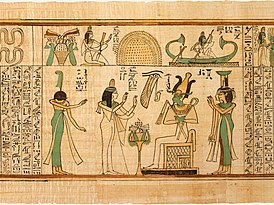 Funeral papyrus of singer Amon Nani ( XXI dynasty , c. 1050 BC), Metropolitan Museum of Art | |||||||||||
| Author | |||||||||||
| Original language | |||||||||||


The name “Book of the Dead” was given by the Egyptologist Karl Richard Lepsius , but it would be more correct to call it the “Book of the Resurrection”, as its Egyptian name literally translates as “Chapters on the Exit to the Light of the Day.”
Some of the best examples of the “Book of the Dead” written on papyrus scrolls date back to the heyday of culture during the XVIII dynasty . The largest number of papyri with texts from the Book of the Dead was found in the graves of Thebes - in the Theban tombs of priests and their families. These papyruses are richly decorated with drawings of scenes of burial, a memorial ritual , a posthumous court, as well as others related to the memorial worship and ideas about the afterlife.
There is also a Sais version of the Book of the Dead, which appeared during the XXVI dynasty , when there was a general revival of ancient religious and funerary traditions, temples were restored, and the old texts of the Book of the Dead were rewritten, revised, and streamlined.
History
The Book of the Dead is associated with earlier collections of funeral texts - “Texts of Sarcophagi” ( Middle Kingdom ) and “Texts of the Pyramids” ( Ancient Kingdom ).
In the era of the Old Kingdom, there was a custom of casting spells aloud for the deceased pharaoh , which was supposed to provide him with the afterlife. Later, similar texts began to be recorded in the tombs of Egyptian nobles. By the time of the Middle Kingdom, collections of funeral spells (partly old, partly composed anew according to their model) were already recorded on the surface of sarcophagi and became available to anyone who could afford it. In the New Kingdom and later, they were recorded on papyrus scrolls, and sometimes on the skin. These scrolls were called the “Books of the Dead,” despite the fact that they vary greatly in the content and arrangement of the texts.
This religious and magical collection gives the impression of a chaotic pile of prayers , chants , praises and incantations associated with the funeral cult. Gradually, elements of morality penetrate the Book of the Dead. Chapters 1, 18, 30, and 125 point to the development of ethical views.
At its core, the Book of the Dead is a religious collection, so the elements of morality contained in it are intertwined with ancient magic. In the 30th chapter of the Book of the Dead, the deceased conjures his heart not to testify against him in a posthumous court. This motley mixture of religious and magic beliefs is explained by the fact that the Book of the Dead was compiled and edited over the course of several centuries. Ancient texts were traditionally preserved until late , and their content often became incomprehensible and even required explanations, which, for example, were added to the 17th chapter of the Book of the Dead.
Osiris Court
At the beginning of the reign of the XVIII dynasty, the scene of the Court of Osiris appeared on the papyri of the “Book of the Dead”, for the first time “great scales” are depicted [2] . Of particular interest to researchers is the 125th chapter, which describes the posthumous trial of Osiris over the deceased. There is an illustration to the chapter: Osiris (the king and judge of the underworld) sits on the throne with the signs of imperial authority (with the crown of atef , with a rod and a whip). At the top are 42 gods (obviously the gods of the nomes ). In the center of the hall are “great scales” on which the gods Thoth and Anubis weigh the heart (ib) of the deceased (the symbol of the soul of the ancient Egyptians).
According to the beliefs, the heart of the deceased was placed on one side of the scales, and the feather of the goddess of truth Maat was placed on the other to check how righteously the deceased lived [2] . If the great Ennead passed a guilty verdict, the monster Ammat devoured the heart of the deceased [3] , which deprived the sinner of the opportunity to continue his life in the fields of Ialu . At the trial, the deceased turns to Osiris, and then to each of the 42 gods, making excuses for the mortal sin that this or that god knew. The same chapter contains the text of an exculpatory speech ( Confession of denial ) [4] :
Glory to you, the great God, the lord of mutual truth. I have come to you, my lord. You brought me to contemplate your beauty. I know you, I know your name, I know the names of 42 gods who are with you in the chamber of mutual truth, who live, trapping the evil and eating their blood on the day of the report in the face of the Good. So I came to you, the lord of truth; I brought the truth, I drove away the lie. I did not do unfair things to people. I did not do evil. I didn’t do that for the gods an abomination. I did not kill. He did not reduce the loaves in the temples, did not reduce the food of the gods, did not pluck the deceased gifts from the dead. I did not reduce the measures of grain, did not decrease the measures of length, did not violate the measures of the fields, did not increase the weight weights, did not forge the arrows of the weights. I'm clean, I'm clean, I'm clean, I'm clean.
In the same chapter, a speech is given that is delivered upon exiting the "chamber of mutual truth." It is interesting in that the deceased says in it [4] :
... there is no accusation against me from the modern king ... I came to you without sin, without vice, without evil, without a witness against whom I would do anything evil ...
He, as in the present trial, proves that the charge against him is unfounded, that there are no witnesses against him. With this speech he refers to 42 gods, who can be called jurors , whom he "appeased by the fact that they are pleased" [4] .
The elements of morality necessary for a stable social and economic life in Ancient Egypt were initially fixed by religion , and only then by law. In its description, the court of Osiris is very similar to the court of the pharaoh - the supreme judge (similar to Osiris - the lord of mutual truth), who was the chairman of the supreme judicial board of 30 judges (an analogy with the gods in the court of Osiris).
Notes
- ↑ N.N. Shvets. Dictionary of Egyptian mythology. - Moscow: Centerpolygraph, 2008 .-- S. 74. - 256 p. - ISBN 978-5-9524-3466-0 .
- ↑ 1 2 Ernest Alfred Wallis Budge. Ancient Egypt. Spirits, idols, gods = From Fetish to God in Ancient Egypt / Translator: Igorevsky L. A. .. - M .: Tsentrpoligraf, 2009. - S. 52, 172, 185, 204-206. - 480 p. - (The Mysteries of Ancient Egypt).
- ↑ Ivan Cancer. Myths and legends of ancient Egypt. - Dragonfly, 2013 .-- S. 101, 254, 257.
- ↑ 1 2 3 Reading book on the history of the Ancient World / ed. E.A. Cherkasova. M .: Education, 1991.
Literature
- Book of the Dead // Brockhaus and Efron Encyclopedic Dictionary : in 86 volumes (82 volumes and 4 additional). - SPb. , 1890-1907.
- Mathieu M. A. The problem of studying the Book of the Dead // Mathieu M. E. Selected works on the mythology and ideology of ancient Egypt - M., 1996. - P. 98-105
- Turaev B.A. Egyptian literature . - M. , 1920.
- Ancient Egyptian "Book of the Dead" // Questions of history / Transl. with other Egypt., introduction and comments by M. A. Chegodaev. - 1994. - No. 8 . - S. 145-163; No. 9. - S. 141-151 . Archived March 6, 2013.
- Chegodaev M.A. Papyrus graphics of Ancient Egypt / URSS. - M. , 2004. - ISBN ISBN 5-354-00813-1 .
- Chegodaev M. A. Ancient Egyptian papyrus graphics of the Late Time: features of the relationship between text and image // Aristei: Bulletin of classical philology and ancient history. - M .: Dmitry Pozharsky University, 2010. - No. 2 . - S. 148-155 . - ISSN 22209050 . Archived on August 10, 2016.
- Book of the Dead: Becoming God in Ancient Egypt / Foy Scalf. - The Oriental Institute of the University of Chicago, 2017 .-- 377 p.