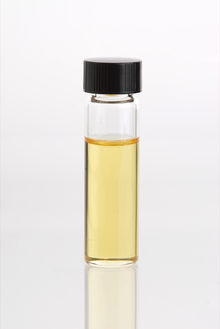
Neroli oil , or orange blossom oil , is an essential oil found in orange flowers ( Citrus aurantium var. Amara and Citrus aurantium var. Aurantium ), cultivated in France , Italy , Algeria , Tunisia , Morocco and other countries.
Content
Properties
Nerolium oil is a yellowish or amber-yellow mobile liquid with blue fluorescence, which has a spicy aromatic smell reminiscent of the smell of orange and a bitter taste. Soluble in ethanol (1: 2 - in 80%); insoluble in water. In the light it turns orange-red.
| Acidic number | Ethereal number | |||
|---|---|---|---|---|
| 0.866 ÷ 0.872 | 1,463 ÷ 1,475 | +6 ÷ +11 | no higher than 2 | 25 ÷ 65 |
Chemical Composition
The oil contains (+) - limonene , dipentene , α- and β-pinenes , (-) - linalool , nerol , geraniol , nerolidol , farnesol , α-terpineol , 2-phenylethanol , nonanal , decanal , benzaldehyde , jasmone , ( -) - linalyl acetate , non -ethyl acetate , camphene , methylanthranilate , indole , acetic , phenylacetic and benzoic acids and other components.
Pharmacological properties
The oil does not have a phototoxic effect , but due to the high price it is rarely used, and only in products of higher grades. Aromatherapists consider neroli oil to be one of the most effective sedatives and antidepressants . Suitable for all skin types, used primarily for sensitive skin. Stimulates the activity of cells and their growth.
Getting
Obtained from orange flowers by distillation with steam and extraction of the aqueous layer of the distillate with petroleum ether, the oil yield of 0.1-0.15%.
The main manufacturers are Algeria, Italy and France.
Application
Applied as a component of perfume compositions and fragrances for cosmetic products.
See also
- Orange oil
- Petigrene Orange Oil
Links
- Orange blossom // Brockhaus and Efron Encyclopedic Dictionary : in 86 volumes (82 volumes and 4 additional). - SPb. , 1890-1907.