The Indian ringed parrot [1] , or the Kramer necklace parrot [2] ( lat. Psittacula krameri ) is a bird from the subfamily of real parrots. It lives in South Asia and several regions of Africa . Throughout the range, it is a large bird that lives mainly near humans, including in large cities. This is the most numerous and widespread species among true parrots [3] .
| Indian ringed parrot | |||||||||||||||||||||||||||||||||||||
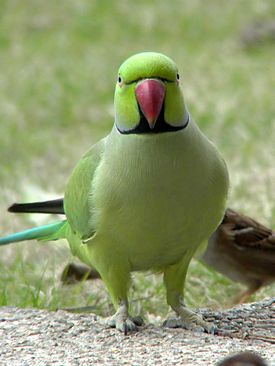 Hong Kong parrot | |||||||||||||||||||||||||||||||||||||
| Scientific classification | |||||||||||||||||||||||||||||||||||||
|---|---|---|---|---|---|---|---|---|---|---|---|---|---|---|---|---|---|---|---|---|---|---|---|---|---|---|---|---|---|---|---|---|---|---|---|---|---|
| |||||||||||||||||||||||||||||||||||||
| International scientific name | |||||||||||||||||||||||||||||||||||||
Psittacula krameri ( Scopoli , 1769 ) | |||||||||||||||||||||||||||||||||||||
| Area | |||||||||||||||||||||||||||||||||||||
 land habitats | |||||||||||||||||||||||||||||||||||||
| Security status | |||||||||||||||||||||||||||||||||||||

The main color of the plumage of the Cramer necklace parrot is green, with minor inclusions of other colors. Around the neck in males passes a narrow pink-red ring, hence the name “necklace” (in females there is no ring [4] ). Like other real parrots, it flies beautifully, its flight is high and fast [2] . This bird tends to stay in groups and flocks, reaching hundreds and even thousands of heads.
The Cramer Parrot is a predominant inhabitant of open biotopes , however, it spends almost all the time on trees and rarely descends to the ground. It nests in hollows; in cities it often takes holes for nesting in the walls of buildings. Like all real parrots, the Cramer necklace is a herbivorous bird that feeds on fruits, grains and nuts; often causes significant damage to crops. The lifestyle of the parakeet in Africa is not well understood; in Asia, where this parrot is one of the most common birds of the cultural biotope, it has been studied quite fully. The name of the bird reflects the merits in the biology of the German naturalist Wilhelm Kramer [5] .
The Indian ringed parrot is one of the most frequently held captive parrots. He has the ability to memorize and imitate human speech and other sounds, although this ability is not as developed as in some other parrots. In some countries of Europe with a mild climate, the USA and a number of other countries, stable populations of second-run wild necklace parrots have formed, which have recently become a problem for local ecosystems.
The ringed parakeet occupies a prominent place in Indian culture, such as painting.
Appearance
Cramer's necklace parrot was described as a species in 1769 by Italian-Austrian naturalist Giovanni Scopoli [6] , who chose the species name of the bird in order to perpetuate the memory of zoologist Wilhelm Cramer.
The Cramer Parrot is a relatively small bird. Its total length along with the tail is 40–42 cm, the wing is about 16 cm long. It is a well-formed parrot with a rather elongated body [2] . The long tail is about half of the total length of the bird, reaching 20 cm. The weight of an adult bird is 115-140 grams [7] . The legs of the four-fingered parrot, the first and fourth toes are forward, the second and third to the back [8] .
The color of the ringed parrot is generally green, about the same tone as the foliage of the trees. The head to the back of the head becomes bluish, there are black feathers on the throat, from the beak to the eye there is a thin but clearly visible black stripe. Another black strip surrounds the neck in the form of a semicircle, creating the appearance of a “collar” separating the head from the body. This black stripe in males is bordered by a narrow pink stripe. The beak is bright red, but the very tip of the beak and the mandible are dark, often almost black. The male’s throat is black and the female’s throat is usually dark green. Paws are gray, with a pinkish tinge [2] [7] . The two longest feathers of the tail are blue in color [9] . The lower part of the feathers is dark gray, which is clearly visible in the flying bird, but in the sitting parrot these dark parts of the feathers are not visible. The lower side of the extreme tail feathers is olive-yellowish [10] . Depending on the lighting, the main plumage may cast blue to a greater or lesser extent; Especially noticeable are blue tones in low light in cloudy weather [9] . Among the captive parrots, a number of color variations have been bred for many decades (see below) .
Sexual dimorphism in the Cramer necklace parrot is weakly expressed, but it is still noticeable even to a layman. First of all, females are deprived of a black and pink neck "necklace", which they express only a slightly darker color of green feathers. The overall color of the females is somewhat dimmer. The tail of females is slightly shorter than that of males, in addition, feathers on the back of females are more cast blue [11] .
The voice of the ringed parrot is a loud, high and piercing screech, which is one of the most frequently heard and recognizable bird cries in South Asia. This parrot is very loud. Excessively loud and sharp screams are one of the disadvantages of this bird when it is kept in the cage [4] .
Natural Range
The range of the Indian ringed parrot is extremely large. Specialists emphasize that the Cramer parrot has the widest range of all the parrots of the Old World [12] . In addition, this is the only parrot that lives in two parts of the world, in Asia and Africa [4] .
In Africa, the natural range of this bird is a strip running from east to west, north of the zone of moist forests, but south of the Sahara . The African part of the range of the parrot covers Mali , southern Niger , the northern regions of Ghana and Burkina Faso , Togo , Benin , southern Nigeria , Cameroon and Chad , northern CAR , southern Sudan , northern Uganda , Ethiopia , Djibouti and north-western Somalia . The Asian part of the range is almost all of South Asia (India, Pakistan , Bangladesh , Nepal , Ceylon ) and part of Southeast Asia (south of Myanmar ) [12] [6] .
The main natural habitat of the Kramer parrot is the forest. This bird is found in the wild in a variety of forests, including wet ones [12] . It was also indicated that this parrot is a bird characteristic of open landscapes with spiny shrubs [2] , it lives in savannas [10] . However, in any biotope, the presence of large trees is one of the determining conditions for the habitat of parakeets [13] . Parrots are recorded at an altitude of up to 1600 m above sea level in Asia and up to 2000 m in Africa [12] .
Lifestyle
General Features
The Indian ringed parrot is a bird that lives in large groups or colonies. In nature, he does not occur at all alone [11] . Usually parrots are held in groups of several individuals, sometimes several dozen. However, clusters of the order of thousands of heads are also known that occur where there are particularly favorable conditions [14] . Cramer parrots do not have an individual habitat. These birds prefer not to make long-distance flights, living in the same area where they feed. Flocks of parrots often stay together with other birds - corvids , lanes and parrots of other species [15] .
The Cramer Necklace Parrot is noisy and agile. Most of the time, parrots spend on trees, but quite often descend to the ground. Around noon, the birds are busy searching for food, after which they fly to a watering place, and then sit on trees and rest for several hours. After several hours of rest, the parrots again fly to feed, and later in the evening they fly back to their favorite trees for an overnight stay. Being on a tree, parrots can use their beak to climb the trunk, clinging to their bark. This parrot flies very quickly, with frequent flapping wings [8] . On the ground, he walks slowly and awkwardly, shifting from one foot to another [3] .
Nutrition
Like all other true parrots, Cramer's necklace parrot is a purely herbivorous bird; however, there is information that parrots contained in cages can be given meat products, such as boiled chicken [16] . He eats a wide variety of fruits, nuts , grains. He also eats berries , flowers , buds and green parts of plants, drinks floral nectar . The bird feeds mainly on trees, but for this purpose it can go down to the ground. Despite the fact that the necklace is distinguished by noisy and noisy behavior, it usually does not make loud sounds during feeding [17] .
A study of Kramer's parrots in the area of the city of Polonnaruwa in Ceylon showed that the composition of the feed consumed, firstly, is extremely diverse, and secondly, it significantly depends on the seasonal availability of certain fruits or flowers, both cultivated and wild. For example, in April, during the flowering of many plant species, in the composition of the feed, flowers occupy almost the prevailing place (first of all, the flowers of the Drypetes sepiara tree from the putrangive family). In August, the fruits of cassia , the orchid and the mimosa are bashful . In October – December, ficus Ficus retusa , the Adina cordifolis plant from the madder family, and the Grewia polygama plant from the mallow family play an important role in nutrition [17] .
In almost the entire range in Asia, the Cramer necklace parrot causes significant damage to agriculture. Parrots eat a lot of fruits of agricultural plants, moreover, this bird spoils much more grain than it can eat. In India, necklace parrots have been observed more than once, tearing grain bags with their beaks to get to their contents [14] . Studies by Pakistani scientists call the parakeet one of the main pests of sunflower planting, which in Pakistan's Punjab is one of the favorite types of food for these birds. Data from the mid-1980s indicate that in India in some places parrots sometimes completely destroyed the crop of mustard , mango and guayaia [13] .
In Ceylon, parrots willingly eat rice , making raids on the fields, however, according to the aforementioned study, in the presence of a sufficient number of other cereals and fruit crops ( sorghum , mango, guayaia, etc.), the proportion of rice in the diet of birds decreases sharply. In the Polonnaruwa area, parrots also eat corn , sunflower seeds, peanuts and the fruits of many other cultivated plants. The tendency of parrots to feed in the forest with a lack of cultivated plants in the period between the ripening of the crop is also well expressed [17] . A study of the intestinal contents of parrots from the Ludhiana region (Indian state of Punjab ) gave the following result: cereals 45%, fruits of various trees 38%, oilseeds 16% [13] .
Reproduction
The maturation of the Cramer parrot usually occurs at the age of two, but usually the birds begin to breed at the age of three to four years. Attempts to make masonry made before this age are often unsuccessful. This bird is monogamous; pairs of this parrot are formed for a long time, but not for life (like many other parrots) [18] .
During mating games, birds make quiet, twittering sounds. The female during the courtship ritual turns her head and opens her wings, while her pupils are dilated. The male is next to her and, standing on one leg, offers her food [10] . In India, the largest number of hatching birds is confined to April, although in general Indian parrots breed from December to May. In Africa, the breeding season is from August to November [14] . At the same time, over the African part of the range, these dates can vary markedly. So, in Eritrea this is August, and in Darfur - October-November [2] .
Parrots choose a hollow nest for the device, and if the size of the hollow is insufficient, the bird can slightly expand it with the beak. Sometimes the nest is found in holes in the rock. In the Asian part of the range, where parrots often live in an anthropogenic biotope, they use various openings in the walls of buildings for nesting [3] . In the USA, nests were noted in the recesses in wooden poles - the supports of power lines [14] . Often, Cramer's necklace parrots occupy hollows left by other birds in South Asia, such as woodpeckers and beards . Parrots can sometimes make a hollow on their own, with the help of a beak. In Africa, the nest is almost always located in natural depressions and usually at a considerable height. The nest of the parrot is lined with small pieces of wood and dust [7] [10] .
Data on the number of eggs laid in different sources vary. Soviet data from the early 1970s reported that the clutch of a parrot consists of 4 eggs [2] , some American say about 2–5 eggs laid [9] . It was also reported that with a spread in the number of eggs from 2 to 6, clutch of 3-4 eggs is most often found [14] . Egg laying occurs within one to two days [19] . The eggs of the Cramer necklace parrot are pure white, shiny, 30.5 × 24 mm in size [15] .
Hatching lasts 22-24 days, only the female incubates. Like all parrots, a brood of a necklace is a chick type, that is, chicks hatch completely helpless and naked. The skin of young parrots is pink, their beak is also pink. Chicks remain in the nest for 6-7 weeks [14] . In the natural range, parrots often make two clutches during the breeding season, but in countries with colder climates they usually do one [18] . Like all parrots in general, the necklace feeds the chicks with semi-digested slurry from the swallowed food, burping it from the goiter. Both parents feed the chicks, but the female is larger and more frequent than the male [10] .
The fledged young growth has the same coloration as the female, but is somewhat dimmer. The beak of young parrots is not red, but pale pink, the ring around the eyes is also pale. In young people, in addition, two of the longest median feathers of the tail are missing [11] . The full color of the adult, with a necklace around the neck, the male acquires at the age of 18 [11] , or from 18 to 32 months [20] .
Population Status
The Cramer Necklace Parrot in most places of its range is a numerous species. This parrot belongs to birds, the number of which is beneficial for human activities. This bird, although it is found in the wild, always gravitates to anthropogenic biotopes, where it finds a good forage base. In South Asia, the Indian ringed parrot has been found in large numbers in settlements, even in the central parts of large cities with parks and gardens. In cities, parrots are almost completely not afraid of people. Experts emphasize that the Cramer necklace parrot is characterized by the highest degree of adaptability to a variety of biotopes and living conditions [14] .
The conservation status of the general population of this parrot, both in Asia and in Africa, according to the International Union for Conservation of Nature, is the least threatened , and this status has been maintained for many years: the same assessments were made in 2004 , 2008 and 2009 On the whole, the total number of this parrot tends to increase. Estimates of the total number of parrots in the world have not been carried out [6] .
The development of agriculture and the expansion of agricultural land leads to an increase in the number of Indian ringed parrots. The expansion of the range became noticeable in the 19th century , when the intensive development of the plantation economy in the Asian states began. For example, in Pakistan Punjab, the number of parrots has increased significantly due to extensive irrigation during the colonial period. Irrigation measures were accompanied by planting of tall trees, such as the cotton tree , which provided the parrots with ample opportunities for nesting and feeding [13] .
Mostly necklace parrots are found in huge numbers. The number of these birds recorded by Pakistani scientists in a special study indicates their abundance in places with a favorable food supply. In a small experimental plot, sown with sunflower, half a acre (0.2 ha ) in size, 139, 142 and 137 birds, respectively, arrived for feeding for three days [13] .
In nature, the enemies of the Cramer parrot are various birds of prey, for clutches and chicks they are a danger to snakes . If we talk about European populations, then among the predators that can be dangerous for parrots, various daytime birds of prey are also mentioned, as well as those birds that can destroy the parrot's nests and destroy its eggs and chicks (for example, jay ) [21] . In general, there were no threats to the population of these birds, although in a number of places, the capture of these birds for sale is noticeably affected by the number of Kramer parrots [7] [15] .
Subspecies
Four subspecies of the Indian ringed parrot are usually described, of which two are found in Africa and two in Asia [20] [10] :
- Psittacula krameri krameri (Scopoli 1769) . A typical subspecies occupying the western and central parts of the African range (Guinea, Senegal, southern Mauritania, western Uganda, southern Sudan).
- P. k. parvirostris (Souancé 1856) , living in the rest of the African range.
- P. k. borealis (Neumann 1915) , whose range is northern India from 20 ° C. Sh., Pakistan, Bangladesh, Nepal and Myanmar.
- P. k. manillensis (Bechstein 1800) lives on the rest of the Asian range (southern India, Ceylon and the islands off the Indian coast).
The differences between the subspecies are rather weak and can be noticeable only when looking at the bird directly in the vicinity. They consist in color details, different lengths of the tail feathers, as well as a slight difference in the size of the birds. The body length with a tail in Asian subspecies is approximately 2-3 cm longer than in African ones [7] [10] .
Populations of parrots outside their natural range
Cramer's necklace parrot, as a common pet, often flies away from the owners and runs wild. In the presence of favorable conditions (first of all, a rather warm climate), he quickly adapts to free life in countries that are not related to his natural habitat. In a number of countries in Europe and the United States, fairly large populations of free-living parrots have formed. As a rule, ringed parrots in Europe are found compactly, mainly kept in settlements (primarily large cities) or near them, where birds find a good forage base. A positive role for the parrot population is also played by the absence of predators in settlements. Interestingly, in Europe Cramer parrots in recent years are already named among the potential pests of crops. They also pose a danger to local ecosystems, upsetting the existing interspecific balance and exerting serious pressure on some local bird species, such as woodpeckers [9] [5] . Some sources do not exclude the need to begin regulating the number of these parrots in Europe [5] .
In Europe, the largest populations of parrots live in London and Brussels [20] . In London, they are held mainly in the southern regions. The history of the Kramer necklace parrots in the UK dates back over a century and a half - the first reports of them date back to 1855 [22] . The number of Indian ringed parrots in London is growing extremely fast, if in 1995 there were about one and a half thousand, then in 2011 - about 32 thousand. In recent years, parrots have begun to pose a serious problem for the city, causing damage to the planting of cultivated fruit trees. Moreover, Cramer parrots began to quickly displace the original British bird species from their ecological niches [23] . The danger is also that parrots can be carriers of bird diseases [22] .
A large number of parrots live in the Netherlands ( Amsterdam , Utrecht , The Hague ) and Germany (in large agglomerations in the Rhine Valley). Many necklace parrots are observed in Spain , as well as Italy , mainly in Rome , where they nest in the historical center of the city. In Japan, in many large cities, such as Tokyo , Kyoto , Osaka , hundreds of these birds live [7] .
In the United States, the largest population of ringed parakeets lives in California in the Bakersfield area. The beginning of its formation dates back to 1977 . The rapid growth of this colony is characteristic: in 1998 there were 187 birds, and at the end of 2011 - at least 1800 (according to some estimates, even about 3 thousand). Other large colonies of these birds were recorded in Meteri ( Louisiana ), San Antonio ( Texas ), Honolulu ( Hawaii ) and Malibu ( Florida ) [20] . The population of parrots in Florida, in the Miami area, which is apparently one of the oldest in the United States, is well studied - the beginning of its development dates back to 1960 [14] .
In addition to these countries, small populations are recorded in Venezuela and the Virgin Islands , as reported by American sources [20] . A certain number of parrot necklaces (also according to American data) also lives in Tehran , holding mostly in the northern part of the city [7] . The International Union for Conservation of Nature provides more comprehensive data that claims that Cramer's necked parrots outside their natural range have been reported from almost all over the world. Their populations are registered in several countries in the Middle East ( Saudi Arabia , Iraq , Syria , Jordan , the United Arab Emirates , Israel , Lebanon , Qatar , Yemen ), on the islands of the Indian Ocean ( Maldives , Mauritius ), as well as in Turkey , Cuba , and Hong Kong and Macau . In Singapore, the first parrots of this species were recorded in 1951 , and since 1986 have been observed there regularly [24] . In Africa, the Cramer necklace parrot was also brought into countries outside its natural range - Kenya and South Africa [6] .
Since 1996, meetings with the Cramer necklace parrot have been recorded in Tashkent , where it supposedly nests, which is facilitated by the relatively mild climate of the capital of Uzbekistan and the abundance of fruit plantations in the city. Wild parrots probably come from individuals flying out of their enclosures; there is information that in 1999 a whole batch of birds was released, after which, apparently, a population capable of breeding was formed [25] .
In Azerbaijan, the Cramer necklace parrot population appeared in the early 2000s in the Governor’s Garden in the center of the capital city of Baku , where they feed on the fruits of olive trees in winter [26] .
Captive Indian Parrot
The Indian ringed parrot is known to people from antiquity and is one of the most common feathered pets. Some sources report that it was contained in cells in ancient Greece and Rome [9] . In India, the tradition of its home maintenance is about 3 thousand years [27] .
Kramer's parrot as a pet is lively and cheerful, it gets along well with people. This is a good "talker", able to memorize and imitate a significant number of words and sounds, and although it is indicated that in this respect it is inferior to many other parrots [3] , according to some reports it can remember up to 250 words [7] . It is believed that males are able to remember more words than females. In captivity, this bird can live up to 25 years (it is also alleged that they can live up to 40 and even 50 years [8] [28] ). For a full-fledged upkeep, a sufficiently spacious cage is needed, preferably even an aviary, which provides the possibility of intensive movement. It is also recommended that the parrot has access to various items for the game [19] . Subject to certain conditions, the contents of the Cramer necklace parrot is simple and can be recommended even to beginner amateurs [18] .
Necklace parrots breed in captivity more often than others. However, until now, all breeding cases described in the literature have been observed only when these birds were kept in enclosures [4] .
Over the years, a huge number of varieties of the necklace parrot with a very different color have been bred. Initially, there were about 20 main breeds, but 200-300 color variations were derived from them by selection. Among the home-made parakeets there are birds of a completely yellow, white, blue color or motley, combining several colors [29] [10] . Some species do not have rings around their neck [9] .
Indian Ring-shaped Parrot
In medieval India, necklace parrots were often the pets of noble persons and monarchs, and ownership of this parrot was considered an element of luxury and prestige [7] . They can often be seen on Indian miniatures of the XVI - XVIII centuries (the so-called Mughal miniatures ).
Gallery
Fortune-teller parrot in Singapore's Indian Quarter
Parrot on the railing of a building in Agra (India)
A male parrot on a wall near the Qutub Minar minaret ( Delhi )
Female Parrot (Faridabad, Indian State of Haryana)
Группа попугаев на дереве (район Фаридабада, штат Харьяна)
See also
- Александров кольчатый попугай
- Синантропные организмы
Notes
- ↑ Бёме Р. Л. , Флинт В. Е. Пятиязычный словарь названий животных. Birds. Латинский, русский, английский, немецкий, французский / Под общ. ed. Acad. V. E. Sokolova . - M .: Rus. яз., «РУССО», 1994. — С. 127. — 2030 экз. — ISBN 5-200-00643-0 .
- ↑ 1 2 3 4 5 6 7 Жизнь животных, под ред. С.П.Наумова и А.П.Кузякина. . — М. : «Просвещение», 1971. — Т. 4 (птицы). — С. 367. — 612 с. — 300 000 экз.
- ↑ 1 2 3 4 Martin Woodcock. Birds of the Indian Subcontinent. — Harper Collins Publishers, First Published 1980. — С. 64. — 176 с. — ISBN 0-00-219712-X .
- ↑ 1 2 3 4 Ожереловый, или малый кольчатый, попугай (Psittacula krameri) . Зооклуб — мегаэнциклопедия о животных. Дата обращения 20 июня 2013. Архивировано 29 июня 2013 года.
- ↑ 1 2 3 Ring-necked Parakeet. Introduction. (eng.) . Planet Wildlife (2010). Дата обращения 22 июня 2013. Архивировано 29 июня 2013 года.
- ↑ 1 2 3 4 Psittacula krameri (англ.) . The IUCN Red List of Threatened Species. Дата обращения 20 июня 2013. Архивировано 29 июня 2013 года.
- ↑ 1 2 3 4 5 6 7 8 9 Rose-ringed Parakeets (англ.) . Avian Web. Дата обращения 22 июня 2013. Архивировано 29 июня 2013 года.
- ↑ 1 2 3 Rose-ringed parakeet (англ.) . Indian Mirror (2011). Дата обращения 23 июня 2013. Архивировано 29 июня 2013 года.
- ↑ 1 2 3 4 5 6 Rose-ringed Parakeet Psittacula krameri (англ.) . National Audubon Society (2013). Дата обращения 22 июня 2013. Архивировано 29 июня 2013 года.
- ↑ 1 2 3 4 5 6 7 8 Psittacula krameri [Scopoli 1769 ] (англ.) . Psittacula World — Guide to Asian Parakeets. Дата обращения 21 июня 2013. Архивировано 29 июня 2013 года.
- ↑ 1 2 3 4 Rose-ringed Parakeet (англ.) . Birding Information. Дата обращения 22 июня 2013. Архивировано 29 июня 2013 года.
- ↑ 1 2 3 4 Psittacula krameri Rose-ringed parakeet (англ.) . Encyclopedia of Life. Дата обращения 23 июня 2013. Архивировано 29 июня 2013 года.
- ↑ 1 2 3 4 5 Muhammad Tariq Iqbal, Hammad Ahmad Khan, Mahmood-ul-Hasan Ahmad. Feeding regiments of rose-ringed parakeet Psittacula krameri on a sunflower field in agro-ecosystem in Central Punjab, Pakistan (англ.) (pdf). fogsl.net. — Pakistan Veterinary Journal, 20 (4), 2000. Дата обращения 22 июня 2013. Архивировано 29 июня 2013 года.
- ↑ 1 2 3 4 5 6 7 8 Bruce Neville. Rose-ringed Parakeet Psittacula krameri (англ.) (pdf). Florida Fish and Wildlife Conservation Commission (6 января 2003). — Florida's breeding bird atlas: A collaborative study of Florida's birdlife. Дата обращения 22 июня 2013. Архивировано 29 июня 2013 года.
- ↑ 1 2 3 Ringneck Parakeet (Psittacula krameri) (англ.) . World Parrot Trust. Дата обращения 23 июня 2013. Архивировано 29 июня 2013 года.
- ↑ Indian Ringneck Parakeets (англ.) . Animal World. Pets and animal information. Дата обращения 22 июня 2013. Архивировано 29 июня 2013 года.
- ↑ 1 2 3 Sarath W. Kotagama, GM Dunnel. Feeding ecology of rose-ringed parakeet Psittacula krameri in Polonnaruwa (англ.) (pdf). fogsl.net. Дата обращения 22 июня 2013. Архивировано 29 июня 2013 года.
- ↑ 1 2 3 Jim Hayward. Ringneck Parakeet, Indian (Psittacula krameri manillensis) (англ.) . Parrots Magazine. Дата обращения 23 июня 2013. Архивировано 29 июня 2013 года.
- ↑ 1 2 Psittacula krameri (англ.) . Birdtricks.com. Дата обращения 23 июня 2013.
- ↑ 1 2 3 4 5 Wild Rose-ringed Parakeets (англ.) . Nature Alley. — Original research by Alison Sheehey, Nature Alley and Barbara Mansfield, Kern Audubon Society. Дата обращения 21 июня 2013. Архивировано 29 июня 2013 года.
- ↑ Assaf Shwartz, Susan Shirley. Psittacula krameri (англ.) . Delivering alien invasive species inventories Europe (21 февраля 2007). Дата обращения 22 июня 2013. Архивировано 29 июня 2013 года.
- ↑ 1 2 Ring-Necked Parakeet, Psittacula krameri (англ.) . GB Non-native Species Secretariat (2011). Дата обращения 23 июня 2013.
- ↑ John Platt. Swarms of parakeets invade London (англ.) . Mother Nature Network (16 сентября 2011). Дата обращения 22 июня 2013. Архивировано 29 июня 2013 года.
- ↑ Psittacula krameri (Scopoli, 1769) (англ.) . The DNA of Singapore. Дата обращения 22 июня 2013. Архивировано 29 июня 2013 года.
- ↑ Ожереловый попугай Крамера . Birds.uz . Дата обращения 19 августа 2017.
- ↑ Ожереловые попугаи - легенда Губернаторского садика . minval.az . Дата обращения 25 февраля 2019.
- ↑ Ring-necked Parakeet. Culture & References. (eng.) . Planet Wildlife (2010). Дата обращения 22 июня 2013. Архивировано 29 июня 2013 года.
- ↑ Rose-ringed parakeet (англ.) . Indian Mirror (2011). Дата обращения 23 июня 2013. Архивировано 29 июня 2013 года.
- ↑ Rose Ringed Parakeet info (англ.) . Parrot-bird.com. Дата обращения 20 июня 2013. Архивировано 29 июня 2013 года.
Literature
- Salim Ali. The Book of Indian Birds . — 12th Rev edition. — Oxford University Press, USA, 1997. — 412 p. — ISBN 0195637313 .
- Richard Grimmett, Carol Inskipp, Tim Inskipp. Birds of India, Pakistan, Nepal, Bangladesh, Bhutan, Sri Lanka and the Maldives . — Princeton University Press, 1999. — 384 p. — ISBN 0691049106 .
- В. Баррет, М. Харли. Попугаи. Большая иллюстрированная энциклопедия. . — М. : Мир книги, 2007. — 256 p. — ISBN 978-5-486-01329-4 .
- Гринёв В. А. Попугаи: Справочное пособие. — М. : Лесная промышленность, 1991. — 334 p. — ISBN 5-7120-0296-5 .
- Jerusalem I. Parrots and songbirds: species, content, training . - Rostov-on-Don: Vladis, 2001 .-- 320 p. - ISBN 5-94194-073-4 .