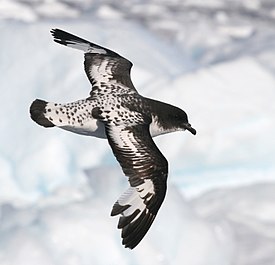
Like other petrel-shaped, the representatives of this family have two tube-shaped openings on the upper part of the beak through which they secrete sea salt and gastric juices. The beak is long and hook-shaped with a sharp end and very sharp edges. This helps to better hold slippery prey, such as fish .
The size of petrels varies greatly. The smallest species is the small petrel , whose length is 25 cm, the wingspan is 60 cm, and its mass is only 170 g. Most species are not much larger than it. The only exception is giant petrels resembling small albatrosses . They can reach values up to 1 m, wingspan up to 2 m and weight up to 5 kg.
The plumage of petrels is white, gray, brown, or black. All species look quite inconspicuous, and some are so similar to each other that it is very difficult to distinguish between them. Apparent sexual dimorphism in petrels is not observed, with the exception of a slightly smaller value in females.
All petrels can fly very well, but depending on the species they have different flight styles. Their paws are very poorly developed and are located far behind. They do not even allow you to stand and on land the petrel must additionally rely on its chest and wings.
With the exception of the mating season, petrels spend their entire lives at sea and are adapted to even the most severe weather conditions. Their food is small fish and invertebrate marine animals swimming near the surface of the water. Petrels nest, usually near the coast, often on steep cliffs or piles of stones. They lay one single egg with a white shell, which is unusually large in relation to the size of the bird itself. The incubation period lasts from 40 to 60 days. In small species, the hatched cub begins to fly after 50 days; in larger species, the first flight on average occurs after 120 days.
The petrel family is divided into 2 subfamilies with 14 genera [2] [3] :
The Fulmarinae subfamily is a bird with a gliding gliding flight; food is obtained in the most superficial layers; when eating, they land on the water, are not adapted or are not adapted to diving.
- Giant Petrels ( Macronectes )
- Stupid ( Fulmarus )
- Antarctic petrels ( Thalassoica )
- Cape Doves ( Daption )
- Snow petrels ( Pagodroma )
- Blue petrels ( Halobaena )
- Whale Birds ( Pachyptila )
- Aphrodroma
- Typhoons ( Pterodroma )
- Pseudobulweria
- Mascarene Typhoon ( Pseudobulweria aterrima )
- Typhoon boulevards ( Bulweria )
The Puffininae subfamily is a bird with a planning flight, alternating with frequent flapping of wings, often landing on the water and able to dive quite well (especially many species of the genus Puffinus ) both from summer and from a sitting position.
- Thick-billed Petrels ( Procellaria )
- Westland Petrel ( Procellaria westlandica )
- Speckled Thunderbirds ( Calonectris )
- Real Thunderbirds ( Puffinus )