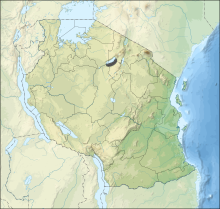
Hadza is an indigenous people in northern Tanzania . They live in the provinces of Arusha , Singida and Shinyanga near Lake Eyasi . They talk in an isolated eponymous language .
| Hadza | |
|---|---|
| Abundance and area | |
| Total: 800 ( 2000 ) | |
| Tanzania : Arusha , Singida , Shinyanga provinces | |
| Tongue | Hadza |
| Religion | traditional beliefs, Christianity |
| Related peoples | Not known for sure |
| Origin | pygmies (hypothesis), Khoisan peoples (hypothesis) |

Content
Study History
For European science, Hadza was discovered in 1931 by a German ethnologist and archaeologist Ludwig Kohl-Larsen. Most studies of this ethnic group were carried out until the mid -60s of the 20th century, that is, before significant changes in their lifestyle. They formed an idea of the traditional Hadza lifestyle. Subsequent studies by scientists from different countries at the end of the 20th and the beginning of the 21st centuries significantly deepened the knowledge of this people and made a significant contribution to the development of ideas about primitive communities .
Ethnonyms
In the literature, the names for the Hadza people are as follows:
- Hadzapi , Hadzabe , Hadza , Hatsa are variants of endoethnonym .
- Kindig , Vakindig , Vatindig , Tindig - is found in Swahili - speaking nations. They come from the verb tindika , meaning “to end, to be cut off, to feel a lack of anything, to be lost, to end,” reflecting the isolation of the Hadza ethnic group. L. Kohl-Larsen used the “watindig” version and translated as “fugitives”.
- kanguge - etymology is not specified.
D. A. Olderogge called Hadza "East African Bushmen." Sometimes this name is used in the present, although calling them simply “Bushmen” is not correct.
Origin
The origin of the Hadza is not entirely clear. Since they are anthropologically related to the Negro race with a small number of capoid traits, they used to be traditionally regarded as a remnant of the Khoisan peoples in East Africa . A recent genetic study has shown that they are, in fact, more related to the West African pygmies . According to Knight et al. (2003), Y-chromosomal haplogroups are represented in Hadza mainly by the subbranch B2b-M112 haplogroup B (52% [1] [2] ), that is, the same sublarge that is present in typical representatives of the pygmy people Mbuti and aka . A large proportion of the Y chromosomal haplogroup E3a (30%) shows a known Bantu admixture. The remaining Y-chromosomal haplogroups are represented in Hadza by other subclades of the haplogroup E (E1b1a, E1b1b [3] ).
Mitochondrial DNA is represented in Hadza haplogroups L2 (mainly subclade L2a1 of pygmy origin) and L3 (mainly subclade L3g of East African origin), and none of them coincide with those of the Khoisan peoples of South Africa , which belong to the subclades L1d / L1k. Hadza L0a reaches 5% [3] .
The complete genetic picture suggests that the original Hadza population was carriers of the Y-chromosomal haplogroup B2b and the mitochondrial haplogroup L3a1, and subsequently adopted a stream of genes from the Bantu peoples [2] . The ancestors of the Hadza separated from the ancestors of the eastern pygmies and koisans from 98,000 to 96,000 years ago, from the ancestors of Sandawa (living only 150 km from them) - 87,800 years ago [3] .
Traditional lifestyle
Hadza - hunter-gatherers. Hunting is done exclusively by men alone or in small groups, in some cases uniting up to 15 people, as when hunting for a hippopotamus . Hunting weapons - bow . The tips are mostly stone , sometimes forged from barren iron . They used to hunt buffaloes and antelopes with a bow. Used poisoned arrows. The peak of hunting is in the dry season. Gathering involved not only women but also men, especially during periods when hunting is ineffective. Gather the fruits of wild plants, eggs of birds and turtles . Products gathering up to 80% of the Hadza diet.
The dwelling in which the Hadza spend most of the year is a grass hut with a branch frame. Huts are located close to each other in a natural protected place. During the rainy season, some people move to shelters under rocks. Basic parking do not have.
The traditional clothing for women is a leather apron, and for men an apron and belt of modesty. They usually go barefoot , they wear sandals when crossing the thorny paths .
Describing the Hadza society, some researchers emphasized its egalitarianism, that is, the insignificance of socio-economic inequality. A. V. Korotaev (1999) characterized him as even more egalitarian than most primate communities. This trait is not common to all primitive communities, but from the peoples of Africa unites Hadza with the Bushmen and the Pygmies.
The family is small. Marriages are usually ambilocal, with a tendency to uxorilocalism . The relationship system , like that of the Bushmen, is bilateral. Related terms may apply to persons with whom the speaker is not in actual kinship (as among Bushmen and Australian Aborigines ).
Hadza families form small groups that wander together. Usually the transition to a new place takes place every two weeks. The composition of such groups is not constant, at the request of their members, they can be combined or divided. Territories occupied by communities or "resident groups" do not have clear boundaries; in fact, every Hadza can live, hunt, and collect food wherever he wishes. In the dry season, the Hadza unite in groups of 100–200 people; in the rainy season, they again live in separate communities.
J. Woodburn in 1968 described that the Hadza inhabited lands are divided into four parts, each of which is inhabited by a group of people of up to 150 people; all such groups have their own names derived from the names of the localities they inhabit. Despite their variable composition, these associations were more stable than resident groups, their members were searching for food on “their” territory and gathered on their land during the dry season.
Hadza does not have a formalized institute of group or community leaders, although some people are influenced by their personal qualities. The decisions concerning the whole team are made by men.
Current State
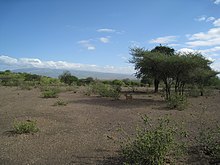
In the first half of the 20th century, the Hadza lived on the plains and foothills to the northeast of Lake Eyasi in the dry steppes and savannas . But the destruction of the tsetse fly in the Hadza territories opened the way for neighboring pastoralists and farmers. Nowadays, the Hadza population is gradually decreasing, under pressure from izsansu , Mbulu and Masai, they are being pushed into the swamps and wastelands south of Eyasi. According to the Hadza themselves, over the past few decades they have lost about three-quarters of their lands. Part of the Hadza abandoned the nomadic way of life and now help farmers in the processing of their fields. Hadza try to fight for their rights by appealing to the Tanzanian government to protect the territory of their original residence from the encroachments of neighboring peoples, emphasizing the ecological compatibility of their existence and the centuries-old traditions of their way of doing business. [four]
Notes
- ↑ Tishkoff Sarah A., Katherine Gonder Mary, Henn Brenna M. et al. (2007). "Chromosome History of Click-Speaking Populations of Africa Inferred from mtDNA and Y Chromosome Genetic Variation". Molecular Biology and Evolution. 24 (10): 2180–2195.
- ↑ 1 2 Knight Alec, Underhill Peter A., Mortensen Holly M. et al. (March 2003). "African Y Chromosome and mtDNA Divergence Provides Insight into the History of Click Languages." Current Biology. 13: 464–473.
- ↑ 1 2 3 Daniel Shriner et al. Genome Biology and Genetics , Genome Biology and Evolution, Volume 10, Issue 3, 1 March 2018, Pages 875–882, 14 March 2018
- ↑ Gromova N.V., 2004
Literature
- D.V. Bogatenkov, S.V. Drobyshevsky. Racial diversity of humanity // Course "Anthropology" on the site IDO RUDN . Archived February 19, 2012. Archived February 19, 2012.
- M.L. Butovskaya , A. Mabulla. Hadza in the context of intercultural interaction: features of the social behavior of children and adolescents enrolled in the school of the village Endomaga // Interracial and interethnic relations in modern Tanzania: Proceedings of the Russian integrated expedition in the United Republic of Tanzania (2005 season). Moscow: Institute of African Studies, Russian Academy of Sciences, 2007.
- M.L. Butovskaya . We and them: the evolution of sociality in the order of primates and the problem of the origin of human society // OPUS: Interdisciplinary research in archeology. - M. , 2002. - № 1-2 . - p . 7-25 .
- M.L. Butovskaya. The evolution of man and his social structure // Nature. - 1998. - № 9 .
- N.V.Gromova About the new translation of the Hahzabah folklore texts in Swahili (not available link) (2004). Archived July 4, 2004.
- V. Kabo. Primitive pre-agricultural community . - M .: Science, 1986. Archival copy of April 29, 2007 on the Wayback Machine
- Hadza in Ethnologue. Languages of the World .
- For the Hadza people, muscularity does not matter when choosing a spouse
Links
- Photos of the Hadza Tribe
- Video : dances of herders and hunters of the Hadza tribe, firing of fire, distribution of booty.
- Visiting Hadza , lecture by Stanislav Drobyshevsky